


ESG reporting has never been more important.
Nor has it been more complex.
Investors demand greater transparency.
Regulators expect more meaningful disclosures.
Customers want evidence, not promises.
Boards need reliable information to oversee sustainability risks and opportunities.
Yet many organisations continue to ask the wrong question.
Which reporting framework should we adopt?
The better question is this.
How do we build an ESG reporting framework that meets the needs of investors, regulators, customers and other stakeholders while strengthening governance?
The answer lies in understanding how GRI, SASB and TCFD complement one another.
According to Novisto, organisations generate the greatest value when they use leading ESG reporting frameworks together, allowing each to address different stakeholder expectations while creating a more complete sustainability reporting framework.
Read More: ESG Reporting and Disclosure
Good ESG reporting begins with governance, not reporting
Many organisations begin by asking what data they should disclose.
Effective organisations begin by asking what information matters.
ESG reporting is not simply a reporting exercise.
It is a governance process.
Boards should first understand:
The sustainability risks facing the organisation.
The issues that matter most to stakeholders.
How ESG supports long-term strategy.
Which sustainability outcomes should be measured.
Only then should reporting frameworks be selected.
Without governance, reporting risks becoming a compliance exercise rather than a strategic tool for accountability and value creation.
GRI, SASB and TCFD are designed to work together
One of the most common misconceptions is that organisations must choose between reporting frameworks.
They do not.
Each framework addresses a different aspect of ESG performance.
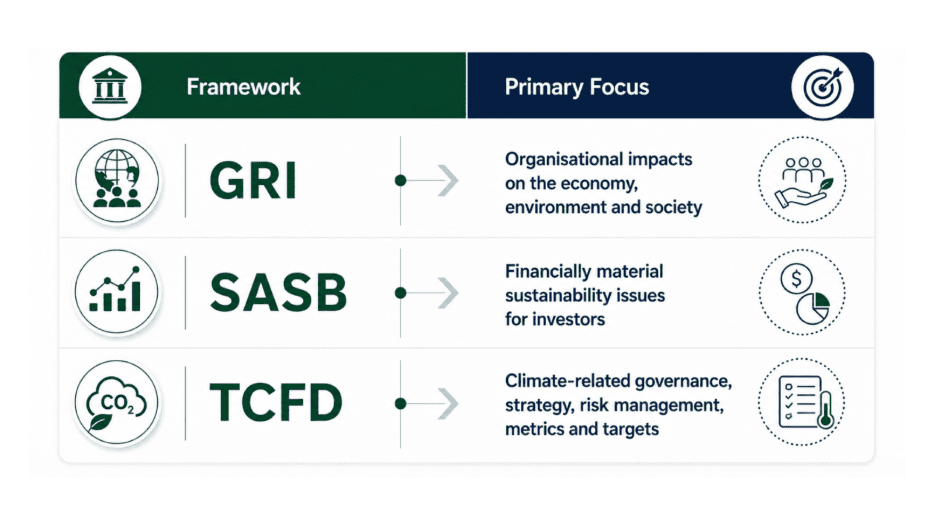
According to Novisto, combining these frameworks enables organisations to satisfy a broader range of stakeholder expectations while reducing duplication across sustainability reporting.
Rather than competing with one another, they strengthen one another.
Materiality should determine what you report
One of the biggest mistakes organisations make is reporting everything.
More disclosure does not necessarily improve transparency.
Good reporting focuses on what is genuinely material.
A robust ESG Materiality & Risk Assessment helps organisations identify the environmental, social and governance issues that have the greatest influence on long-term value creation.
This enables organisations to prioritise disclosures that matter most to:
Investors.
Customers.
Employees.
Communities.
Regulators.
Materiality transforms ESG reporting from information overload into meaningful communication.
Stakeholder engagement strengthens reporting credibility
ESG reporting should never be developed in isolation.
Effective reporting reflects the expectations of the people affected by organisational decisions.
This requires meaningful Stakeholder Engagement throughout the reporting process.
Organisations that actively engage stakeholders are better able to:
Identify emerging ESG issues.
Understand stakeholder priorities.
Strengthen trust.
Improve reporting quality.
Support better governance.
Strong reporting begins with listening before reporting.
Climate reporting has become a board responsibility
Climate-related reporting is no longer solely an environmental issue.
It is a governance issue.
The Task Force on Climate-related Financial Disclosures (TCFD) encourages organisations to disclose:
Board oversight of climate risks.
Management responsibilities.
Climate-related strategy.
Risk management processes.
Performance metrics and targets.
Research published by Labrador demonstrates how organisations can align climate disclosures across multiple ESG reporting frameworks, improving consistency while reducing unnecessary duplication.
Climate governance is increasingly becoming business governance.
ESG reporting should support better business decisions
Reporting should not simply describe performance.
It should improve it.
A mature ESG reporting framework informs:
Strategic planning.
Investment decisions.
Risk management.
Capital allocation.
Operational improvement.
Long-term resilience.
Embedding ESG into strategic decision making requires more than reporting.
It requires an effective ESG Strategy Development process supported by ESG Integration in Investment Decisions.
When governance and strategy work together, ESG becomes a driver of business performance rather than simply a reporting requirement.
Measuring impact matters as much as reporting it
Stakeholders increasingly expect organisations to demonstrate outcomes rather than activities.
Publishing an ESG report is only one part of the journey.
Organisations also need to understand whether their sustainability initiatives are creating meaningful environmental and social value.
This is where Social Impact Measurement and Management becomes essential.
Strong governance ensures organisations measure what matters, evaluate progress objectively and continuously improve ESG performance.
Reporting without measurement creates visibility.
Measurement creates accountability.
The future belongs to organisations that integrate governance and ESG reporting
The direction of travel is clear.
Stakeholders expect better ESG disclosures.
Regulatory expectations continue to evolve.
Reporting frameworks are becoming increasingly aligned.
The organisations that succeed will not be those producing the longest sustainability reports.
They will be those producing the most credible ones.
Because credibility begins with governance.
And governance begins with understanding what truly matters.
Lumorus: Better Business, Built on Purpose
At Lumorus, we believe ESG reporting should do more than satisfy disclosure requirements.
It should strengthen governance, improve decision making and build long-term stakeholder trust.
Lumorus is a UK headquartered global governance, ESG, company secretary and advisory firm supporting organisations across Europe, Africa, Asia, the Caribbean, Canada, the Middle East and international markets.
We help organisations design governance-led ESG frameworks that align reporting with internationally recognised standards while supporting sustainable business performance.
Our ESG expertise includes:
Whether you are developing your first ESG report or strengthening an existing reporting programme, Lumorus can help you build a reporting framework that delivers transparency, accountability and long-term value.
Visit Lumorus to learn how we can help strengthen your ESG reporting and governance capability.
Website: lumorus.com
Email: [email protected]
Together, we can build better business: one that performs with purpose, leads with integrity and creates lasting value.
Sources
- Novisto – Four Popular ESG Reporting Schemes That Complement Each Other
- Labrador – Aligning ESG Reporting Frameworks with TCFD