


Most boards believe they are governing effectively because meetings are taking place, reports are being reviewed, and compliance obligations are being addressed.
That assumption is increasingly dangerous.
The modern board is operating in an environment defined by regulatory scrutiny, stakeholder pressure, operational complexity, cyber risk, AI disruption, and rising expectations around accountability. Under these conditions, governance can no longer function as a passive oversight exercise.
Top-performing boards understand this clearly.
They do not separate compliance from performance. They understand that governance quality directly influences organisational resilience, strategic execution, investor confidence, and long-term value creation.
The strongest boards are not simply compliant boards. They are operationally effective boards.
And increasingly, the difference between average boards and high-performing boards comes down to governance discipline, board evaluation, accountability visibility and the quality of board dynamics underneath the surface.
Compliance Alone Does Not Create an Effective Board
Many boards still approach governance primarily through compliance activity.
Policies are approved. Regulatory obligations are addressed. Minutes are documented. Committees meet regularly.
These activities matter. But governance effectiveness is not measured by process completion alone.
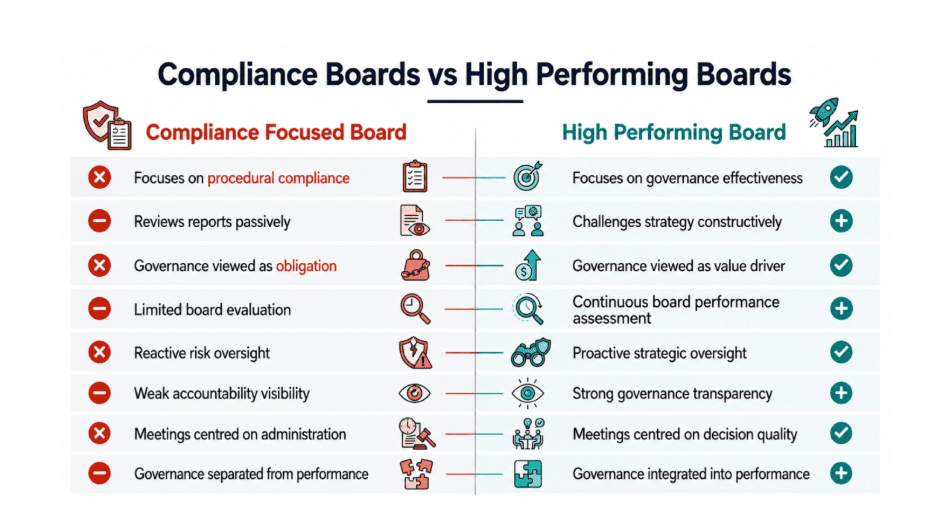
A board can satisfy procedural compliance requirements while still failing strategically.
The real governance question is not simply:
Are governance activities taking place?
It is:
Is the board strengthening decision-making, oversight, accountability and organisational performance?
According to the Institute of Directors Kenya, effective boards create value by improving strategic direction, oversight quality, accountability structures and organisational leadership effectiveness rather than simply monitoring compliance obligations.
Compliance Boards vs High performing Boards
What Top Boards Actually Prioritise
Top boards focus on five interconnected governance priorities simultaneously:
- Strategic oversight
- Accountability and transparency
- Risk governance
- Board effectiveness
- Organisational performance
They understand governance as a system of stewardship rather than paperwork.
This means governance structures are designed not simply to satisfy regulators, but to improve institutional decision-making.
The strongest boards ask difficult questions consistently:
- Does the board have the right skills and composition?
- Are directors receiving high-quality information?
- Are governance responsibilities clearly defined?
- Are risks escalating faster than governance visibility?
- Is management being challenged effectively?
- Does the board understand operational realities beneath reporting?
Weak boards often avoid these questions because they expose uncomfortable governance gaps. Strong boards institutionalise them.
Why Board Evaluation Is Becoming Essential
One of the clearest differences between average boards and top-performing boards is governance self-awareness.
High-performing boards evaluate themselves regularly.
Not symbolically. Seriously.
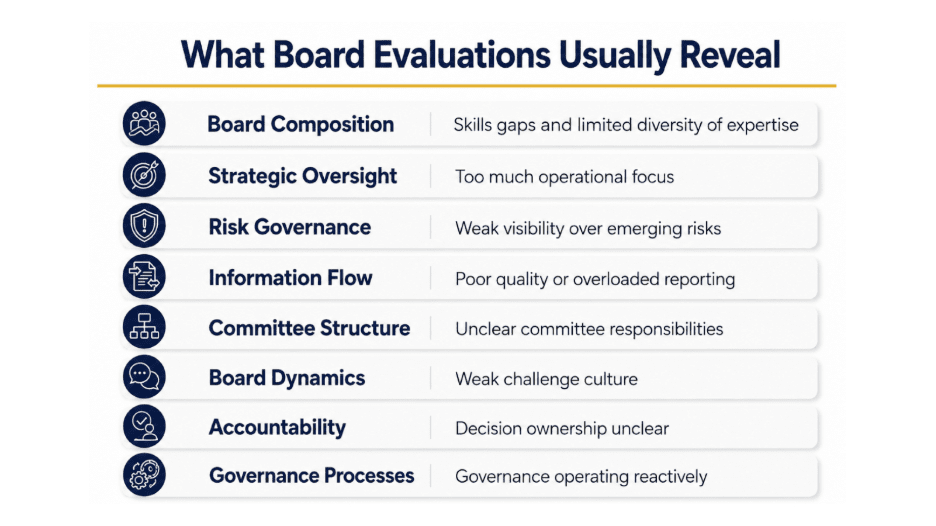
Board evaluations help organisations identify:
- Governance blind spots
- Weak oversight areas
- Board composition gaps
- Committee effectiveness problems
- Leadership and succession concerns
- Information flow weaknesses
- Cultural and behavioural issues
- Strategic oversight limitations
Without evaluation, boards often operate based on assumptions about effectiveness rather than evidence.
According to governance guidance from the Centre for Corporate Governance Kenya, effective boards require continuous assessment, director development and governance improvement mechanisms to remain effective in changing operating environments.
What Board Evaluations Usually Reveal
Strong Boards Build Governance Infrastructure, Not Governance Theatre
Some organisations invest heavily in governance appearance rather than governance capability.
Policies exist. Governance language sounds sophisticated. Committees are numerous. Documentation is extensive.
Yet governance underneath remains weak.
Top boards avoid governance theatre.
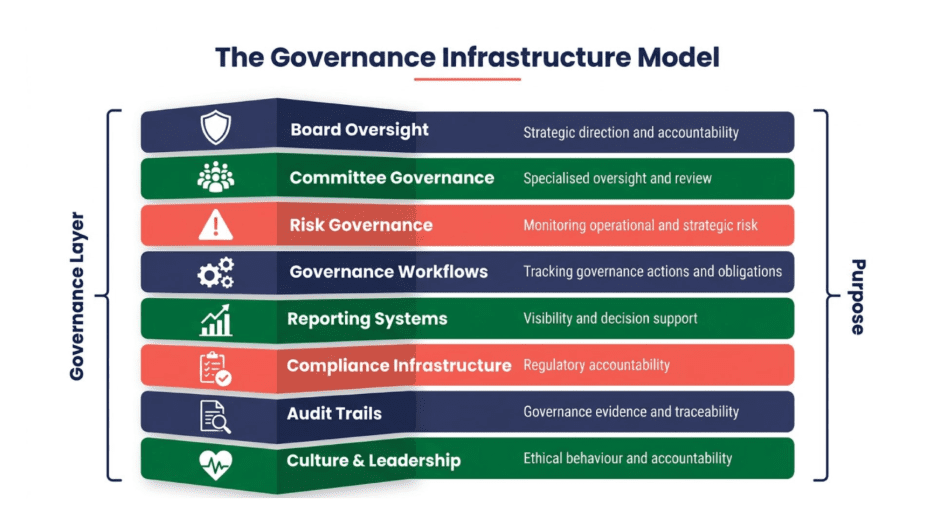
They focus on operational governance infrastructure.
This includes:
- Clear accountability systems
- Structured board reporting
- Defined decision rights
- Effective committee oversight
- Governance workflows
- Escalation mechanisms
- Risk visibility systems
- Independent challenge culture
Governance infrastructure matters because complexity compounds over time.
As organisations scale, governance systems designed for smaller businesses often become structurally inadequate.
This is particularly visible in:
- Fast-growth organisations
- Multi-entity structures
- Regulated businesses
- Invest backed organisations
- Cross border operations
Without governance infrastructure, boards gradually lose operational visibility beneath management reporting.
That creates strategic vulnerability.
The Governance Infrastructure Model
The Link Between Governance and Performance
One of the biggest misconceptions in corporate governance is the idea that governance and commercial performance are separate priorities.
The evidence increasingly suggests the opposite.
Weak governance eventually undermines performance.
This happens because governance failures create:
- Poor strategic decisions
- Slow accountability escalation
- Risk oversight gaps
- Leadership blind spots
- Regulatory exposure
- Investor confidence problems
- Operational inefficiencies
- Reputation damage
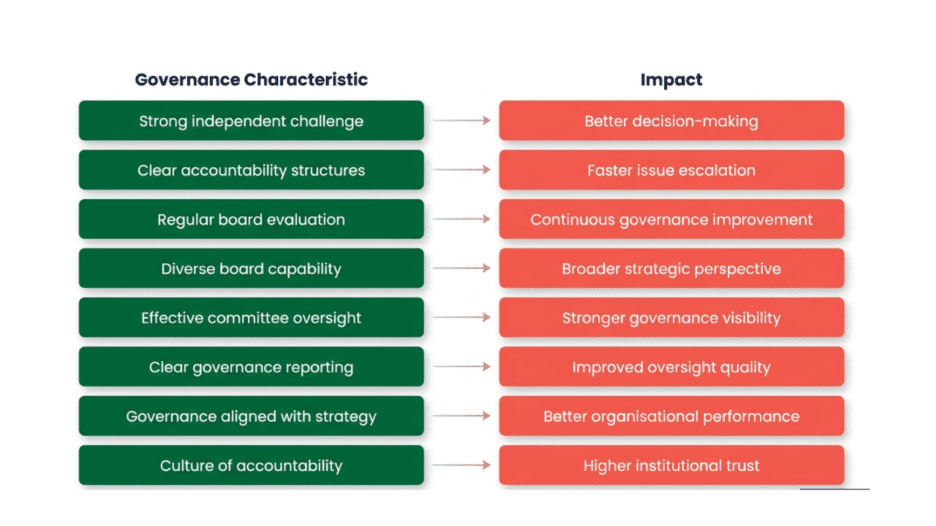
Strong governance improves organisational resilience because decision-making becomes more disciplined, visible and accountable.
This is why institutional investors increasingly evaluate governance quality as part of broader performance and risk assessment.
Governance is no longer viewed purely as a compliance discipline. It is increasingly recognised as a performance capability.
Case Study: The Board That Missed the Operational Reality
A mid-sized financial services organisation believed its governance framework was functioning effectively. Board meetings were regular, reporting was detailed and committees were active.
Yet operational problems continued escalating underneath the surface.
A governance review later revealed several weaknesses:
- Risk reporting focused heavily on historic metrics
- Directors lacked visibility over operational bottlenecks
- Board papers were excessively detailed but strategically weak
- Committee responsibilities overlapped significantly
- Management challenge culture was limited
The issue was not governance activity. The issue was governance effectiveness.
Following a structured board evaluation and governance redesign process, the organisation simplified reporting structures, clarified committee oversight responsibilities and improved governance visibility significantly.
The board became more strategically effective because governance became operationally clearer.
Characteristics of High-Performing Boards
Why Governance Maturity Is Becoming a Competitive Advantage
The governance expectations placed on boards are increasing globally.
Boards are now expected to oversee:
- ESG and sustainability risks
- AI governance and technology ethics
- Cybersecurity resilience
- Regulatory compliance
- Stakeholder accountability
- Culture and conduct risk
- Long-term organisational sustainability
This requires a much higher level of governance maturity than many boards currently possess.
Top boards recognise this early.
They invest in:
- Governance capability
- Board development
- Governance infrastructure
- Independent evaluation
- Governance technology
- Operational accountability systems
Because they understand something many organisations still underestimate:
Governance quality eventually becomes commercially visible.
Sometimes through performance.
Sometimes through resilience.
Sometimes through crisis.
But eventually, always through outcomes.
Governance Is No Longer a Support Function
The strongest boards no longer view governance as an administrative necessity.
They view it as institutional infrastructure.
Governance determines:
- How power is exercised
- How decisions are challenged
- How risk is escalated
- How accountability operates
- How trust is maintained
- How organisations perform under pressure
That is why top boards invest seriously in governance effectiveness.
Not because regulators require it.
Because organisational performance increasingly depends on it.
Lumorus: Better Business, Built on Purpose
At Lumorus, we believe Being Good is Better for Business.
We help organisations lead with integrity, govern with confidence and create value that lasts. Through our work across Governance Advisory, Company Secretary Service and ESG-Social Impact Consulting, we support boards, executives and leadership teams to strengthen accountability, improve decision making and build resilient, responsible organisations.
With offices and expert teams across the UK, Africa, the Caribbean, Latin America and Canada, and clients operating globally, Lumorus brings international perspective, specialist expertise and practical judgement to every engagement.
Whether you are strengthening board effectiveness, improving governance oversight, enhancing governance infrastructure or preparing for greater regulatory scrutiny, Lumorus is here to help you move from intention to action.
Together, we can build better business: one that performs with purpose, leads with integrity and creates lasting value for people, planet and profit.
To continue the conversation, visit:
www.lumorus.com
[email protected]
Sources
- Institute of Directors Kenya — Transforming Board Performance: A Comprehensive Guide to Board Evaluation and Effectiveness in Kenya
- Centre for Corporate Governance Kenya — Building Effective Boards \nhttps://ccg.or.ke/building-effective-boards/