


Many organisations proudly report their ESG achievements.
Trees planted.
Volunteers mobilised.
Policies introduced.
Communities supported.
These are valuable activities.
They are not necessarily evidence of impact.
Today, investors, regulators, customers and communities are asking a different question.
What changed because of what you did?
That distinction separates organisations creating genuine value from those simply reporting activity.
According to the International Finance Corporation (IFC), organisations with strong environmental and social governance are better positioned to improve transparency, strengthen investor confidence and create sustainable long-term value.
Read More: ESG Reporting and Disclosure
Activity is not impact
Many ESG reports focus on what organisations have done rather than what they have achieved.
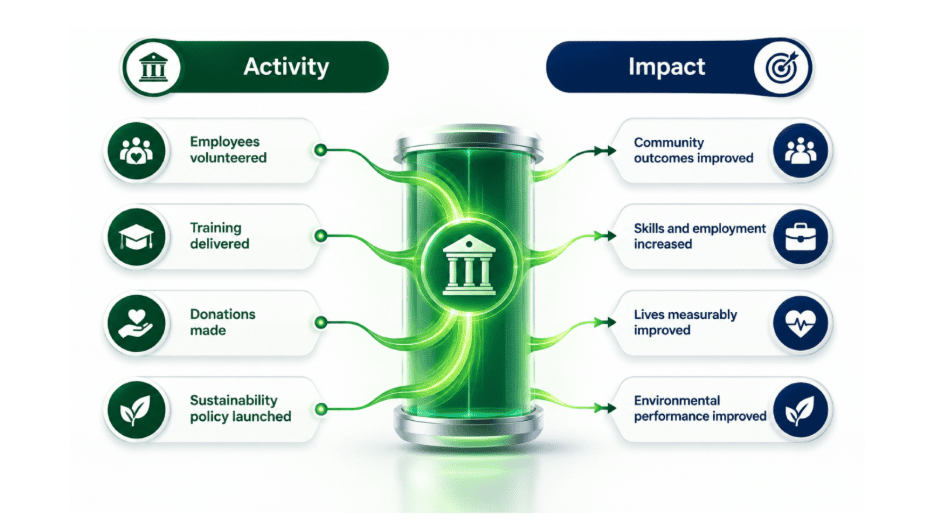
Activity measures effort.
Impact measures change.
Without evidence of outcomes, organisations risk confusing good intentions with meaningful results.
Optics can create the illusion of progress
Corporate sustainability reports.
Awards.
Social media campaigns.
Photographs.
These all help communicate ESG initiatives.
They do not prove success.
Increasingly, stakeholders expect organisations to demonstrate measurable environmental and social outcomes rather than simply describe programmes.
According to the OECD G20 Principles of Corporate Governance, transparency and reliable information are fundamental to accountability and effective governance.
Boards therefore need evidence.
Not assumptions.
Why impact measurement matters
Impact measurement transforms ESG from storytelling into strategic decision making.
It enables boards to answer critical questions.
Governance Questions Every Board Should Ask
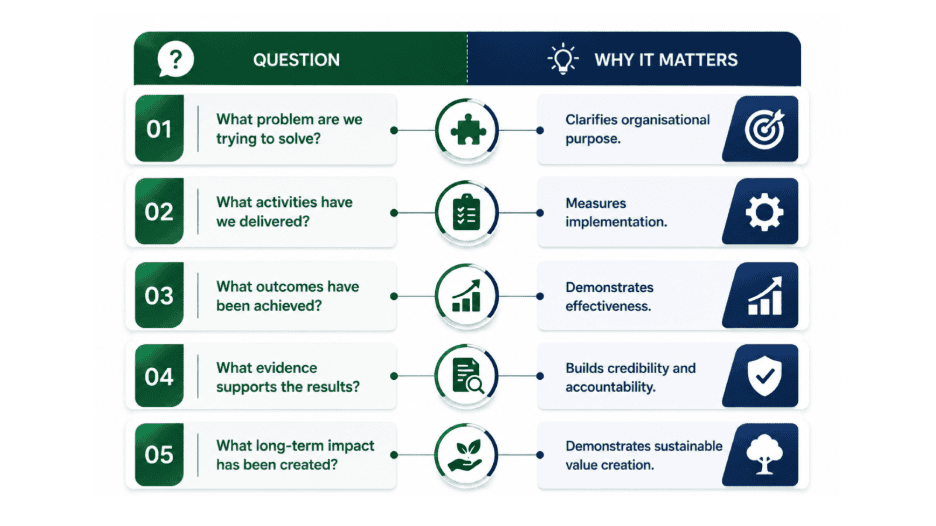
Without evidence, these questions remain unanswered.
Good governance depends on credible information.
A robust ESG Materiality & Risk Assessment helps organisations identify which environmental and social issues genuinely matter, ensuring impact is measured where it creates the greatest value.
Technology measures activity. Governance measures impact.
Collecting ESG data has become easier.
Understanding what that data means has become harder.
Technology can automate reporting.
It can centralise information.
It cannot determine whether an initiative has improved lives, strengthened communities or reduced inequality.
Real impact requires governance.
Oversight.
Evaluation.
Continuous learning.
According to the Global Reporting Initiative (GRI), sustainability reporting should focus on material impacts rather than simply listing organisational activities.
Strong reporting should therefore form part of a broader ESG Strategy Development process rather than exist as a standalone reporting exercise.
Stakeholder engagement turns reporting into accountability
Social impact cannot be determined by organisations alone.
It should also reflect the experience of those affected by organisational decisions.
Meaningful Stakeholder Engagement helps organisations understand whether ESG initiatives are creating genuine value rather than simply generating positive publicity.
Stakeholder engagement improves:
- Transparency.
- Accountability.
- Trust.
- Decision making.
- ESG reporting quality.
The organisations that build lasting trust are those that listen as carefully as they report.
Measuring impact should influence business decisions
The purpose of ESG reporting is not simply to produce a sustainability report.
It is to improve organisational performance.
Reliable impact data enables organisations to:
- Make better investment decisions.
- Allocate resources more effectively.
- Improve ESG strategy.
- Demonstrate accountability.
- Strengthen stakeholder confidence.
Integrating ESG into strategic planning through ESG Integration in Investment Decisions ensures sustainability becomes part of how organisations create long-term value rather than simply how they communicate it.
Similarly, Social Impact Measurement and Management provides organisations with the evidence needed to demonstrate whether programmes are creating measurable change.
The organisations that earn trust measure impact
ESG is no longer judged by the number of initiatives an organisation launches.
It is judged by the value those initiatives create.
Activity demonstrates effort.
Optics create visibility.
Impact creates trust.
The organisations that will lead in responsible business are those that can demonstrate, with credible evidence, how their governance and ESG programmes improve lives, strengthen communities and create sustainable long-term value.
Lumorus: Better Business, Built on Purpose
At Lumorus, we believe responsible business should be evidenced, not assumed.
Lumorus is a UK headquartered global governance, ESG, company secretary and advisory firm supporting organisations across Europe, Africa, Asia, the Caribbean, Canada, the Middle East and international markets.
We help organisations strengthen governance, measure ESG performance and demonstrate meaningful social impact through practical governance, strategy and reporting frameworks.
Our ESG expertise includes:
Whether you are developing your ESG strategy, measuring social impact or strengthening sustainability reporting, Lumorus can help you build governance frameworks that create measurable and lasting value.
Visit Lumorus to learn how we can help your organisation move from reporting activity to demonstrating genuine impact.
Website: lumorus.com
Email: [email protected]
Together, we can build better business: one that performs with purpose, leads with integrity and creates lasting value.