



Company secretary work sits at the heart of every well governed organisation. It is the function responsible for statutory compliance, board administration, entity management, regulatory filing, and the preservation of institutional knowledge that keeps a company legally sound and operationally credible. It is also, in most organisations, one of the most under resourced and over stretched functions in the building.
The reason is structural. The volume and complexity of CoSec work has grown significantly over the past decade. Regulatory environments across Africa, the UK, and emerging markets are tightening. Entity structures are becoming more complex. Board expectations are rising. The number of filing obligations, deadlines and compliance requirements that a CoSec team must track and execute has expanded considerably. The infrastructure available to most CoSec professionals, spreadsheets, shared inboxes and institutional memory, has not kept pace.
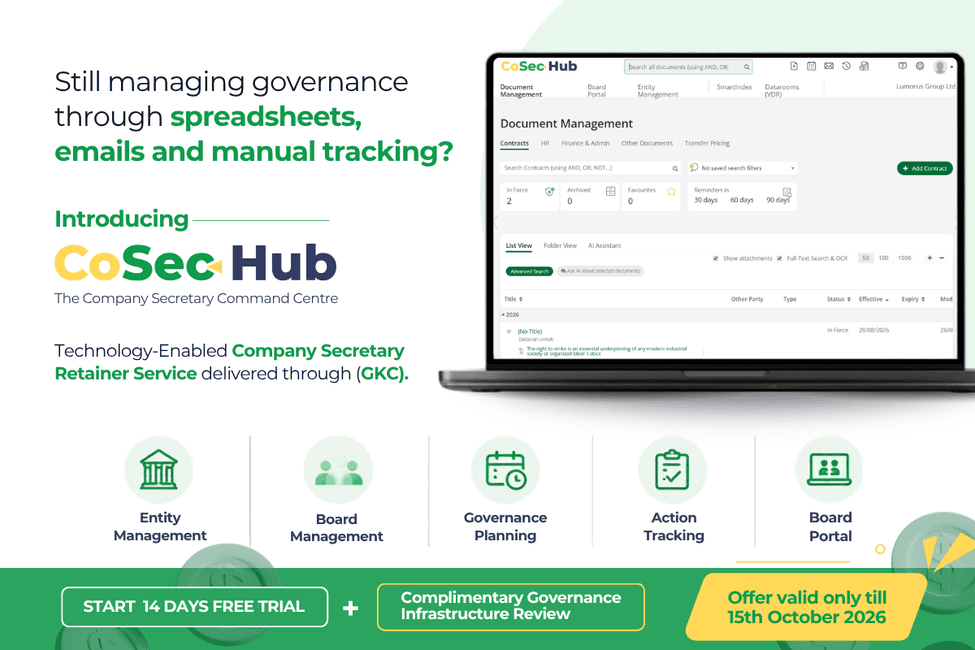
CoSec Hub, powered by Lumorus, was built to close that gap.
What Company Secretary Work Actually Involves
Before understanding how CoSec Hub simplifies the work, it helps to understand what the work actually demands. Company secretary responsibilities span a wide and interconnected set of obligations that touch every part of a governed organisation.
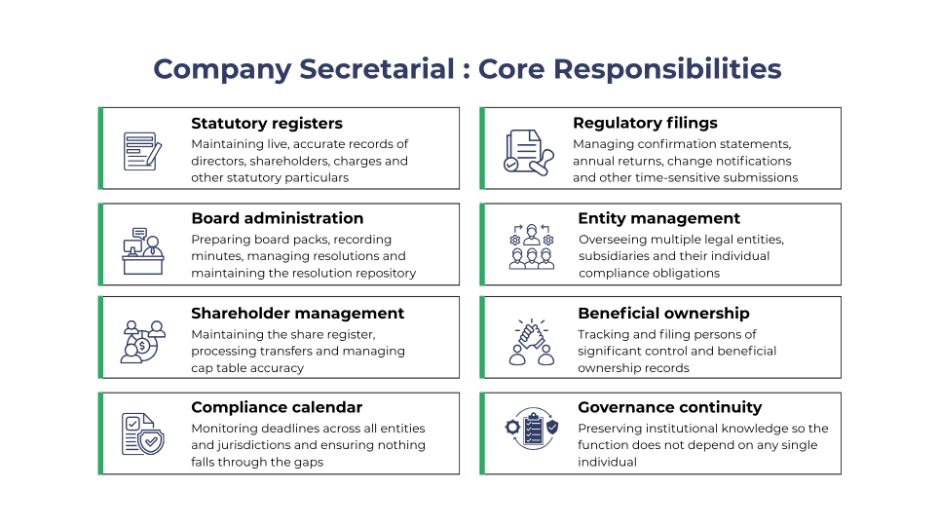
Each of these areas carries legal weight. A missed filing deadline is not an administrative inconvenience. It is a regulatory exposure. An inaccurate statutory register is not a record keeping issue. It is a legal liability. The function demands precision, consistency and a system of record that can be interrogated, audited and defended at any point.
The Problem CoSec Professionals Face Every Day
The reality for most CoSec professionals is that they are executing high stakes, legally consequential work using tools that were never designed for it. The spreadsheet that holds the statutory register has no audit trail. The shared inbox that manages board correspondence has no workflow logic. The filing calendar that tracks deadlines belongs to whoever sets it up and moves with them when they leave.
“The CoSec function carries more legal and regulatory weight than most organisations appreciate. It deserves infrastructure that reflects that weight.”
The consequences of this infrastructure mismatch show up in predictable ways:
- Deadlines are missed because a reminder sat in the wrong inbox or a calendar was not updated
- Due diligence processes surface inconsistencies in statutory registers that nobody knew existed
- New team members take months to become effective because knowledge is stored in the heads of those who came before them
- Board resolutions cannot be located because they were filed by subject line in an email folder that no longer exists
- Multi-entity management becomes unmanageable as the number of subsidiaries grows and the spreadsheet templates multiply
- Audit preparation requires hours of manual reconciliation across documents, files and systems that were never designed to talk to each other
These are not edge cases. They are the routine experience of CoSec professionals working without fit for purpose infrastructure. CoSec Hub addresses each of them directly.
How CoSec Hub Simplifies the Work
CoSec Hub is a governance infrastructure platform that integrates technology with professional company secretary services. It replaces the manual, fragmented workflows that define most CoSec operations with a single, structured environment built specifically for the demands of the function.
One Place for Everything
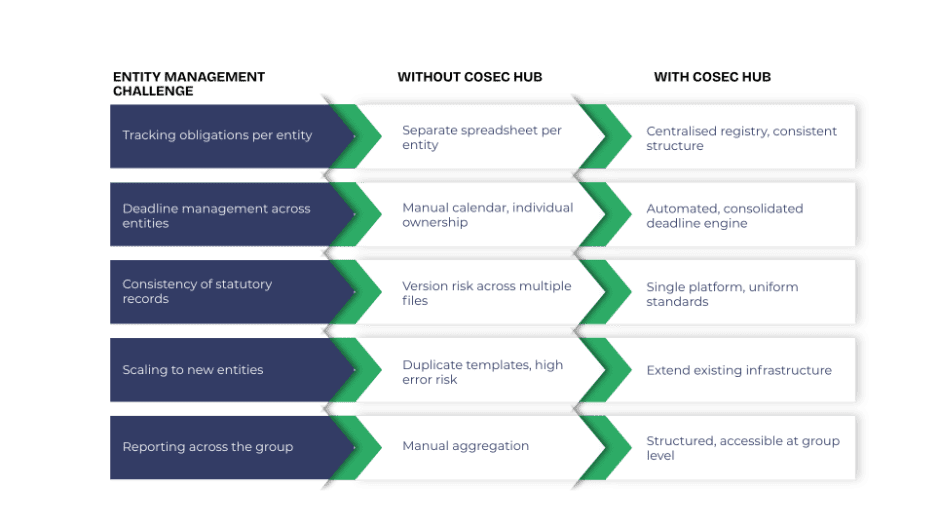
The most immediate simplification CoSec Hub delivers is consolidation. Statutory registers, board resolutions, filing records, entity information, shareholder data and compliance deadlines all live in one place. There is no need to reconcile across spreadsheets, search through email threads, or contact a colleague to find out where a document is stored. The information is structured, accessible, and current.
Statutory Registers That Are Always Accurate
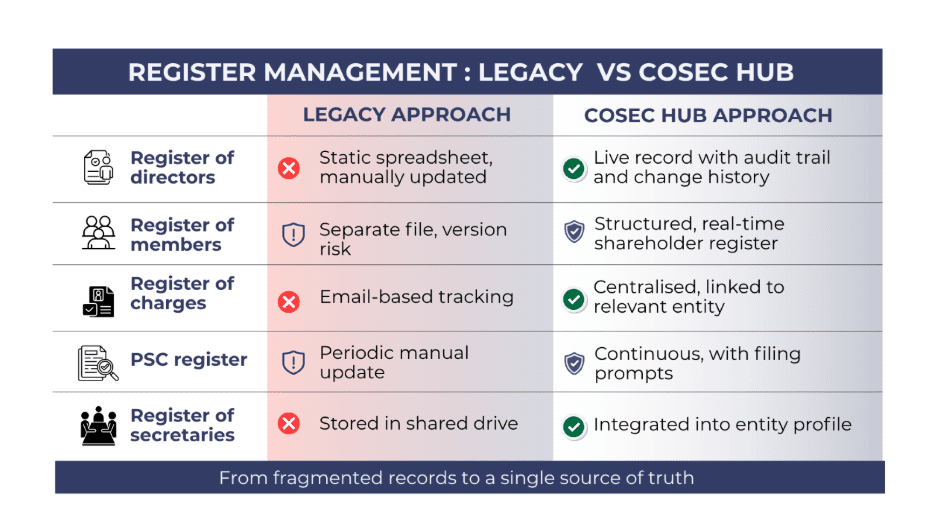
CoSec Hub maintains statutory registers as live, structured records with full audit trails. Every change is logged. Every entry is timestamped. Every amendment is traceable to the person who made it and the date on which it was made. The register is always current, always auditable, and always ready for inspection.
Automated Compliance Deadlines
Filing deadlines are one of the highest risk areas in CoSec operations. A missed confirmation statement, a late annual return, a delayed change notification: each carries regulatory consequences that can damage a company’s standing and create legal liability for its officers.
CoSec Hub tracks compliance deadlines through an automated engine that monitors obligations across all entities and jurisdictions. Alerts are generated in advance. Escalation protocols are triggered where action is required. The team is notified before a deadline becomes a problem, not after it has been missed.
A Searchable Resolution Repository
Board resolutions are legally significant documents. They evidence the decisions made by the board and provide the authority for actions taken by the company. Storing them in email folders or shared drives, with no consistent naming convention and no search capability, is a governance failure waiting to surface at the worst possible moment.
CoSec Hub maintains a structured resolution repository linked to the relevant entity, meeting record, and date. Every resolution is searchable, retrievable, and auditable. The question of whether a particular decision was properly authorised can be answered in seconds rather than hours.
Entity Management That Scales
Managing a single entity is manageable with basic tools. Managing ten, twenty or fifty entities across multiple jurisdictions with spreadsheet templates is not. The complexity compounds with every additional entity added, and the risk of inconsistency, missed deadlines and version errors grows accordingly.
CoSec Hub provides a centralised entity registry that maintains consistent structure and compliance standards across every entity in the group. Adding a new entity does not mean duplicating a template and hoping nothing is missed. It means extending a system that already works.
Institutional Knowledge That Lives in the System
One of the most persistent and least visible risks in CoSec operations is the concentration of institutional knowledge in individuals. The team member who knows where everything is, when everything falls due, and what was decided at every AGM for the past five years is an asset to the organisation and a single point of failure.
CoSec Hub encodes institutional knowledge into the platform rather than leaving it to reside in individuals. Processes are documented in the system. Records are structured and accessible to authorised team members. Onboarding a new CoSec professional does not require months of knowledge to transfer from a predecessor. The system holds what the function needs to operate.
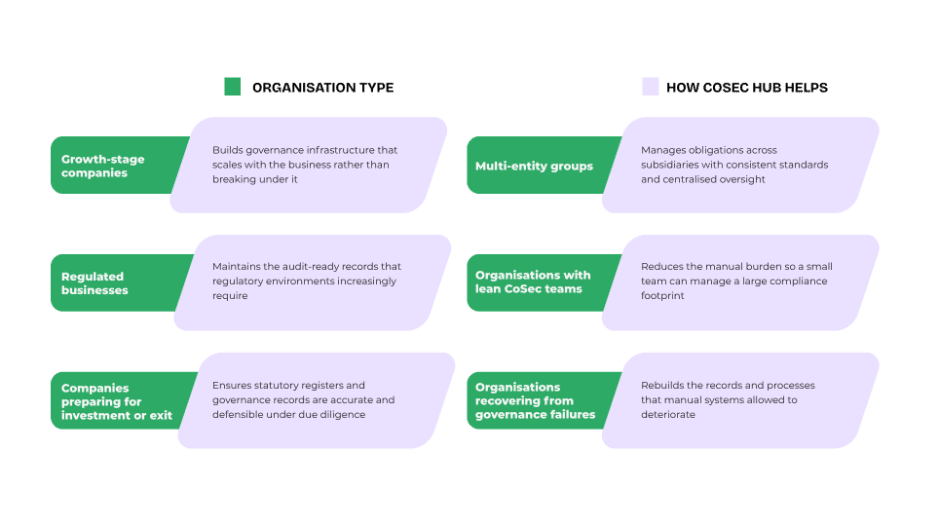
Who CoSec Hub Is Built For
CoSec Hub is designed for the full range of organisations for whom company secretarywork is a genuine operational and legal responsibility.
The Regulatory Environment Makes This Urgent
Regulatory expectations across Africa and the UK are not static. The Companies and Allied Matters Act amendments in Nigeria, the Companies Act requirements in Ghana, the UK Economic Crime and Corporate Transparency Act and the broader direction of travel across emerging market regulators all point in the same direction: greater transparency, faster disclosure, more rigorous record keeping and real accountability for governance failures.
Organisations running their CoSec function on manual infrastructure are not simply operationally inefficient. They are increasingly misaligned with the legal and regulatory stand\\ards they are required to meet. The gap between the infrastructure they have and the standard they are expected to reach is widening.
“The question is no longer whether to modernise CoSec infrastructure. It is whether to do it before a governance failure makes the decision for you.”
What the Simplification Actually Delivers
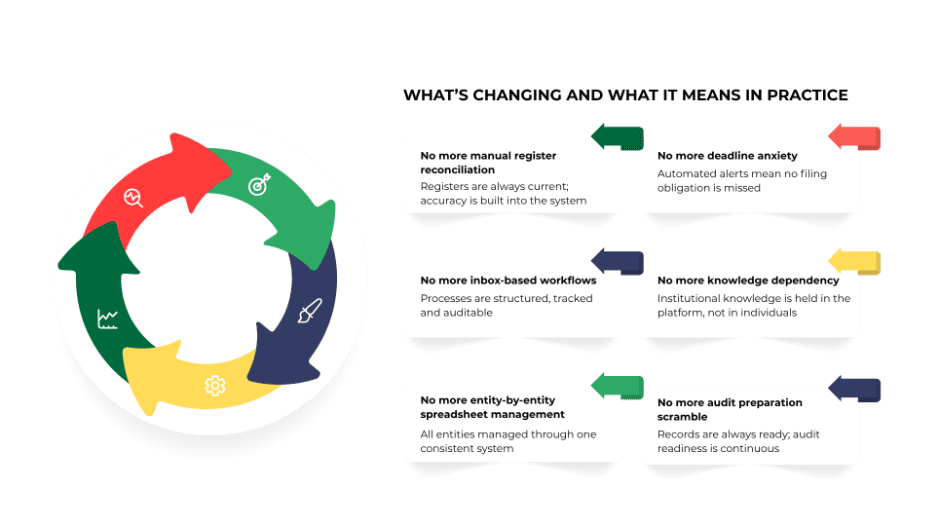
Simplification in the context of CoSec Hub is not about reducing the rigour of CoSec work. It is about removing the friction that manual infrastructure creates, so that CoSec professionals can focus on the substance of the function rather than the mechanics of managing inadequate tools.
The result is a CoSec function that operates with the precision, consistency and resilience that the work has always demanded, supported by infrastructure that is finally built to match.
Start with CoSec Hub
The transition to fit for purpose CoSec infrastructure does not require rebuilding everything at once. It starts with a clear view of where the current model is genuinely fragile and a structured move to a platform built for the work.
CoSec Hub, powered by Lumorus, is that platform. It is built for organisations that have outgrown the spreadsheet and inbox model and need governance infrastructure that can carry the weight of real compliance, real accountability and real governance, not the appearance of it.
cosec.lumorus.com | lumorus.com | [email protected]
Citations & Sources
- Companies and Allied Matters Act (CAMA) 2020, Federal Republic of Nigeria. Corporate Affairs Commission. \
- UK Economic Crime and Corporate Transparency Act 2023. Companies House.
- Chartered Governance Institute UK & Ireland. Company Secretary Benchmarking Survey: Governance Operations and Technology Adoption. 2023.
- Institute of Chartered Secretaries and Administrators. Corporate Governance Failures and Board Evaluation Outcomes. 2023.
Published by Lumorus · CoSec Hub · 6 min read · Powered by Lumorus