



Governance is becoming too complex to manage through spreadsheets, emails and institutional memory
For many years, company secretaries successfully managed governance activities using a combination of experience, diligence and manual processes.
Compliance deadlines were tracked in spreadsheets.
Board papers were stored in shared folders.
Statutory registers were maintained manually.
Governance knowledge sat with a small number of experienced individuals.
For smaller organisations, these approaches may have been sufficient.
Today, they are increasingly becoming a governance risk.
Boards expect greater visibility.
Regulators expect stronger accountability.
Investors demand better governance oversight.
And organisations are managing more entities, more stakeholders and more governance obligations than ever before.
As governance complexity grows, company secretaries need something more robust.
They need governance infrastructure.
What is governance infrastructure?
Governance infrastructure refers to the systems, processes, controls and governance tools that enable governance activities to be managed consistently, efficiently and transparently.
Just as financial infrastructure supports financial management, governance infrastructure supports governance operations.
A strong governance infrastructure typically includes:
- Entity Management
- Compliance Calendars
- Governance Forward Planning
- Board Management
- Statutory Registers
- Board Action Tracking
- Contract Management
- Meeting Lifecycle Management
- Governance Reporting
- Governance Intelligence
The objective is not simply compliance.
The objective is creating governance visibility, accountability and resilience.
Why traditional governance processes are under pressure
The role of the company secretary has evolved significantly.
Company secretaries are increasingly expected to support:
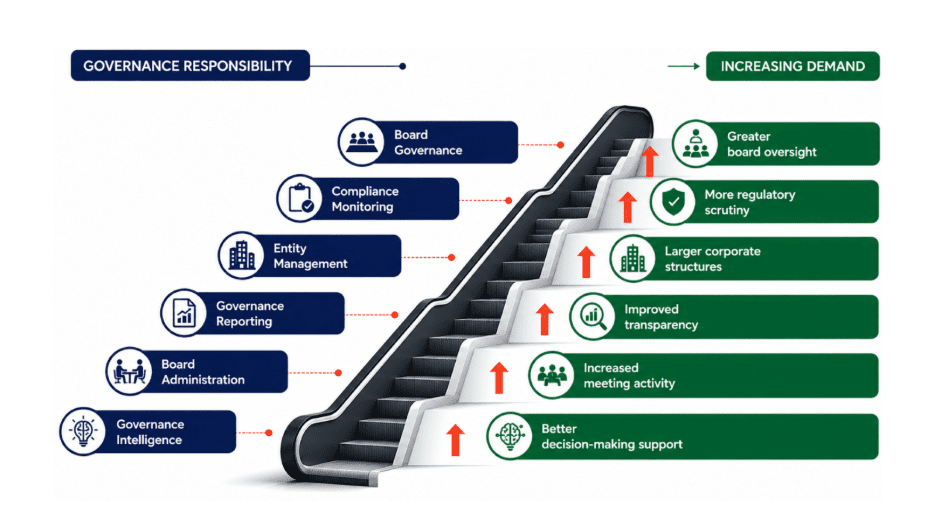
At the same time, governance resources often remain limited.
This creates a growing gap between governance expectations and governance capability.
Infrastructure helps bridge that gap.
Five reasons company secretaries need governance infrastructure
1. Governance complexity is increasing
Many organisations now operate across multiple entities, business units and jurisdictions.
Each additional entity creates new governance responsibilities.
These may include:
- Regulatory Filings
- Director Appointments
- Shareholder Changes
- Statutory Register Updates
- Corporate Actions
- Annual Compliance Obligations
Without structured governance infrastructure, visibility often declines as complexity increases.
Governance complexity grows faster than most organisations expect.
2. Compliance visibility is essential
One of the most common governance challenges is lack of visibility.
Company secretaries need to know:
- What obligations exist
- Who is responsible
- When activities are due
- Whether tasks have been completed
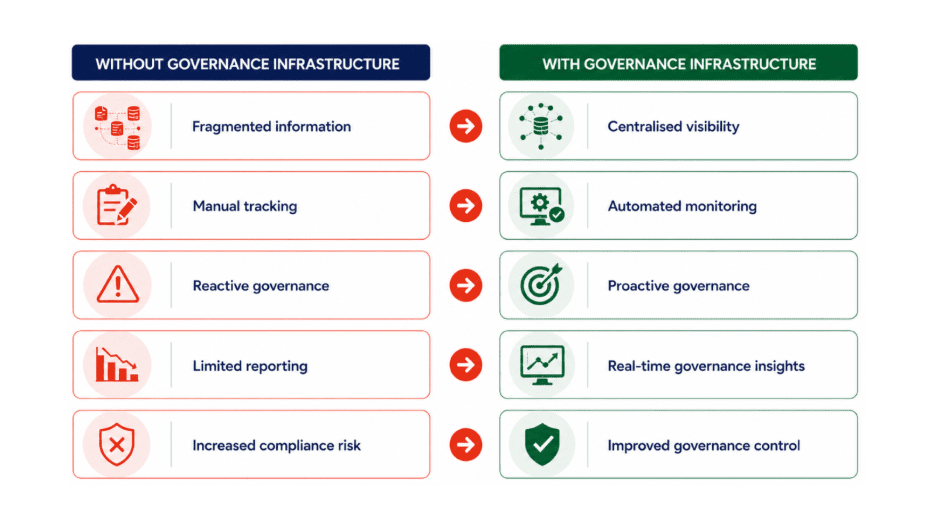
Governance infrastructure creates a central source of truth.
This helps reduce the risk of missed obligations and governance failures.
3. Boards require stronger support
The quality of board oversight depends heavily on governance support.
Modern boards expect:
- Timely board papers
- Accurate governance information
- Clear action tracking
- Effective meeting administration
- Governance reporting
Governance infrastructure helps company secretaries manage these responsibilities more efficiently and consistently.
Good governance rarely happens by accident.
It is usually supported by strong governance systems and processes.
4. Governance should not depend on one individual
Many organisations face significant governance risk because critical governance knowledge sits with one person.
This creates operational vulnerability.
When individuals leave, governance continuity can be disrupted.
Governance infrastructure helps organisations create:
- Process Consistency
- Governance Continuity
- Knowledge Retention
- Compliance Resilience
- Organisational Memory
Strong governance should be institutionalised rather than person-dependent.
5. Governance teams need better information
Company secretaries are increasingly expected to provide governance intelligence rather than simply governance administration.
Leadership teams want visibility over:
- Compliance Status
- Governance Risks
- Board Actions
- Entity Obligations
- Governance Performance
Governance infrastructure enables company secretaries to move from administrative coordination to strategic governance support.
This is one of the most important shifts occurring within the profession today.
The risks of operating without governance infrastructure
The absence of governance infrastructure can create significant challenges.
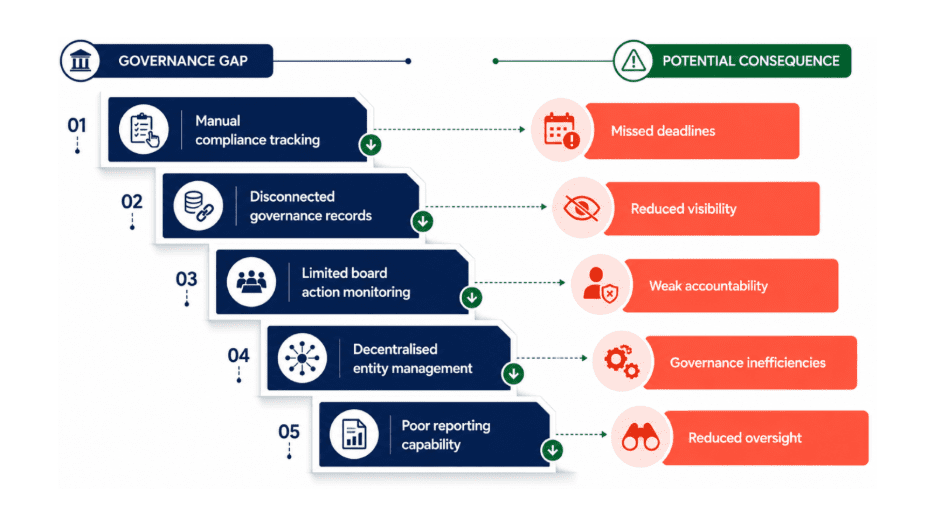
Most governance failures do not occur because organisations intentionally ignore governance.
They occur because governance becomes difficult to manage as complexity increases.
Governance warning signs to watch for
The following indicators often suggest governance infrastructure requires strengthening.
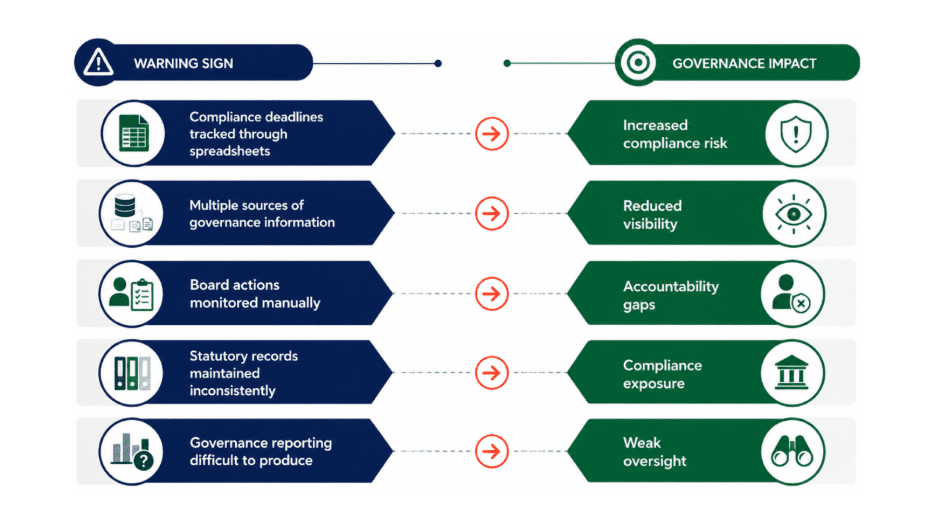
These issues often emerge before more serious governance failures become visible.
Why CoSec Hub takes a different approach
CoSec Hub was built around a simple belief.
Modern company secretaries need more than software and more than outsourced administration.
They need governance infrastructure.
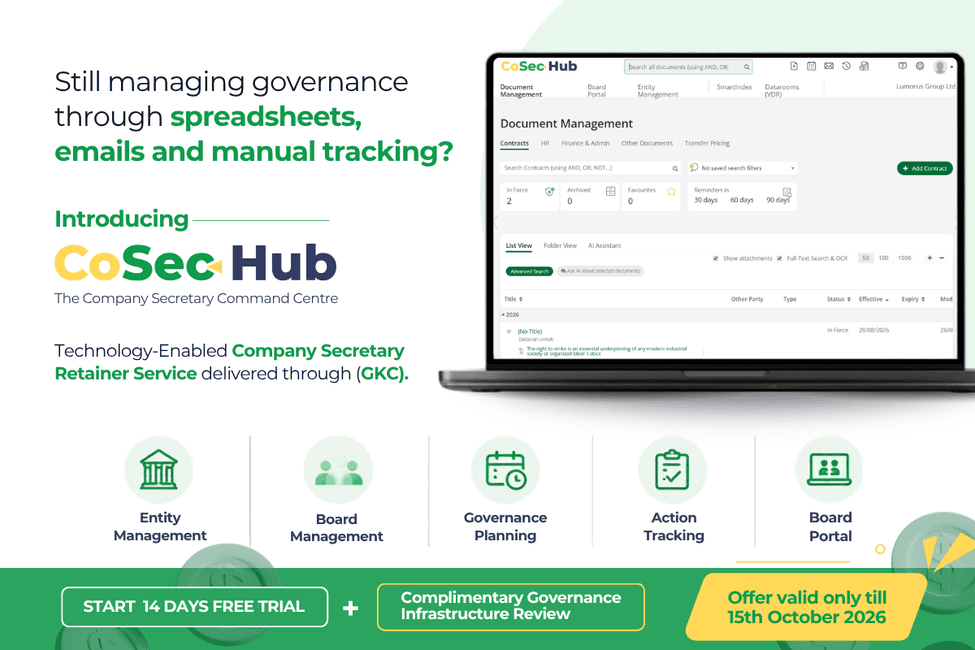
That is why CoSec Hub combines technology and governance expertise through a technology-enabled Company Secretary Retainer Service.
CoSec Hub
The Company Secretary Command Centre supporting:
- Entity Management
- Compliance Calendars
- Governance Forward Planning
- Board Management
- Contract Management
- Statutory Registers
- Board Action Tracking
- Meeting Lifecycle Management
Governance Knowledge Centre (GKC)
Providing:
- Company Secretary Expertise
- Governance Operations Support
- Board Administration
- Compliance Monitoring
- Governance Intelligence
- Multi-Jurisdiction Governance Support
- Governance Advisory Support
Together, CoSec Hub and the Governance Knowledge Centre (GKC) deliver a technology-enabled Company Secretary Retainer Service designed to help company secretaries build the governance infrastructure needed for modern governance operations.
About CoSec Hub
CoSec Hub is the Company Secretary Command Centre.
Built by Company Secretaries for Company Secretaries, CoSec Hub combines technology and governance expertise to support governance operations, compliance oversight, entity management and board administration.
Delivered through CoSec Hub and the Governance Knowledge Centre (GKC), the service provides technology-enabled Company Secretary Retainer Services designed for modern company secretarial, legal governance and compliance teams.
Lumorus: Better Business, Built on Purpose
Lumorus is a UK-headquartered global governance, company secretarial, ESG and advisory firm supporting organisations across multiple jurisdictions and regulated environments.
We help organisations strengthen governance infrastructure, accountability systems and board oversight capability as operational complexity, regulatory expectations and enterprise risk continue to evolve.
Explore how CoSec Hub and the Governance Knowledge Centre (GKC) can help your organisation move from fragmented administration to connected, auditable and board-ready governance.
CoSec Hub: cosec.lumorus.com
Lumorus: lumorus.com
Email: [email protected]
CoSec Hub + Governance Knowledge Centre (GKC): Where Automation Meets Governance Authority.