



For many growing organisations, adding a second entity feels straightforward.
A new subsidiary is established. A holding company is created. An overseas operation is launched. A special purpose vehicle is formed to support investment or expansion.
Then another entity follows.
And another.
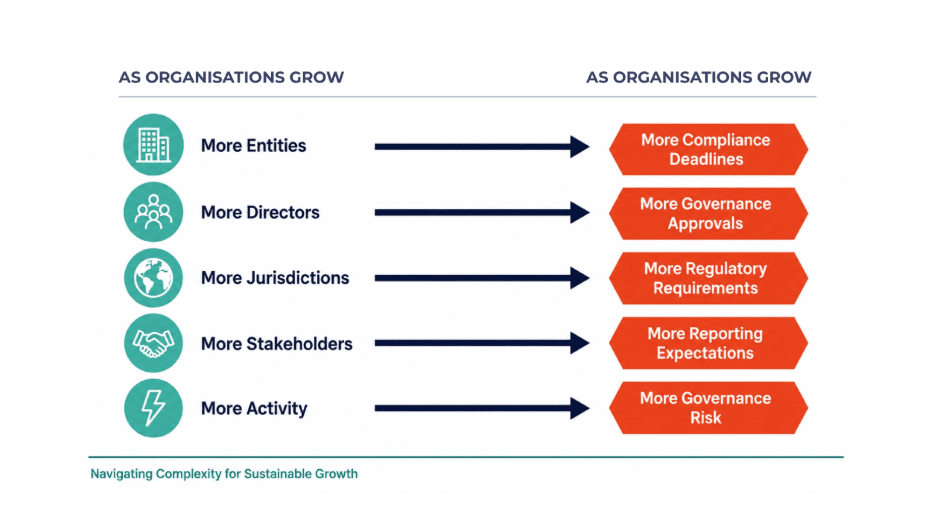
Before long, what began as a relatively simple corporate structure has evolved into a complex governance ecosystem involving multiple legal entities, directors, jurisdictions, compliance obligations and regulatory deadlines.
This is where many organisations begin to lose visibility.
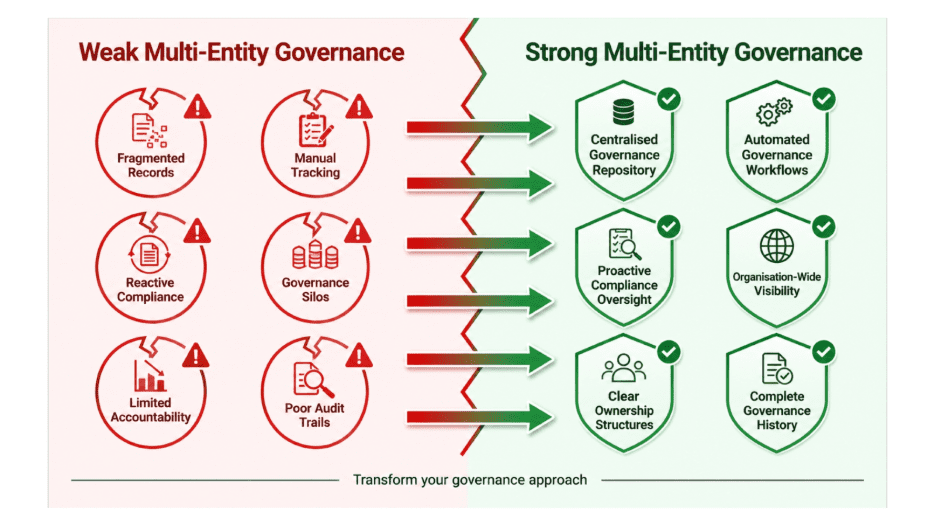
Compliance becomes fragmented. Governance records become decentralised. Accountability becomes unclear. Filing deadlines become harder to track.
The challenge is not usually a lack of effort.
The challenge is a lack of governance infrastructure.
According to Deloitte, governance complexity increases exponentially as organisations expand across multiple entities, jurisdictions and regulatory environments. Without coordinated oversight systems, compliance risks become significantly harder to manage.
The question for leadership teams is no longer whether governance activity is taking place.
The question is whether governance can be coordinated, monitored and evidenced across the entire corporate structure.
Why multi-entity compliance becomes so difficult
Many organisations continue managing entity governance through a combination of spreadsheets, emails, shared folders and manual reminders.
This may work when there are only one or two entities.
It becomes increasingly difficult when organisations must manage:
- Multiple Subsidiaries
- Overseas Entities
- Different Regulatory Frameworks
- Director Appointments
- Statutory Filings
- Board Meetings
- Shareholder Approvals
- Annual Returns
- Corporate Registers
- Compliance Deadlines
Each entity creates its own governance obligations.
The complexity multiplies quickly.
What often emerges is a governance environment where information exists, but visibility does not.
The hidden risks of fragmented entity management
Most multi-entity governance failures are not caused by misconduct.
They are caused by weak coordination.
Common issues include:
- Missed Filing Deadlines
- Outdated Statutory Registers
- Incomplete Governance Records
- Unclear Accountability
- Missing Board Resolutions
- Fragmented Document Storage
- Inconsistent Governance Processes
- Poor Audit Trail Visibility
Individually, these may appear administrative.
Collectively, they create significant governance exposure.
These weaknesses often remain hidden until organisations face:
- Investor Due Diligence
- Regulatory Reviews
- External Audits
- Funding Rounds
- Mergers And Acquisitions
- Banking Reviews
This is when governance infrastructure is tested.
And many organisations discover they do not have one.
What strong multi-entity governance looks like
High-performing organisations approach governance differently.
Rather than managing entities individually, they manage governance centrally.
This allows leadership teams to maintain visibility across the entire corporate structure.
Strong governance systems typically provide:
- Centralised Entity Records
- Compliance Calendars
- Governance Workflows
- Board Approval Tracking
- Director Management
- Filing Oversight
- Audit Trails
- Governance Reporting
The objective is simple.
Create a single source of governance truth across the organisation.
Why governance visibility matters
One of the biggest governance challenges facing organisations today is visibility.
Leadership teams often assume governance is functioning properly because activities are happening.
Board meetings take place.
Filings are submitted.
Approvals are granted.
But governance effectiveness depends on visibility, not assumptions.
Boards increasingly need answers to questions such as:
- Which filings are due next month?
- Which entities have outstanding actions?
- Are governance approvals fully documented?
- What compliance risks are emerging?
- Can governance decisions be evidenced quickly?
- Are statutory records current across all entities?
Without visibility, governance becomes reactive.
With visibility, governance becomes manageable.
How CoSec Hub helps organisations manage multiple entities
CoSec Hub was built specifically to solve this challenge.
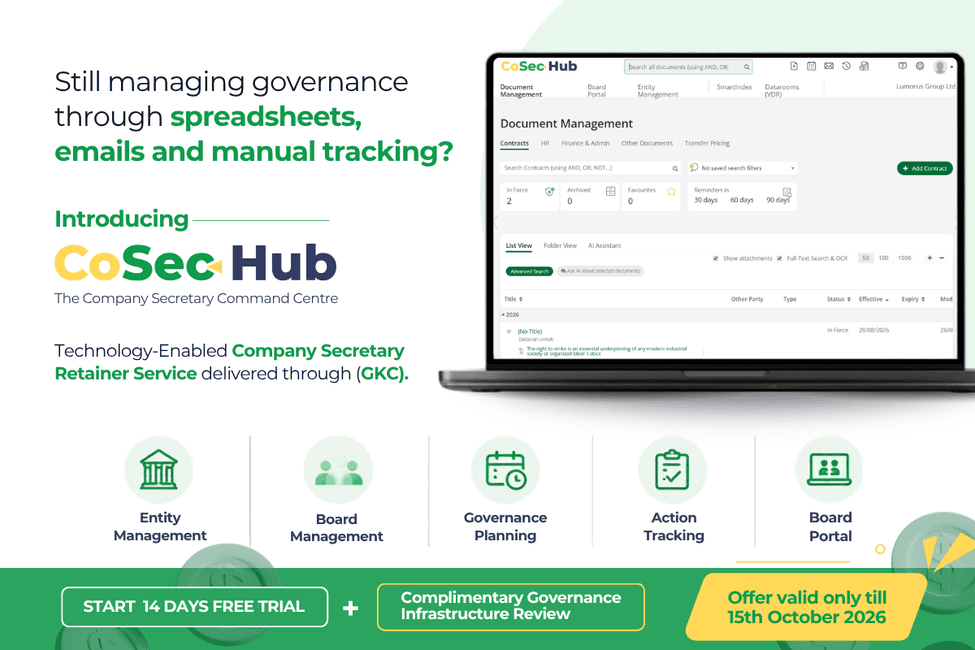
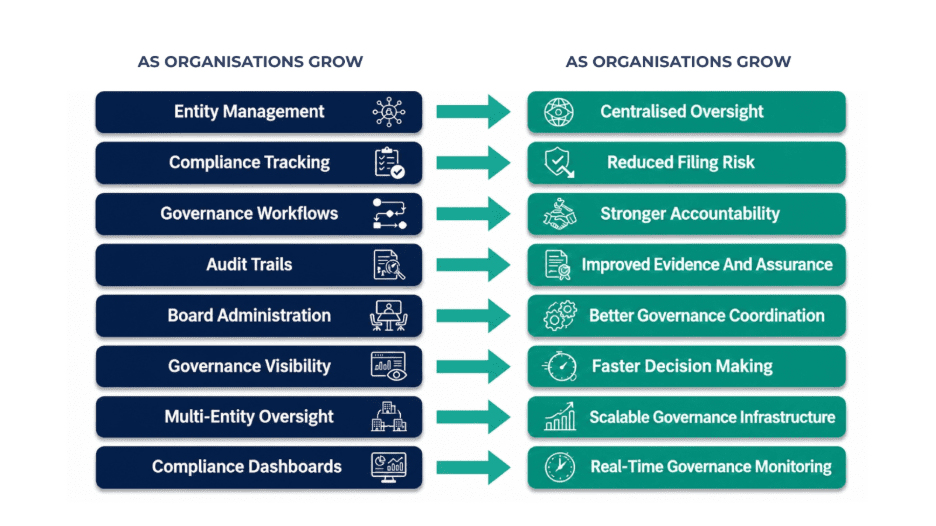
Rather than treating governance as a series of disconnected administrative tasks, CoSec Hub provides a central governance command centre for managing entity compliance, governance workflows and company secretarial operations.
Through CoSec Hub, organisations can:
- Centralise Entity Records
- Manage Compliance Calendars
- Track Governance Actions
- Monitor Filing Obligations
- Coordinate Board Administration
- Maintain Governance Audit Trails
- Improve Accountability Visibility
- Support Multi-Jurisdiction Governance
The platform helps governance teams move away from fragmented spreadsheets and email-based administration towards connected governance infrastructure.
This creates greater oversight, stronger accountability and improved governance resilience.
Explore CoSec Hub
Governance complexity requires governance infrastructure
The organisations that manage multi-entity compliance most effectively are not necessarily those with the largest governance teams.
They are the organisations with the strongest governance systems.
As businesses scale, governance cannot depend on spreadsheets, memory and fragmented administration alone.
It requires infrastructure capable of supporting visibility, accountability and compliance across the entire organisation.
Boards and company secretary teams should ask one question:
Is our governance infrastructure strong enough for the complexity, scrutiny, and accountability we now face?
If the answer is uncertain, it may be time to rethink how governance is being managed.
About CoSec Hub
CoSec Hub is the governance command centre for the modern company secretary.
Designed for growing businesses, multinational organisations, NGOs and regulated entities, CoSec Hub helps organisations centralise governance operations, strengthen compliance visibility and manage multiple entities through connected, auditable and board-ready governance infrastructure.
Lumorus: Better Business, Built on Purpose
Lumorus is a UK headquartered global governance, company secretarial, ESG and advisory firm supporting organisations across Europe, Africa, Asia, the Caribbean, Canada and other international markets.
For more than 10 years, we have helped boards, leadership teams and organisations strengthen governance, accountability and organisational resilience.
Is your governance infrastructure strong enough for the complexity, scrutiny and accountability you now face?
Contact Lumorus to request a Governance Infrastructure Assessment and explore how CoSec Hub can help your organisation move from fragmented administration to connected, compliant and board-ready governance.
CoSec Hub: cosec.lumorus.com
Lumorus: lumorus.com
Email: [email protected]
CoSec Hub, powered by Lumorus: the command centre for the modern company secretary.