



81 jurisdictions, 292 indicators and one clear message: cross-border compliance is getting harder
International growth creates opportunity, but it also creates governance complexity that many organisations underestimate.
According to TMF Group’s Global Business Complexity Index 2026, the business environment across 81 jurisdictions was assessed using 292 indicators spanning accounting and tax, employment and legal entity management. Together, those jurisdictions represent more than 90% of the global economy.
The findings show just how different operating environments can be. Greece ranked as the most complex jurisdiction in the 2026 index, followed by Mexico and Brazil, while the Cayman Islands, Hong Kong SAR and the Netherlands appeared among the least complex. More importantly, the research identifies frequent regulatory change, administrative burden and uneven digital requirements as recurring drivers of complexity.
For boards, General Counsel and Company Secretaries, the lesson is not that some markets should be avoided. Instead, it is that the same governance operating model cannot simply be copied into every jurisdiction without adaptation.
A group may have a strong compliance framework at headquarters while individual subsidiaries operate under different company laws, filing deadlines, ownership rules, employment requirements and governance expectations. Consequently, multi-jurisdiction compliance becomes less about managing individual deadlines and more about maintaining control across a system that is constantly changing.
Read More: Statutory & Regulatory Compliance
Executive Takeaway
The most significant multi-jurisdiction compliance challenges usually arise from six areas:
- Different laws and filing requirements across countries
- Frequent regulatory change
- Fragmented entity and ownership information
- Weak coordination between headquarters and local advisers
- Inconsistent governance processes across subsidiaries
- Heavy reliance on spreadsheets, email and individual knowledge
However, the greatest risk is often not local non-compliance itself. It is the loss of group-wide visibility.
When organisations cannot see which obligations are due, which entities are exposed or which actions remain outstanding, boards are forced to rely on fragmented assurance.
A stronger model combines:
- Central governance oversight
- Local regulatory expertise
- Accurate entity records
- Compliance calendars
- Clear ownership and escalation
- Technology-enabled visibility
- Experienced Company Secretary support
That combination allows organisations to grow internationally without allowing governance complexity to grow unchecked.
Why multi-jurisdiction compliance becomes difficult so quickly
The first foreign subsidiary rarely feels difficult.
There is one new entity, a local adviser and a manageable set of obligations. However, once the business expands into several markets, complexity begins to multiply rather than increase gradually.
Each jurisdiction can introduce different requirements covering:
- Incorporation and legal form
- Registered office arrangements
- Director appointments
- Resident director requirements
- Shareholder records
- Beneficial ownership
- Annual returns
- Accounts and statutory filings
- Board and shareholder meetings
- Tax reporting
- Employment obligations
- Data protection
- Regulatory licences
- Entity dissolution
As a result, ten subsidiaries do not necessarily create ten times the work. The combination of different laws, deadlines, languages and advisers can create far greater coordination demands.
The OECD’s work on the governance of company groups highlights this tension. Parent companies have legitimate reasons to coordinate governance across a group, yet subsidiary boards remain subject to the law of their own jurisdiction and may have duties that limit direct intervention from headquarters.
Therefore, effective group governance requires coordination without ignoring local legal responsibility.
Explore More: Corporate Governance Support
Challenge 1: Regulatory change happens at different speeds
Perhaps the most obvious difficulty is that regulation does not change uniformly.
One jurisdiction may introduce new beneficial ownership rules, another may digitise annual filings and a third may change director requirements. At the same time, regulations that appear similar can have different definitions, thresholds or implementation dates.
TMF Group’s 2026 Global Business Complexity Index identifies frequent legislative change as one of the leading causes of business complexity, particularly in jurisdictions that rank towards the more difficult end of the index.
This makes regulatory horizon scanning essential.
A multi-jurisdiction compliance framework should therefore track:
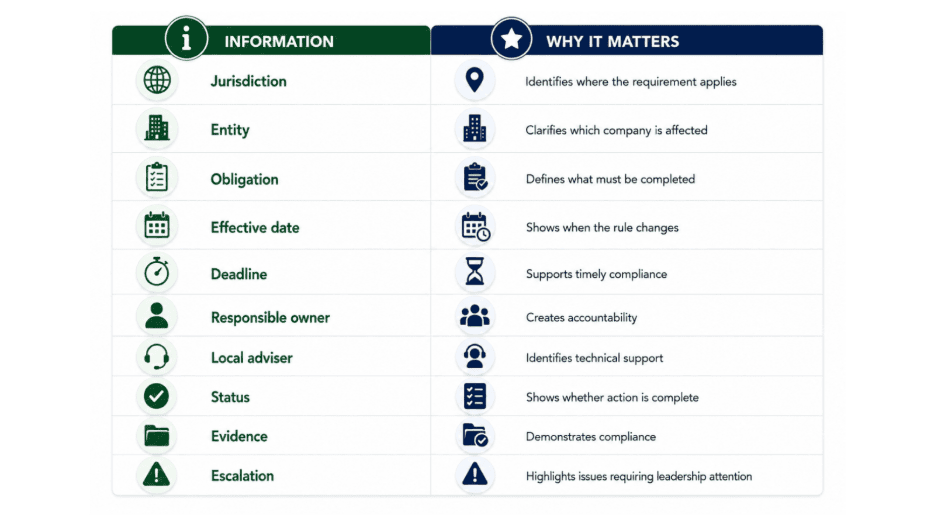
Without this level of structure, regulatory change is easily reduced to email updates that may never translate into action.
Challenge 2: Centralisation can improve control but create local blind spots
International organisations naturally want consistency.
A central governance team can establish common standards, reduce duplication and provide leadership with a clearer view of the group. However, excessive centralisation can create a different problem if local requirements are not properly understood.
For example, headquarters may introduce one global board meeting template or one approval process, even though local company law requires additional formalities.
The OECD notes that subsidiary boards may have independent legal responsibilities under the law of their jurisdiction. Therefore, group governance needs to respect the distinction between legitimate parent oversight and the duties of local boards. (oecd.org)
A better operating model combines two levels.
Group governance should provide
- Common standards
- Central compliance reporting
- Group policies
- Escalation thresholds
- Entity information
- Oversight of material risks
Local governance should provide
- Jurisdiction-specific legal compliance
- Local board accountability
- Regulatory interpretation
- Required filings
- Local corporate records
The strength of the system lies in connecting the two.
Challenge 3: Entity records become inconsistent
One of the most common multi-jurisdiction governance problems is surprisingly basic: different parts of the organisation hold different information about the same entity.
Legal may have one director list, finance another and the local adviser a third. Meanwhile, the central governance database may not yet reflect a recent appointment or ownership change.
This matters because entity information supports much more than company administration.
It can affect:
- Banking
- Regulatory filings
- Tax reporting
- Transactions
- Due diligence
- Beneficial ownership
- Insurance
- Board composition
- Powers of attorney
- Contract approvals
The issue becomes more serious as regulators demand more reliable information about those who own and control companies.
In the UK, Companies House requires identity verification for directors, people with significant control and directors of overseas companies registered in the UK. Failure to meet the relevant requirements can lead to penalties and restrictions.
Similarly, the European Union’s anti-money laundering framework strengthens beneficial ownership transparency and requires organisations to identify natural persons who ultimately own or control legal entities.
Therefore, accurate entity information is becoming part of regulatory infrastructure.
Read More: Company Formation & Structuring
Challenge 4: Different advisers can create fragmented governance
Many multinational organisations expand by appointing local advisers as each new jurisdiction is entered.
Initially, this makes sense. Local specialists understand the law, language and regulatory environment.
However, after several years, the organisation may find itself managing:
- One adviser in France
- Another in Germany
- A different provider in South Africa
- Separate advisers across Asia
- Internal governance teams in the UK
- Several entity management systems
Each part of the model may work individually, while the overall governance system becomes difficult to manage.
TMF Group’s 2026 analysis of cross-border complexity argues that international organisations can worsen external complexity through internal complexity, including the use of numerous processes, platforms and service providers.
This distinction is important.
Organisations cannot eliminate local regulation, but they can simplify how they manage it.
A stronger model creates one point of governance coordination, even where several local specialists remain involved.
Challenge 5: Compliance calendars are difficult to maintain manually
A spreadsheet can be remarkably effective when an organisation has a small number of entities.
However, spreadsheets become less dependable as the number of jurisdictions and obligations increases.
Consider a group with 50 entities. If each entity has only ten significant annual governance and compliance obligations, the organisation is already managing 500 recurring items before considering:
- One-off corporate actions
- Board meetings
- Director changes
- Regulatory updates
- Transactions
- New subsidiaries
- Shareholder approvals
Manual systems can still work, but they create a larger risk of missed updates, duplicate records and limited escalation.
Therefore, modern compliance calendars should provide:
- Jurisdiction-specific deadlines
- Recurring obligations
- Automated reminders
- Clear owners
- Evidence of completion
- Escalation for overdue actions
- Group reporting
- Integration with entity records
The calendar should answer more than what is due?
It should also answer who owns it, what evidence exists and what happens if it is late?
Explore More: Statutory & Regulatory Compliance
Challenge 6: Cross-border board governance becomes inconsistent
A group may establish strong governance standards at parent-company level while subsidiary boards operate very differently.
Some subsidiaries meet regularly, while others rely heavily on written resolutions. Certain boards receive well-developed papers, whereas others approve significant matters with little documented analysis.
This inconsistency can become a serious governance weakness when subsidiaries undertake material activities.
The G20/OECD Principles of Corporate Governance state that compliance and control systems should extend, where possible, to subsidiaries and that boards should maintain clear lines of accountability across enterprise groups.
However, this does not mean every board must operate identically.
Instead, group governance should establish minimum standards covering areas such as:
- Board composition
- Meeting frequency
- Reserved matters
- Conflicts
- Board papers
- Minutes
- Escalation
- Risk reporting
- Corporate actions
Subsidiaries can then adapt those standards to local law and business needs.
Read More: Board & Shareholder Meetings
Challenge 7: Compliance evidence is often separated from compliance activity
Completing an obligation is only part of the job.
The organisation also needs evidence that it was completed correctly.
For example, a statutory filing may have been submitted, yet the confirmation remains with the local adviser. A board resolution may have been approved, while the signed copy sits in someone’s inbox.
This creates a problem when the organisation faces:
- Audit
- Regulatory review
- Due diligence
- Investment
- Acquisition
- Refinancing
- Litigation
- Internal investigation
Audit-ready multi-jurisdiction governance requires evidence to remain connected to the underlying obligation.
A complete compliance record should show
- The requirement
- The relevant entity
- The responsible person
- The deadline
- The action taken
- The approval
- The filing or submission
- The completion evidence
- Any follow-up action
This structure allows compliance to be reconstructed without relying on personal memory.
Challenge 8: Digitalisation does not remove local complexity
Governments around the world are digitising regulatory systems.
At first glance, this should make compliance simpler, and in many cases it does improve processing times and transparency.
However, digitalisation can also create new differences.
Separate jurisdictions may require:
- Different digital identities
- Local electronic signatures
- Specific filing portals
- Particular document formats
- Local language submissions
- Unique authentication processes
TMF Group’s 2026 research on local complexity notes that global standardisation remains difficult because statutory reporting requirements vary across languages, formats and local rules. The same study found that 64% of jurisdictions require all companies to comply with local GAAP standards.
Therefore, digital transformation does not eliminate the need for local expertise.
It simply changes the compliance process.
What a strong multi-jurisdiction compliance model looks like
The best operating model is neither fully centralised nor fully local.
Instead, it combines group governance with local execution.
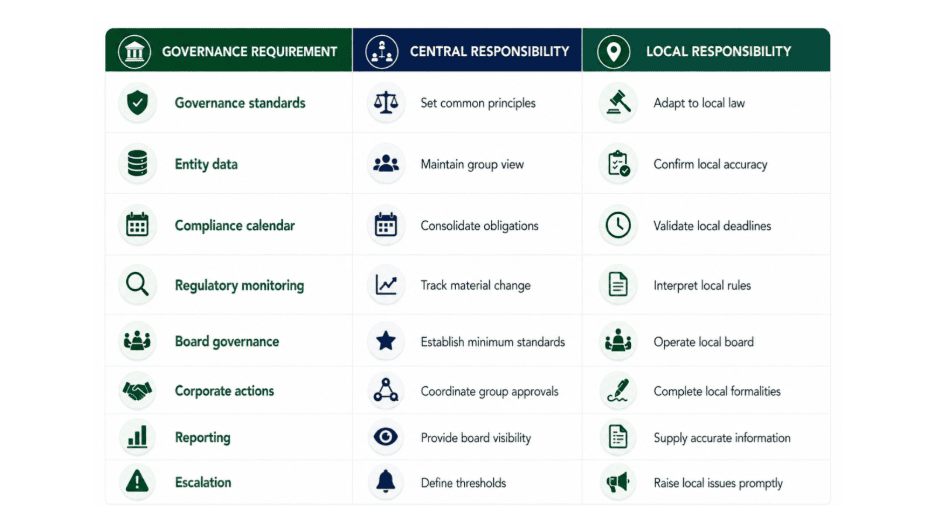
This model gives the parent organisation visibility without weakening the legal responsibilities of subsidiary boards.
The Lumorus View
Multi-jurisdiction compliance fails when organisations try to manage local complexity without a group governance system capable of seeing it.
The issue is rarely that organisations have no compliance activity.
Usually, the opposite is true. Local teams and advisers are working hard, filings are being completed and deadlines are being monitored.
The weakness appears when that activity cannot be seen centrally.
A board cannot oversee risks it does not know exist. Likewise, a Company Secretary cannot manage a global entity portfolio effectively if information arrives only when somebody remembers to provide it.
Therefore, the objective should not be to centralise every decision.
It should be to centralise visibility, standards and escalation, while allowing local professionals to manage jurisdiction-specific requirements.
Why CoSec Hub was built for this problem
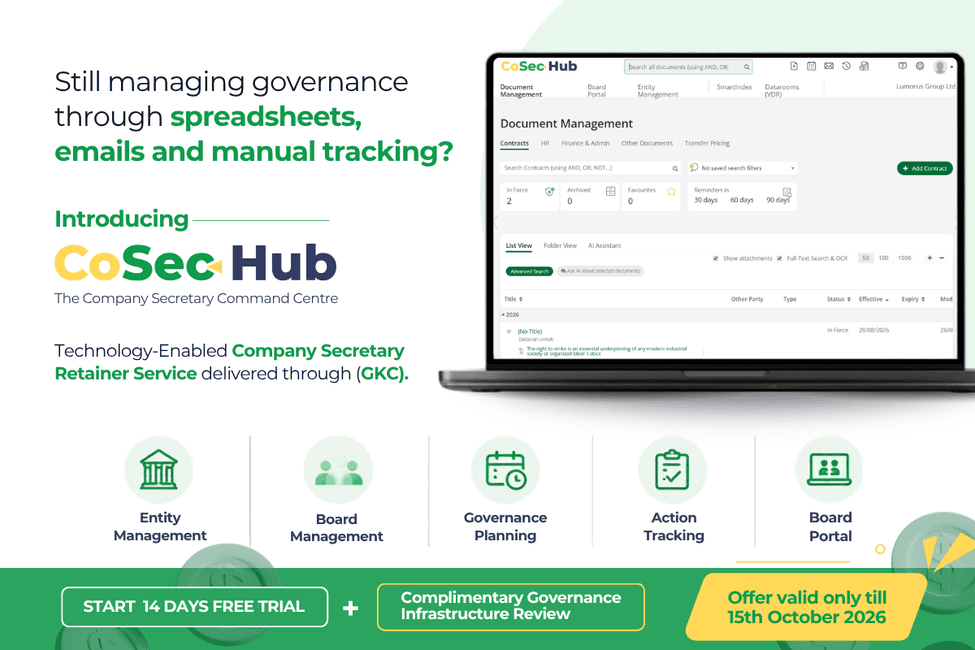
CoSec Hub was designed around the challenge of connected governance.
Its technology layer supports:
- Entity Management
- Compliance Calendars
- Governance Forward Planning
- Board Management
- Contract Management
- Statutory Registers
- Board Action Tracking
- Meeting Lifecycle Management
However, technology alone does not solve multi-jurisdiction compliance.
Therefore, the Governance Knowledge Centre provides:
- Company Secretary Expertise
- Compliance Monitoring
- Governance Operations Support
- Board Administration
- Governance Intelligence
- Multi-Jurisdiction Governance Support
- Governance Advisory
Together, they form a Technology-Enabled Company Secretary Retainer Service.
This model helps organisations combine central governance visibility with professional support across different markets.
Explore: CoSec Hub
Ten questions to test your current compliance model
Boards, General Counsel and Company Secretaries can use the following questions as a practical diagnostic:
- Do we have one accurate list of every legal entity in the group?
- Can we see upcoming compliance obligations across all jurisdictions?
- Who owns regulatory horizon scanning in each country?
- Are local advisers working within one group governance framework?
- Can we identify overdue actions without requesting manual updates?
- Do central and local director and ownership records agree?
- Are board decisions linked to resulting filings and statutory changes?
- Can we retrieve evidence of compliance quickly?
- Does governance continue effectively when key individuals are unavailable?
- Can the board see material exceptions without reviewing every local obligation?
If several answers are uncertain, the organisation probably needs stronger governance infrastructure rather than simply more administrative support.
When should an organisation consider outsourcing?
Not every organisation needs a large internal Company Secretary team.
Outsourcing can be useful when:
- The group is entering several new jurisdictions
- Internal teams lack local expertise
- Compliance has become too operationally demanding
- Entity records are fragmented
- Governance depends heavily on one individual
- Local advisers require better coordination
- Leadership needs stronger group reporting
- Compliance technology needs to be introduced
Professional Company Secretary Outsourcing can help organisations scale governance capacity without building a large internal team in every market.
However, outsourcing does not remove accountability.
The organisation still needs clear ownership of governance and effective oversight of the provider.
That distinction is crucial.
The Bottom Line
Multi-jurisdiction compliance is difficult because regulation, corporate law and governance practice remain local while organisations increasingly operate globally.
The external complexity cannot be eliminated.
However, internal fragmentation can.
Organisations can establish common governance standards, maintain one reliable entity record, centralise compliance visibility and introduce clear escalation processes. At the same time, local Company Secretaries and advisers can provide the jurisdiction-specific knowledge required to comply with local law.
This creates a more resilient model.
TMF Group’s 2026 Global Business Complexity Index reinforces the underlying challenge: cross-border businesses are operating in an environment shaped by frequent regulatory change, geopolitical uncertainty and different levels of administrative complexity. (tmf-group.com)
The boards best positioned to manage this environment will not be those that try to remove every local difference, they will be the boards capable of seeing those differences clearly and governing them consistently.
Cross-border growth should increase the organisation’s footprint. It should not reduce its governance visibility.
Continue Exploring
- For stronger group governance: Corporate Governance Support
- For international compliance oversight: Statutory & Regulatory Compliance
- For board and shareholder governance: Board & Shareholder Meetings
- For new entities and international structures: Company Formation & Structuring
- For scalable external support: Company Secretary Outsourcing
- For stronger annual governance reporting: Annual Report Services
- For clearer board decision records: Minute Taking Solutions
Lumorus: Better Business, Built on Purpose
Lumorus is a UK headquartered global governance, ESG, company secretary and advisory firm supporting organisations across Europe, Africa, Asia, the Caribbean, Canada, the Middle East and international markets.
For more than 10 years, we have helped boards, leadership teams and organisations strengthen governance, accountability and organisational resilience.
For organisations operating across several jurisdictions, good governance requires more than ensuring that individual subsidiaries meet local filing requirements. It requires clear group oversight, reliable entity information, experienced Company Secretaries and governance infrastructure capable of keeping pace as the organisation grows.
Can your board see the compliance position of the entire group clearly, or does the answer still depend on separate spreadsheets, local advisers and individual memory?
Contact Lumorus to explore how our company secretary services and CoSec Hub can help move your organisation from fragmented multi-jurisdiction compliance to connected, visible and board-ready governance.
Email: [email protected]
CoSec Hub + Governance Knowledge Centre: Where Automation Meets Governance Authority.
Sources
- TMF Group – Global Business Complexity Index 2026, covering 81 jurisdictions and 292 business complexity indicators. (tmf-group.com)
- TMF Group – Analysis of regulatory fragmentation and internal complexity in cross-border business. (tmf-group.com)
- TMF Group – 2026 research on local reporting complexity and shared-service environments. (tmf-group.com)
- OECD – The Governance of Company Groups, including the balance between parent oversight and subsidiary board duties. (oecd.org)
- G20/OECD Principles of Corporate Governance – Guidance on governance, controls and accountability across enterprise groups. (oecd.org)
- Companies House – UK director, PSC and overseas company identity verification requirements. (gov.uk)
- Companies House – Identity verification requirements for directors of overseas companies registered in the UK. (gov.uk)
- European Union – EU anti-money laundering regulation and beneficial ownership requirements. (eur-lex.europa.eu)