


Governance expectations for NGOs and nonprofits are rising rapidly.
Donors, regulators, grant providers, international partners and stakeholders increasingly expect nonprofit organisations to demonstrate stronger governance oversight, compliance coordination and accountability systems.
At the same time, many NGOs continue managing governance manually through spreadsheets, emails, shared drives, and fragmented administrative processes.
That model is becoming increasingly difficult to sustain.
Modern nonprofits now manage growing complexity across:
- Board Governance
- Grant Compliance
- Regulatory Reporting
- Multi Country Operations
- Governance Documentation
- Stakeholder Accountability
- Risk Oversight
- Meeting Coordination
- Entity Management
- Audit Readiness
This is why company secretary and governance platforms are becoming strategically important for NGOs and nonprofits entering 2026.
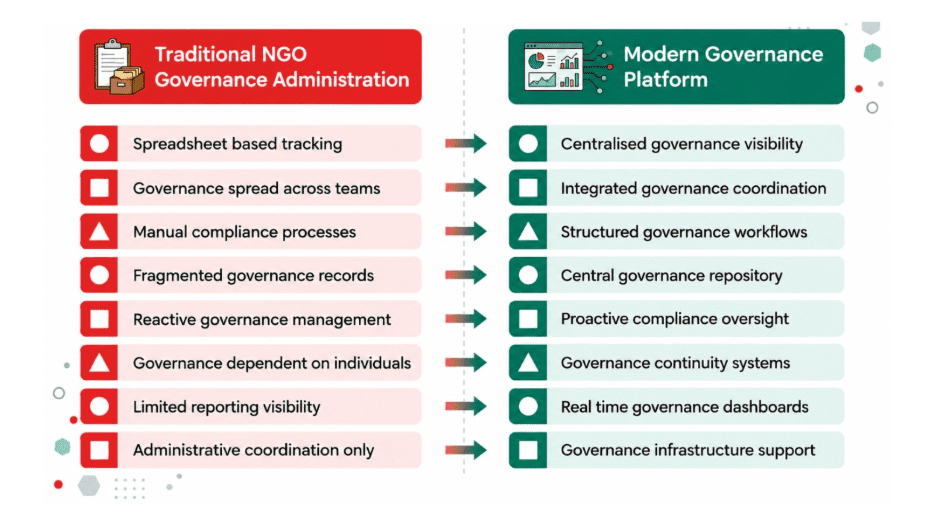
The strongest organisations are moving away from fragmented governance administration towards more connected governance infrastructure.
Why nonprofits need stronger governance systems
Many NGOs historically operated with lean governance structures focused primarily on programme delivery.
As organisations scale, however, governance pressure increases significantly.
Boards become more active. Reporting requirements expand. Compliance obligations multiply. Donor scrutiny intensifies. International operations create additional complexity.
This often exposes governance weaknesses including:
- Fragmented Governance Records
- Weak Compliance Visibility
- Manual Approval Processes
- Poor Audit Trails
- Governance Dependence on Individuals
- Inconsistent Board Documentation
- Limited Governance Coordination
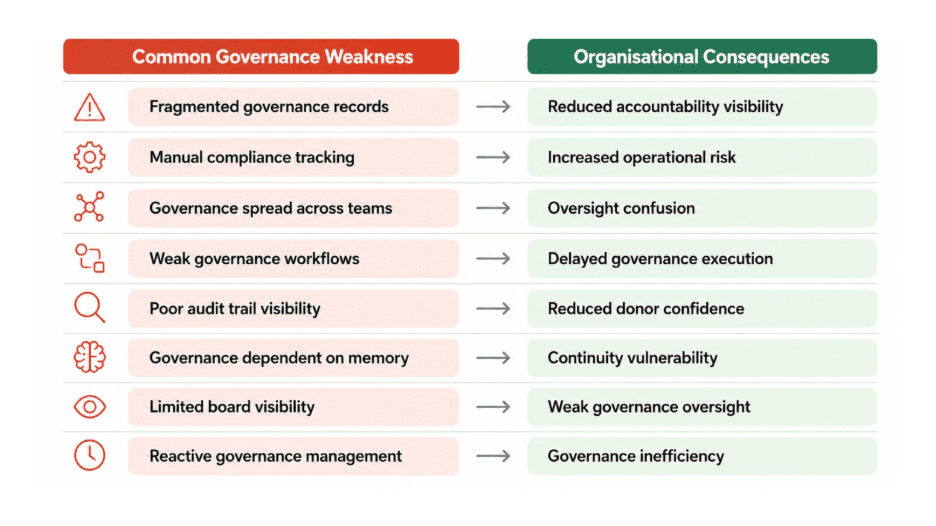
These issues create operational and reputational risk.
For nonprofits, governance credibility increasingly affects:
- Donor Confidence
- Grant Eligibility
- Regulatory Trust
- Funding Opportunities
- Stakeholder Reputation
- Organisational Resilience
This is why governance systems are becoming just as important as programme systems inside many nonprofit organisations.
What NGOs should look for in company secretary software
Many governance tools focus heavily on corporate compliance administration without considering nonprofit governance realities.
Strong company secretary platforms for NGOs increasingly need to support:
- Board Meeting Coordination
- Governance Workflow Management
- Regulatory Compliance Tracking
- Governance Audit Trails
- Document Management
- Governance Visibility
- Accountability Tracking
- Multi Entity Oversight
- Board Reporting
- Governance Continuity
This matters because governance inside nonprofits increasingly requires operational coordination, not simply record keeping.
Boards and leadership teams need stronger visibility into governance status, compliance obligations and organisational accountability.
Modern governance software helps organisations answer critical governance questions quickly:
- Which compliance actions remain outstanding?
- Are governance approvals fully documented?
- Can audit trails be evidenced properly?
- Which governance tasks require escalation?
- Is governance visibility centralised?
- Are board records consistently maintained?
Why CoSec Hub is emerging as a strong option for nonprofits
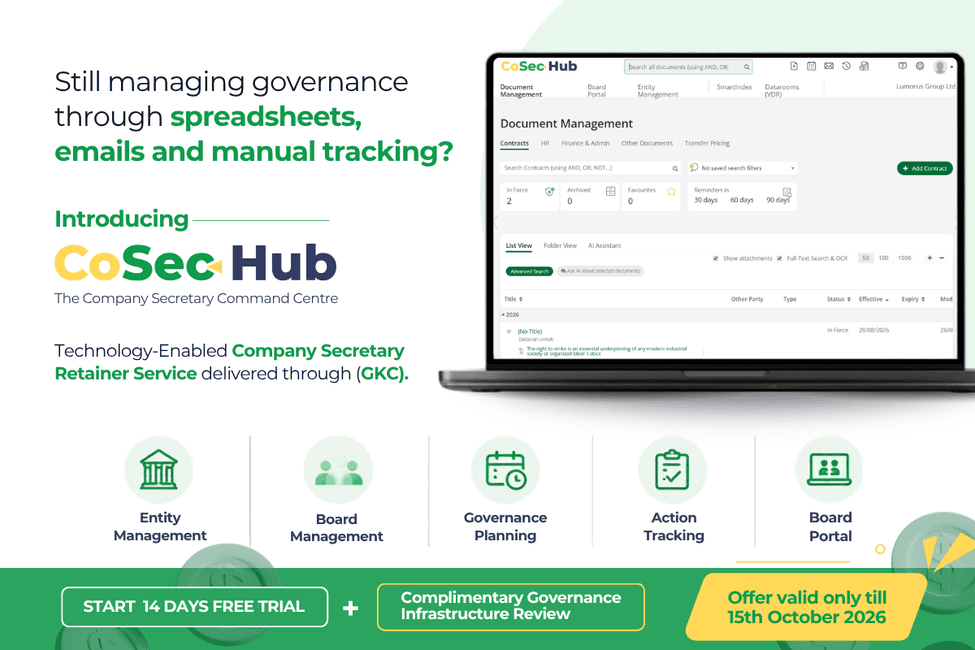
One governance platform increasingly attracting attention in this space is CoSec Hub.
Unlike many traditional company secretary systems focused mainly on filing reminders and static document storage, CoSec Hub is designed more broadly as a governance operations platform.
This makes it particularly relevant for NGOs and nonprofits managing governance complexity across multiple programmes, entities, stakeholders and jurisdictions.
CoSec Hub supports:
- Governance Workflows
- Board Administration
- Compliance Coordination
- Governance Visibility
- Accountability Tracking
- Governance Audit Trails
- Entity Management
- Governance Continuity
The platform allows nonprofit governance teams to centralise governance operations through connected workflows and structured oversight systems rather than fragmented administration.
This becomes increasingly valuable as nonprofits face growing expectations around transparency, accountability and operational governance maturity.
Explore CoSec Hub
Governance technology is becoming essential for nonprofit resilience
The broader governance trend entering 2026 is clear.
Nonprofits increasingly require governance infrastructure capable of supporting accountability, transparency and operational resilience at scale.
This is especially important for organisations operating internationally, managing multiple programmes or working within heavily regulated funding environments.
Governance technology is increasingly helping nonprofits strengthen:
- Donor Reporting
- Governance Transparency
- Compliance Coordination
- Board Oversight
- Organisational Accountability
- Audit Preparedness
- Governance Continuity
- Stakeholder Trust
As scrutiny increases globally, governance capability is becoming a competitive advantage for nonprofits seeking long term sustainability and funding confidence.
Why governance infrastructure matters for nonprofit growth
Many nonprofits focus heavily on programme impact while governance systems remain underdeveloped underneath the surface.
But governance quality increasingly influences whether organisations can scale sustainably, attract funding and maintain stakeholder trust.
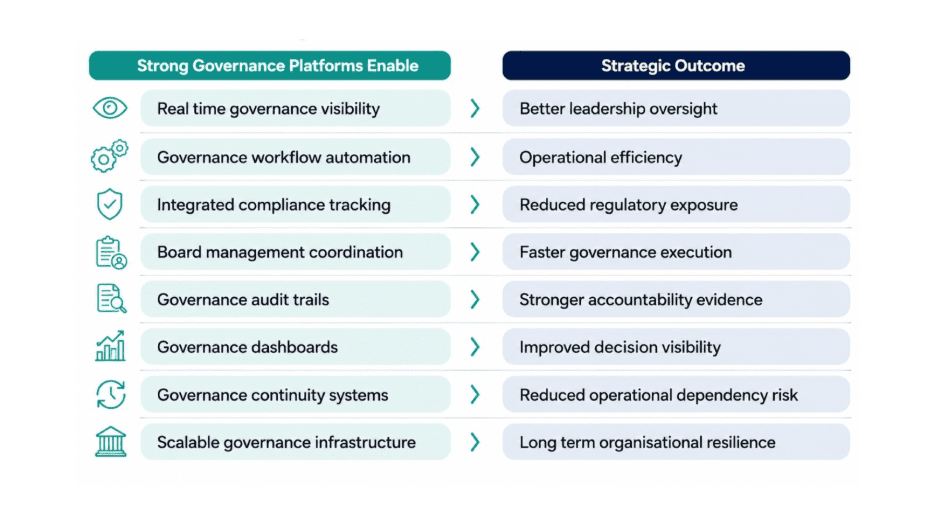
Strong governance systems help nonprofits operate with:
- Better Accountability
- Stronger Oversight
- Greater Transparency
- Faster Governance Coordination
- Improved Compliance Confidence
- Stronger Board Visibility
- Better Organisational Resilience
This is why governance platforms like CoSec Hub are becoming increasingly relevant for modern NGOs and nonprofit organisations.
Because governance today is no longer simply administrative support.
It is operational infrastructure.
The future of nonprofit governance is connected governance
Boards and nonprofit leadership teams should ask an important question: is our governance infrastructure strong enough for the complexity, scrutiny and accountability we now face?
If the answer is uncertain, governance systems may need to evolve alongside organisational growth.
As nonprofit operations become more complex, governance cannot continue depending entirely on spreadsheets, fragmented administration and institutional memory alone.
It requires connected, auditable and operationally resilient governance infrastructure.
CoSec Hub was built to help organisations move from fragmented governance administration towards more structured governance operations capable of supporting modern accountability expectations.
To learn more, visit:
cosec.lumorus.com
lumorus.com
[email protected]
About CoSec Hub
CoSec Hub is the governance command centre for the modern company secretary.
Designed for growing businesses, multinational organisations, NGOs and regulated entities, CoSec Hub helps organisations centralise governance operations, strengthen compliance visibility and manage multiple entities through connected, auditable and board-ready governance infrastructure.
Lumorus: Better Business, Built on Purpose
Lumorus is a UK headquartered global governance, company secretarial, ESG and advisory firm supporting organisations across Europe, Africa, Asia, the Caribbean, Canada and other international markets.
For more than 10 years, we have helped boards, leadership teams and organisations strengthen governance, accountability and organisational resilience.
Is your governance infrastructure strong enough for the complexity, scrutiny and accountability you now face?
Contact Lumorus to request a Governance Infrastructure Assessment and explore how CoSec Hub can help your organisation move from fragmented administration to connected, compliant and board-ready governance.
CoSec Hub: cosec.lumorus.com
Lumorus: lumorus.com
Email: [email protected]
CoSec Hub, powered by Lumorus: the command centre for the modern company secretary.