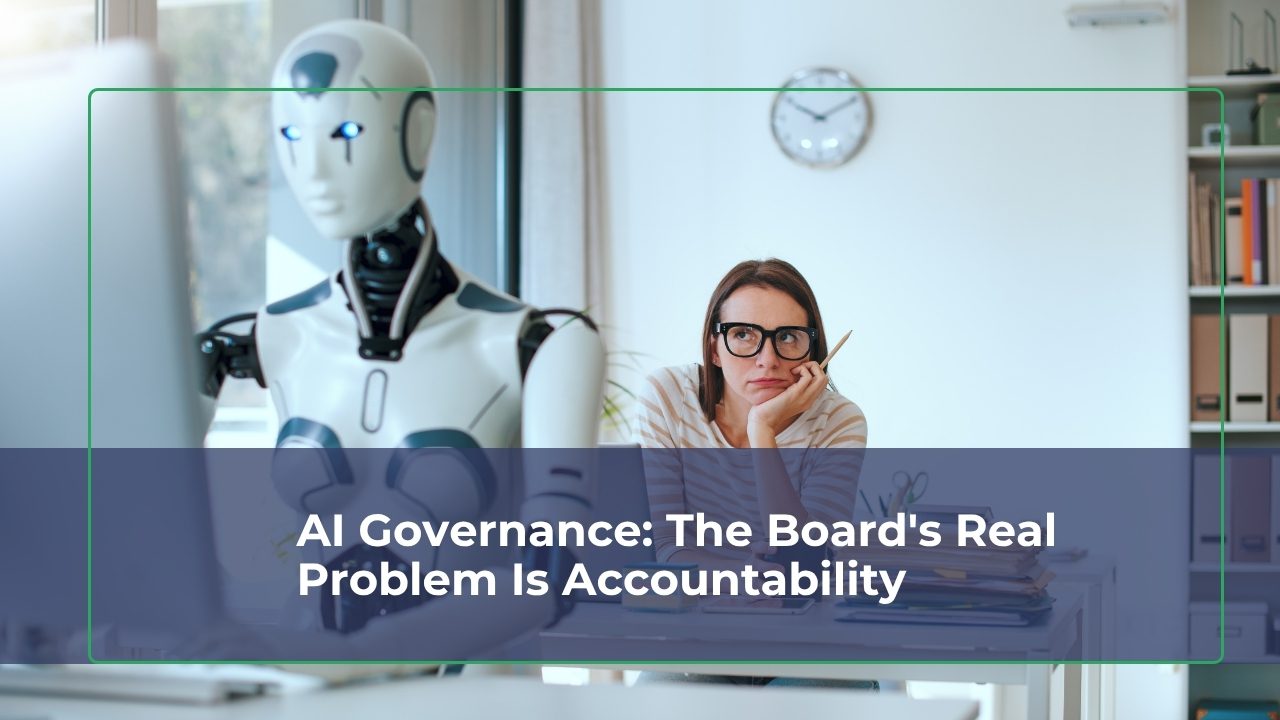



Most organisations still think about AI as software.
That assumption is already becoming outdated.
The next wave of artificial intelligence is moving beyond digital interfaces and into the physical world through robotics, autonomous systems, intelligent machines, and AI powered operational infrastructure.
Physical AI could become one of the most commercially transformative technology shifts since the internet because it allows AI not only to analyse environments, but to interact with them physically in real time.
This changes the governance equation entirely.
Software based AI primarily affects information, data, and decision support. Physical AI affects operations, safety, accountability, labour structures, infrastructure resilience, and real world execution. It introduces governance questions many boards are still completely unprepared to answer.
Who is accountable when autonomous systems fail?
What happens when AI controls operational infrastructure directly?
How should boards oversee AI systems capable of independent physical action?
What governance frameworks exist for machine decision making in the physical environment?
For many organisations, the honest answer is none.
This is why physical AI is not simply a technology shift.
It is becoming a governance infrastructure challenge.
Why Physical AI Changes the Governance Conversation
Most AI governance discussions still focus heavily on software risk, data ethics, and algorithmic bias. Those issues remain important, but physical AI expands the governance challenge dramatically because AI systems are now beginning to interact directly with the operational world.
According to Deloitte and The Wall Street Journal, advances in robotics, automation infrastructure and AI enabled operational systems are accelerating much faster than most organisations anticipated even two years ago. Warehouses, manufacturing systems, logistics operations, healthcare environments and infrastructure networks are increasingly becoming AI responsive environments.
This creates a fundamentally different governance challenge.
When AI begins influencing physical operations directly, governance failures are no longer limited to digital consequences. They can create operational disruption, workplace safety incidents, infrastructure failures, liability exposure, and reputational damage simultaneously.
That means governance systems built primarily for digital oversight are increasingly becoming insufficient.
What Physical AI Actually Means
Physical AI refers to artificial intelligence systems capable of interacting with the physical environment through robotics, sensors, autonomous systems and machine driven operational execution.
This includes technologies such as:
- Autonomous robotics
- AI powered logistics systems
- Intelligent manufacturing infrastructure
- Autonomous mobility systems
- Smart warehouses
- AI enabled industrial operations
- Human machine operational environments
- Sensor driven infrastructure systems
According to Future Scouting’s analysis of the physical AI landscape, the convergence of AI, robotics, sensors and real time environmental processing is rapidly accelerating enterprise adoption across multiple industries simultaneously.
The governance implications are enormous because physical AI collapses the boundary between digital intelligence and operational execution.
AI is no longer simply advising organisations.
It is beginning to act within them.
Traditional AI vs Physical AI
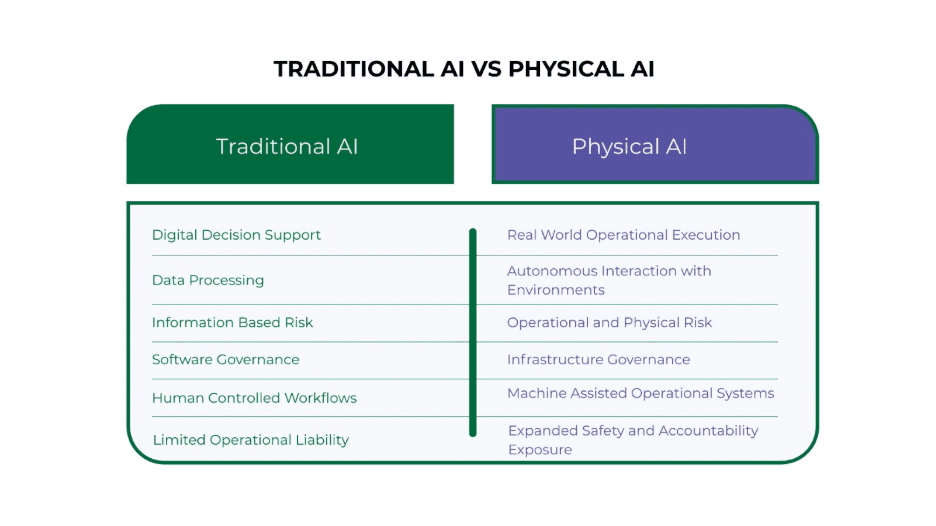
Key Insight:
Physical AI transforms AI from a software issue into an operational governance issue.
Why Most Governance Systems Are Not Prepared
Most governance systems were not designed for autonomous operational environments.
Boards, governance teams and regulatory structures still largely operate using oversight models built for human directed operational systems. Physical AI introduces decision velocity, operational complexity and accountability challenges that many governance frameworks currently struggle to accommodate.
This creates several immediate governance gaps:
- Weak accountability ownership
- Limited oversight visibility
- Poor operational traceability
- Unclear escalation frameworks
- Insufficient AI governance controls
- Fragmented regulatory readiness
- Weak cross functional governance coordination
According to BCG, organisations adopting physical AI successfully are increasingly those building governance capability alongside technological capability rather than after deployment.
This distinction matters enormously.
Technology evolves exponentially. Governance systems usually evolve incrementally.
That creates institutional vulnerability during periods of rapid technological transformation.
The Governance Risks Physical AI Creates
Physical AI creates opportunities for efficiency, productivity, and operational optimisation. But it also creates governance risks many organisations still underestimate.
These risks increasingly include:
- Autonomous operational failures
- Safety and liability exposure
- Weak accountability structures
- Decision traceability gaps
- Regulatory noncompliance
- Operational resilience risks
- Infrastructure dependency exposure
- Human oversight failures
One of the most dangerous assumptions organisations make is believing physical AI risk is primarily technical.
In reality, many failures are likely to emerge through weak governance architecture, fragmented accountability systems, and poor oversight coordination.
This is consistent with broader governance research showing operational failures often originate through governance weakness long before visible crisis emerges.
According to Deloitte, organisations adopting physical AI will increasingly need governance systems capable of supporting operational transparency, cross functional accountability and continuous oversight at scale.
Why Physical AI Is Becoming a Board Level Issue
Physical AI is not simply an operational technology issue.
It is becoming a board level governance issue because it directly affects organisational accountability, operational resilience, and enterprise risk exposure.
Boards increasingly need visibility into:
- AI enabled operational systems
- Governance accountability structures
- Infrastructure resilience
- Human oversight controls
- Operational escalation frameworks
- Regulatory exposure
- Ethical governance boundaries
- Risk ownership models
This is particularly important for organisations operating across regulated environments, infrastructure intensive industries and multinational operational structures where AI related failures could create significant commercial and reputational consequences.
As AI moves into physical operational environments, governance oversight can no longer remain disconnected from technological infrastructure.
What High Performing Organisations Will Do Differently
The strongest organisations are unlikely to treat physical AI as purely a technology deployment exercise.
They will treat it as governance infrastructure transformation.
High performing organisations will increasingly focus on:
- Governance by design
- Clear accountability systems
- AI oversight frameworks
- Operational transparency
- Human escalation controls
- Infrastructure resilience
- Cross functional governance integration
- Real time governance visibility
Research increasingly suggests organisations creating the greatest long term value from AI are those integrating governance maturity into operational transformation from the beginning rather than retrofitting governance later.
This is where many organisations will struggle.
Because operational ambition is currently moving faster than governance preparedness.
Weak AI Governance vs Strong AI Governance
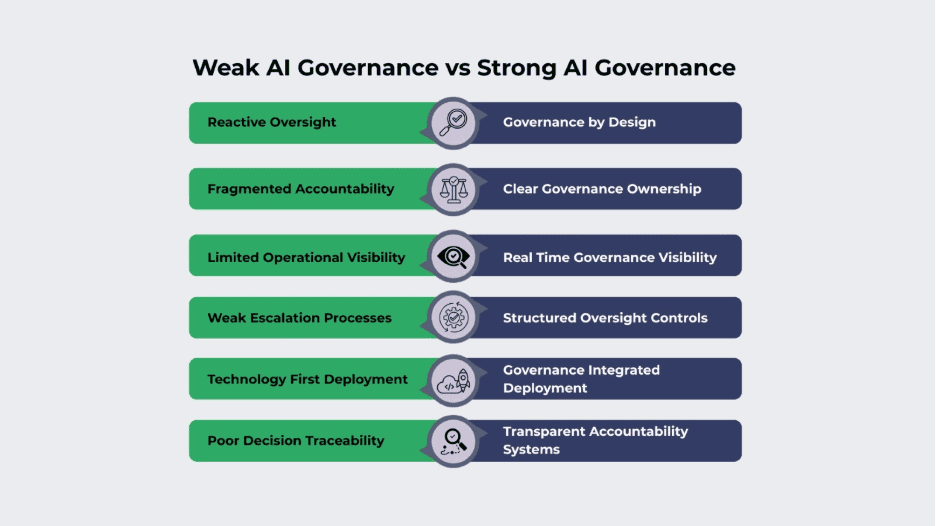
Physical AI Governance Maturity Model
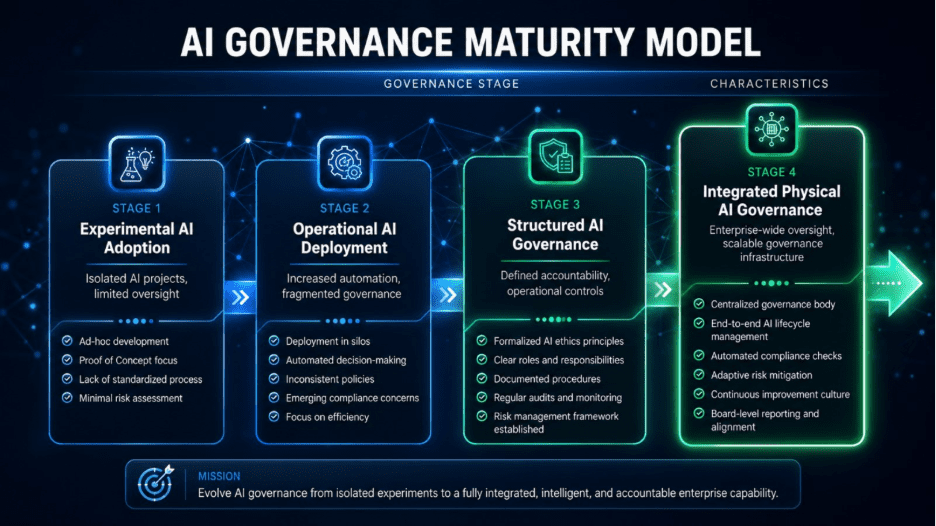
High Performing Organisations Treat AI Governance as Operational Infrastructure
The strongest organisations increasingly recognise that governance systems must evolve alongside technological systems.
Physical AI environments require governance models that are:
- Structured
- Scalable
- Transparent
- Operationally resilient
- Cross functionally integrated
- Accountable in real time
This is particularly important for logistics, manufacturing, infrastructure, healthcare, mining, energy, and multinational operational sectors where AI systems increasingly influence physical execution directly.
AI capability without governance capability creates operational exposure.
AI capability supported by governance infrastructure creates institutional resilience.
Why Lumorus Focuses on Governance Infrastructure and Accountability
Lumorus is a UK headquartered global governance, ESG and advisory firm supporting organisations across Africa, Europe, Asia, the Caribbean, Canada and other international markets.
For more than 10+ years, Lumorus has supported boards, leadership teams and regulated organisations across governance transformation, board effectiveness, governance infrastructure and organisational accountability.
As organisations adopt AI driven operational systems, our work increasingly focuses on helping organisations strengthen:
- Governance infrastructure
- AI governance frameworks
- Accountability systems
- Operational oversight capability
- Governance visibility
- Risk escalation structures
- Organisational resilience
- Board governance readiness
We believe governance systems must evolve at the same speed as technological capability.
Because operational intelligence without governance discipline eventually creates institutional vulnerability.
Explore more: www.lumorus.com/capabilities/corporate-governance
CTA
At Lumorus, we believe Being Good is Better for Business.
We help organisations lead with integrity, govern with confidence, and create value that lasts. Through our work across Governance Advisory, Company Secretary Service and ESG-Social Impact Consulting, we support boards, executives and leadership teams to strengthen accountability, improve decision making and build resilient, responsible organisations.
With offices and expert teams across the UK, Africa, the Caribbean, Latin America and Canada, and clients operating globally, Lumorus brings international perspective, specialist expertise and practical judgement to every engagement.
Whether you are strengthening governance, enhancing board oversight, meeting company secretary responsibilities or building a more purposeful organisation, Lumorus is here to help you move from intention to action.
Together, we can build better business: one that performs with purpose, leads with integrity and creates lasting value for people, planet and profit.
To continue the conversation, visit www.lumorus.com or contact [email protected]
Sources
- Boston Consulting Group — The CEO’s Guide to Physical AI
https://www.bcg.com/publications/2026/the-ceos-guide-to-physical-ai
- Deloitte x Wall Street Journal — The Moment for Physical AI May Be Closer Than You Think
https://deloitte.wsj.com/ceo/the-moment-for-physical-ai-may-be-closer-than-you-think-fe2e8858
- Future Scouting — The Definitive Guide to Physical AI
https://futurescouting.substack.com/p/the-definitive-guide-to-physical