


The purpose of a board review is not to make directors feel comfortable
It is to make boards more effective.
Yet many board evaluations fail to achieve that objective.
Reports are produced.
Surveys are completed.
Interviews are conducted.
Recommendations are presented.
The board notes the findings.
The exercise concludes.
Little changes.
This is one of the least discussed realities in corporate governance.
Many board reviews are designed to avoid discomfort rather than reveal uncomfortable truths.
As a result, they often identify symptoms rather than causes, observations rather than weaknesses and opportunities rather than failures.
Everyone leaves the process reassured.
Few leave challenged.
And that is precisely the problem.
According to the UK Financial Reporting Council’s Guidance on Board Effectiveness, board evaluations should support continuous improvement, robust challenge and board effectiveness. Yet in practice, many reviews fall short of this ambition because they prioritise consensus over candour.
Read More: Governance Review
Most board reviews answer the wrong question
Many evaluations focus on questions such as:
- Are board meetings effective?
- Is information received on time?
- Are committee structures appropriate?
- Are directors satisfied with board processes?
These questions matter.
But they rarely address the deeper governance issues.
The more important questions are often avoided.
Questions such as:
- Is the board challenging management effectively?
- Are directors avoiding difficult conversations?
- Is the chair enabling challenge or suppressing it?
- Are underperforming directors being tolerated?
- Is the board adding strategic value?
- Does the board have the courage to confront uncomfortable risks?
These questions move beyond administration.
They examine power, accountability and behaviour.
And that is where governance effectiveness is truly determined.
The board review industry has a candour problem
A difficult truth exists within many board evaluation processes.
The people conducting the review often depend on maintaining positive relationships with the people being reviewed.
This creates an inherent tension.
According to research published by the Harvard Law School Forum on Corporate Governance, board evaluations frequently struggle to generate meaningful behavioural change because directors may be reluctant to provide candid feedback regarding peers, chairs or influential board members.
The result is predictable.
Reviews become carefully worded.
Findings become diluted.
Recommendations become generic.
Everyone understands the underlying issues.
Nobody says them explicitly.
This creates what might be called governance diplomacy.
Polite.
Constructive.
Professional.
And frequently ineffective.
The most important governance issues are often the least likely to appear in the report
Many governance failures originate in areas that formal reviews rarely examine rigorously.
For example:
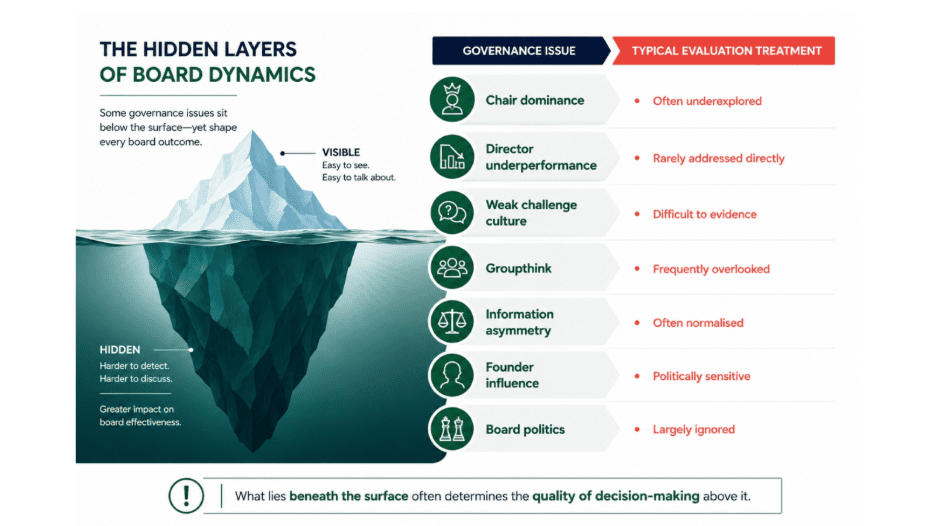
These issues are difficult because they involve people, influence and power.
Yet governance is ultimately about the allocation, exercise and accountability of power.
A board review that ignores power dynamics is often missing the most important part of the governance picture.
Boards rarely fail because of process
Most boards already have:
- Terms of reference
- Governance frameworks
- Meeting schedules
- Committee structures
- Board papers
- Governance policies
The problem is rarely the absence of process.
The problem is usually the quality of oversight.
According to the OECD Principles of Corporate Governance, effective governance depends not only on structures but on the quality of board judgement, accountability and oversight.
This distinction matters.
A board can comply with governance requirements while still making poor decisions.
It can meet regularly while avoiding difficult issues.
It can receive information without asking challenging questions.
Process is important.
Performance is more important.
The most effective board reviews make people uncomfortable
Not because they are confrontational.
Because they are honest.
Effective evaluations create space to discuss:
- Weaknesses
- Blind spots
- Behavioural dynamics
- Governance risks
- Leadership effectiveness
- Board culture
This requires trust.
It also requires independence.
According to the Chartered Governance Institute UK & Ireland, board evaluations deliver the greatest value when they provide objective challenge and facilitate meaningful reflection rather than simply validating existing practices.
Boards should not seek reassurance from evaluations.
They should seek insight.
Those are not the same thing.
The real test of a board review is what happens afterwards
Many boards judge evaluations by the quality of the report.
They should judge them by the quality of the changes that follow.
Questions worth asking include:
- Were difficult issues identified?
- Were actions implemented?
- Did board behaviour change?
- Did oversight improve?
- Did accountability increase?
- Did decision-making strengthen?
If the answer is no, the evaluation may have been informative but not effective.
Governance improvement requires action.
Not merely observation.
Why independent challenge matters
One of the most important functions of governance is constructive challenge.
The same principle applies to governance reviews.
Boards benefit from advisers willing to ask difficult questions.
Not because criticism is valuable in itself.
But because organisational blind spots rarely disappear on their own.
The strongest boards are not those that avoid criticism.
They are those that seek it.
Because mature boards understand that governance effectiveness is not measured by how comfortable directors feel.
It is measured by how effectively they govern.
Board evaluations should strengthen governance, not protect egos
The future of board effectiveness depends on boards becoming more willing to examine uncomfortable realities.
Regulatory expectations are increasing.
Stakeholder scrutiny is growing.
Governance risks are becoming more complex.
In this environment, superficial evaluations offer limited value.
Boards need reviews capable of examining culture, accountability, information flows, decision-making and oversight quality.
That requires honesty.
It requires independence.
And occasionally, it requires saying things that influential people may not want to hear.
Because the purpose of a board review is not to protect reputations.
It is to improve governance.
And governance improves when truth is prioritised over comfort.
Read More: Board Evaluation.
Lumorus: Better Business, Built on Purpose
At Lumorus, we believe governance is not paperwork.
It is the allocation, exercise, constraint and accountability of power inside organisations.
Lumorus is a global governance, ESG, company secretarial and advisory firm helping boards, executives and organisations strengthen governance effectiveness, accountability and long-term value creation.
Our governance expertise includes:
We help boards move beyond compliance towards genuine governance performance.
Together, we can build better business: one that performs with purpose, leads with integrity and creates lasting value.