


Most organisations can describe what they did. Few can prove what changed.
That is the uncomfortable truth at the centre of modern social impact reporting.
Across the corporate sector, NGOs, foundations, development organisations and public institutions, significant resources are invested in programmes designed to create social value.
Annual reports showcase community initiatives.
ESG reports highlight social investments.
Impact reports contain case studies, beneficiary stories and programme statistics.
Yet when boards, investors, funders or regulators ask a simple question, many organisations struggle to provide a convincing answer.
What measurable change occurred because of these activities?
The challenge is not a lack of commitment.
The challenge is a lack of evidence.
According to the Global Impact Investing Network (GIIN), investors are increasingly demanding outcome-focused impact measurement rather than activity-based reporting. The expectation is shifting from demonstrating effort to demonstrating results.
This is creating a growing accountability gap.
Many organisations are reporting social impact.
Far fewer are proving it.
Read More: ESG Accountability & Measurable Impact
The social impact reporting problem nobody wants to admit
Most social impact reports are still largely focused on activity.
They tell stakeholders:
- How much money was invested
- How many people attended a programme
- How many events were delivered
- How many partnerships were formed
- How many volunteer hours were completed
These metrics are easy to collect.
They are also often insufficient.
The fundamental question is not whether an activity occurred.
The question is whether the activity created meaningful and measurable change.
According to the International Finance Corporation (IFC), organisations frequently struggle to move beyond output measurement towards impact measurement because governance systems, data collection processes and accountability structures are often underdeveloped.
This creates an uncomfortable possibility.
Some organisations may be reporting social activity rather than social impact.
Reporting outputs is not the same as reporting outcomes
One of the most persistent weaknesses in social impact reporting is the confusion between outputs and outcomes.
Outputs measure activity.
Outcomes measure change.
The distinction matters.
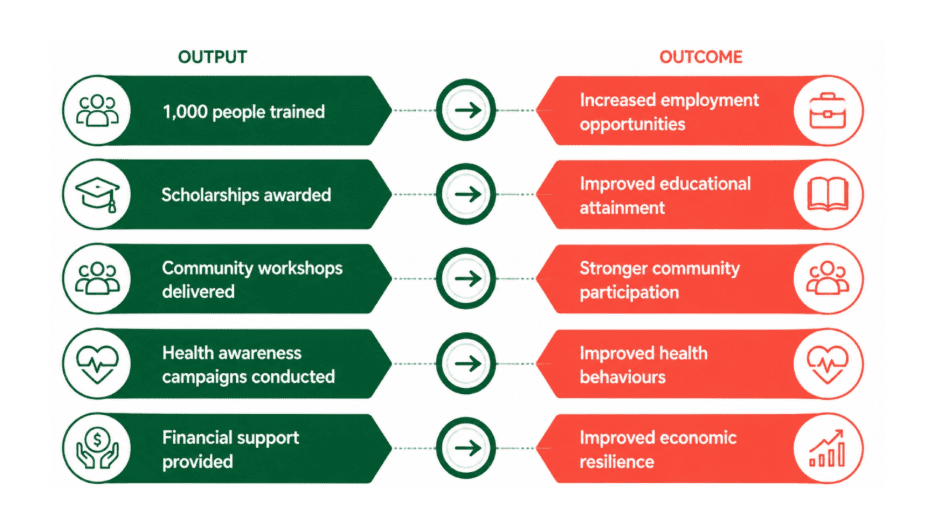
Many organisations stop at the output stage.
It is understandable.
Outputs are easier to measure.
Outcomes are more complex.
Yet stakeholders increasingly want evidence of outcomes.
According to the OECD, demonstrating outcomes and long-term impact remains one of the most significant challenges in sustainability and social value reporting because social change is often influenced by multiple factors beyond an organisation’s direct control.
Complexity does not remove accountability.
It makes accountability more important.
Social impact reporting has become more sophisticated than social impact governance
Over the past decade, organisations have invested heavily in ESG reporting frameworks.
Reports have become longer.
Metrics have become more detailed.
Disclosure standards have become more sophisticated.
Yet governance systems have often failed to keep pace.
Many organisations have sustainability teams.
Many have ESG reporting processes.
Many publish social impact reports.
Far fewer have:
- Board oversight of social impact
- Clear accountability structures
- Impact governance frameworks
- Outcome measurement methodologies
- Long-term impact monitoring systems
This creates a dangerous imbalance.
The reporting often appears stronger than the governance behind it.
According to the World Economic Forum, one of the most significant challenges facing organisations is ensuring that sustainability commitments are supported by governance structures capable of driving implementation and accountability.
Without governance, reporting risks becoming an exercise in communication rather than evidence.
Read More: Sustainability & Responsibility
Data remains the weakest link
Many organisations collect large amounts of data.
The problem is that they often collect the wrong data.
Common challenges include:
- Inconsistent measurement approaches
- Weak baseline data
- Poor beneficiary feedback mechanisms
- Limited long-term tracking
- Lack of outcome indicators
- Inadequate data governance
As a result, organisations frequently find themselves unable to answer fundamental questions.
Did lives improve?
Did behaviour change?
Did opportunities increase?
Did the intervention create lasting value?
According to PwC, stakeholders increasingly expect organisations to provide measurable evidence of social value creation rather than relying on programme descriptions and anecdotal success stories.
Good intentions are no longer enough.
Evidence matters.
Many boards are receiving social impact reports that tell them very little
Board oversight of social impact remains underdeveloped in many organisations.
Reports often focus on activity metrics rather than strategic insight.
Directors may receive information about:
- Programme participation
- Financial expenditure
- Volunteer engagement
- Partnership activity
But receive limited information regarding:
- Outcomes achieved
- Risks emerging
- Performance gaps
- Impact effectiveness
- Return on social investment
This creates a governance problem.
Boards cannot effectively oversee what they cannot meaningfully assess.
Good social impact governance requires information that supports challenge, oversight and decision-making.
Not simply reporting.
Read More: Board Effectiveness & Governance Advisory
Social impact reporting is becoming an accountability issue
Historically, social impact reporting was often viewed as a communications exercise.
Today it is increasingly becoming an accountability exercise.
Investors want evidence.
Funders want evidence.
Communities want evidence.
Regulators increasingly expect evidence.
According to the European Commission’s Corporate Sustainability Reporting Directive (CSRD) framework, organisations are moving towards greater transparency regarding social impacts, stakeholder outcomes and sustainability performance.
The direction of travel is clear.
Claims will increasingly need to be supported by evidence.
Narrative alone will not be enough.
What good social impact reporting looks like
The strongest organisations approach social impact reporting differently.
They begin with governance rather than reporting.
They establish:
- Clear accountability
Someone must own impact performance.
Without accountability, measurement often becomes inconsistent.
- Defined outcomes
Impact objectives should be established before programmes begin.
Success cannot be measured if success is undefined.
- Materiality
Not all social issues are equally important.
Strong organisations focus on the issues that matter most to stakeholders and organisational strategy.
Read More: Materiality Risk Assessment
- Outcome measurement frameworks
The objective is not to measure activity.
The objective is to measure change.
- Governance oversight
Boards should receive information that supports challenge, scrutiny and informed decision-making.
Strong social impact reporting is ultimately a governance discipline.
Not a communications exercise.
The future belongs to organisations that can prove impact
The social impact reporting landscape is changing rapidly.
Stakeholders are becoming more sophisticated.
Reporting expectations are increasing.
Accountability standards are rising.
The organisations that succeed will not necessarily be those with the most programmes.
They will be those with the strongest evidence.
Because the future of social impact reporting is unlikely to be defined by who tells the best story.
It will be defined by who can demonstrate the greatest impact.
And that requires something many organisations still lack.
- Measurement.
- Governance.
- Accountability.
- Evidence.
Read More
Lumorus: Better Business, Built on Purpose
At Lumorus, we believe Being Good is Better for Business.
Lumorus is a UK-headquartered global governance, ESG, social impact and advisory firm supporting organisations across Europe, Africa, Asia, the Caribbean, Canada, the Middle East and international markets.
For more than a decade, we have helped organisations strengthen governance, improve accountability and build credible ESG and social impact frameworks capable of standing up to stakeholder scrutiny.
Our expertise includes:
- Social Impact Strategy
- Social Impact Measurement & Management
- ESG Reporting & Disclosure
- Materiality Assessments
- Sustainability Strategy
- Governance Advisory
- Board Effectiveness
- Governance Infrastructure
We help organisations move beyond reporting activity towards measuring outcomes, evidencing impact and strengthening accountability.
To explore Lumorus ESG, sustainability and social impact solutions, visit:
Together, we can build better business: one that performs with purpose, leads with integrity and creates lasting value for people, planet and profit.