


Regulatory risk is no longer just a compliance issue
It is a governance issue.
For many years, regulatory compliance was viewed primarily as an operational responsibility.
File the returns.
Maintain the registers.
Meet the deadlines.
Respond to regulatory requests.
Today, the landscape is very different.
Regulators expect stronger governance.
Boards face greater scrutiny.
Stakeholders demand transparency.
Compliance failures can quickly become reputational, financial and governance failures.
For company secretaries, this means the role has evolved significantly.
The challenge is no longer simply ensuring regulatory obligations are completed.
The challenge is maintaining governance visibility across increasingly complex organisations.
According to governance professionals surveyed by Azure Group, increasing regulatory requirements, governance complexity and compliance obligations are among the most significant challenges facing modern company secretaries.
Read More: Statutory and Regulatory Compliance
Why regulatory risk is increasing
The volume of governance obligations continues to grow.
Organisations today must navigate:
- Corporate filing obligations
- Director responsibilities
- Data protection requirements
- ESG disclosures
- Board governance obligations
- Multi-jurisdiction regulations
- Stakeholder transparency expectations
- Industry-specific compliance requirements
Each new obligation increases governance complexity.
As organisations expand, so does the challenge of maintaining oversight.
According to the Chartered Governance Institute UK & Ireland, governance functions are increasingly required to provide assurance, transparency and accountability across a growing range of regulatory responsibilities.
The risk is not necessarily that organisations do not understand their obligations.
The risk is losing visibility over them.
Risk 1: Missed statutory and regulatory filings
This remains one of the most common regulatory risks.
Most organisations understand filing requirements.
The challenge is ensuring obligations are monitored consistently.
Common examples include:
- Annual returns
- Regulatory submissions
- Director updates
- Shareholder notifications
- Corporate actions
- Licence renewals
As governance complexity increases, manual monitoring becomes increasingly vulnerable.
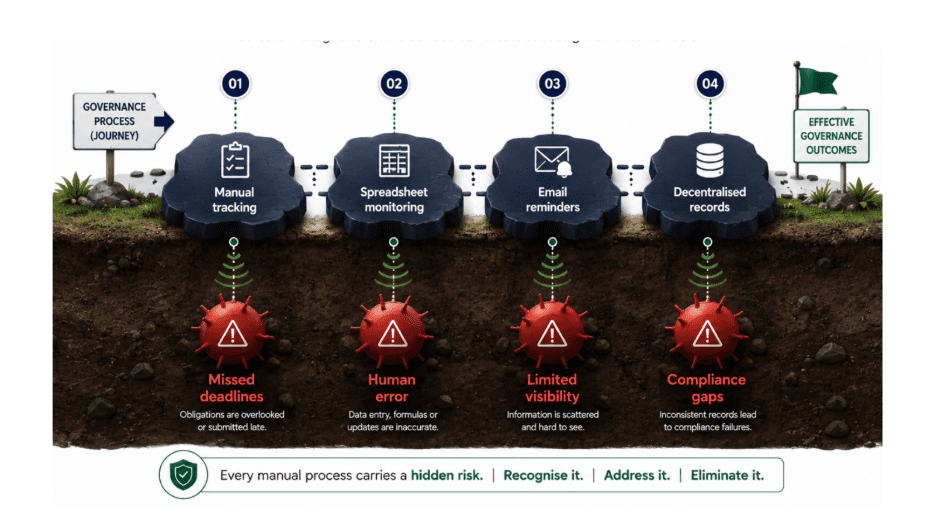
Missed filings rarely occur because obligations are unknown.
They occur because governance visibility breaks down.
Read More: Compliance Calendars
Risk 2: Poor entity management
Entity management remains one of the most overlooked sources of regulatory risk.
As organisations grow, entity structures often become more complex.
New subsidiaries are created.
Corporate restructures occur.
Directors change.
Shareholdings evolve.
Jurisdictions expand.
Without effective entity management, organisations may struggle to maintain accurate records relating to:
- Directors
- Shareholders
- Registered offices
- Statutory registers
- Corporate ownership
- Filing obligations
According to governance experts, fragmented entity information is one of the most common causes of governance inefficiency and compliance exposure.
Good governance depends on knowing exactly what entities exist and what obligations apply to each.
Risk 3: Inadequate board action tracking
Many governance risks emerge after board meetings.
A decision is made.
An action is assigned.
Implementation begins.
Monitoring becomes inconsistent.
This creates a significant governance gap.
Boards rely on effective execution.
Without board action tracking, organisations often struggle to demonstrate:
- Accountability
- Progress
- Decision implementation
- Governance oversight
Regulators increasingly expect organisations to evidence governance processes and accountability structures.
If actions cannot be tracked, governance effectiveness becomes difficult to demonstrate.
Risk 4: Regulatory obligations spread across multiple systems
One of the most common governance challenges is fragmentation.
Compliance information may sit in:
- Spreadsheets
- Shared drives
- Emails
- Individual calendars
- Local entity records
- Departmental systems
The result is often inconsistent visibility.
Different teams hold different information.
No single source of truth exists.
Governance becomes dependent on individual knowledge rather than governance infrastructure.
This creates significant operational and regulatory risk.
Risk 5: Multi-jurisdiction governance complexity
For organisations operating across multiple jurisdictions, regulatory risk increases significantly.
Different jurisdictions may require:
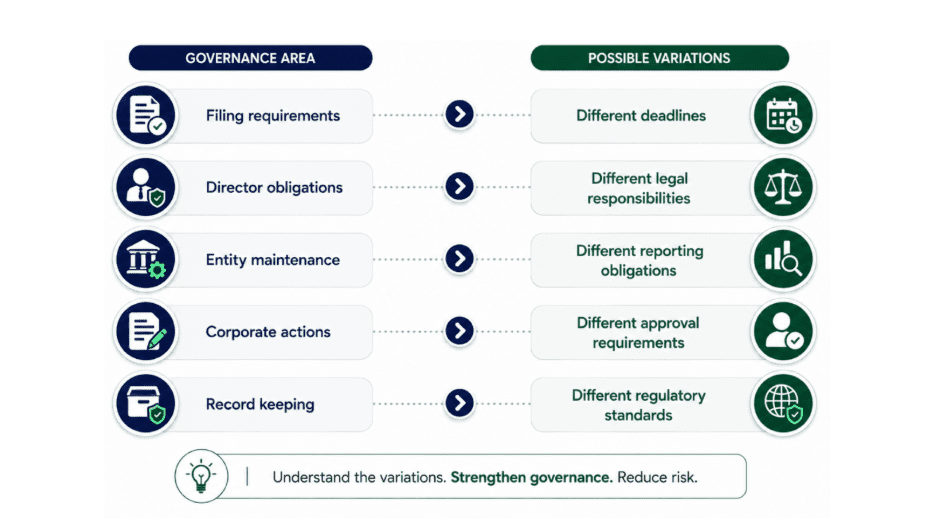
According to governance research, multi-jurisdiction compliance is becoming one of the fastest-growing challenges facing governance teams.
The issue is not simply understanding regulations.
It is coordinating governance activity consistently across different legal environments.
Risk 6: Key-person dependency
Many organisations unknowingly create governance risk by relying heavily on one individual.
Often this is the company secretary.
That individual:
- Tracks deadlines
- Maintains records
- Coordinates the board
- Monitors obligations
- Holds governance knowledge
The arrangement works until it doesn’t.
If critical governance information sits primarily with one person, governance continuity becomes vulnerable.
Strong governance should be institutionalised.
Not person dependent.
This is one of the strongest arguments for governance infrastructure.
Risk 7: Lack of governance reporting and visibility
Boards increasingly require governance intelligence.
They need visibility over:
- Compliance status
- Outstanding obligations
- Governance risks
- Entity activity
- Board actions
- Regulatory exposure
Yet many governance teams still spend significant time gathering information manually.
According to the Financial Reporting Council (FRC), effective governance depends on timely, accurate and decision-useful information.
Without governance reporting, boards often struggle to exercise effective oversight.
Visibility strengthens accountability.
Accountability strengthens governance.
The biggest regulatory risk is often not regulation itself
Many organisations assume regulatory risk is primarily about changing rules.
In reality, the bigger challenge is often governance capability.
The organisations most likely to experience compliance failures are not necessarily those facing the most regulation.
They are often those with:
- Weak governance infrastructure
- Poor visibility
- Fragmented records
- Limited accountability
- Manual governance processes
Regulatory risk is increasingly a governance issue.
Not simply a compliance issue.
Why governance teams need governance infrastructure
As regulatory expectations continue to rise, governance teams require more than compliance reminders.
They require infrastructure.
Strong governance infrastructure supports:
- Compliance Calendars
- Entity Management
- Governance Forward Planning
- Board Management
- Statutory Registers
- Board Action Tracking
- Governance Intelligence
- Meeting Lifecycle Management
These capabilities help governance teams move from reactive compliance monitoring towards proactive governance oversight.
Why CoSec Hub takes a different approach
CoSec Hub was built around a simple belief.
Modern company secretaries need more than software and more than outsourced administration.
They need governance infrastructure.
That is why CoSec Hub combines technology and governance expertise through a technology-enabled Company Secretary Retainer Service.
CoSec Hub
The Company Secretary Command Centre supporting:
Governance Knowledge Centre (GKC)
Providing:
- Company Secretary Expertise
- Governance Operations Support
- Compliance Monitoring
- Board Administration
- Governance Intelligence
- Multi-Jurisdiction Governance Support
- Governance Advisory Support
Together, CoSec Hub and the Governance Knowledge Centre (GKC) deliver governance infrastructure designed to help governance teams manage regulatory complexity with greater visibility, control and confidence.
About CoSec Hub
CoSec Hub is the Company Secretary Command Centre.
Built by Company Secretaries for Company Secretaries, CoSec Hub combines technology and governance expertise to support governance operations, compliance oversight, entity management and board administration.
Delivered through CoSec Hub and the Governance Knowledge Centre (GKC), the service provides technology-enabled Company Secretary Retainer Services designed for modern company secretarial, legal governance and compliance teams.
Lumorus: Better Business, Built on Purpose
Lumorus is a UK-headquartered global governance, company secretarial, ESG and advisory firm supporting organisations across multiple jurisdictions and regulated environments.
We help organisations strengthen governance infrastructure, accountability systems and board oversight capability as governance complexity, regulatory expectations and enterprise risk continue to evolve.
Explore how CoSec Hub and the Governance Knowledge Centre (GKC) can help your organisation move from fragmented administration to connected, auditable and board-ready governance.
CoSec Hub: cosec.lumorus.com
Email: [email protected]
CoSec Hub + Governance Knowledge Centre (GKC): Where Automation Meets Governance Authority.