


Here is an uncomfortable truth many business owners of growing and scaling businesses do not want to confront.
If your governance function were examined under investor due diligence today, how much of it would genuinely hold up under scrutiny?
Not assumed. Not reconstructed after the fact. Properly documented, filed, time stamped and defensible through a clear governance trail.
For many SMEs, the honest answer is very little. That is not necessarily because leadership teams are negligent or irresponsible. It is because governance inside many growing businesses is still handled informally, reactively, and operationally rather than through structured governance infrastructure.
Board meetings happen. Decisions get made. Directors approve actions. Compliance tasks are completed eventually. But governance is not measured by activity alone. It is measured by evidence, traceability, and accountability.
That distinction is becoming commercially dangerous. According to the Corporate Governance Institute, governance and compliance weaknesses remain among the leading reasons SMEs experience delays during investment rounds, refinancing exercises and institutional due diligence processes.
The Governance Work Is Happening. The Evidence Often Is Not
Most businesses believe they are managing governance adequately because operational governance activity is taking place continuously. Board discussions happen regularly, shareholder matters are handled, directors approve decisions, and statutory obligations are addressed when they become urgent.
But governance is not defined by intent. It is defined by documentation, accountability, and verifiable records.
A resolution that was never formally recorded effectively does not exist under scrutiny. A filing that was never submitted becomes a compliance exposure. A register that has not been updated becomes inaccurate governance data.
The assumption that governance was “handled internally” is not evidence in regulatory, banking, or investor environments. This is exactly where many businesses fail during scrutiny. According to governance benchmarking research from ICSA, more than 60% of SMEs entering formal due diligence processes are found to have material governance or compliance gaps despite believing their governance processes were functioning properly.
What Due Diligence Actually Reveals
Governance failures rarely appear dramatic during normal operations. They usually emerge through small, cumulative operational gaps that collectively reveal weak governance infrastructure underneath the surface.
Common examples include statutory filings submitted late, board resolutions never formally recorded, subsidiaries operating without clear oversight structures and governance records fragmented across multiple systems. Individually, each issue may appear manageable or administrative. Collectively, they signal something far more serious: a business operating without a structured company secretary function.
One survey of SME finance leaders found that 74% could not confirm their statutory registers were fully current while 61% admitted board decisions were not consistently documented. These are not isolated governance failures. They are increasingly common operating conditions inside scaling businesses navigating growth without structured governance systems.
What Weak Governance Usually Looks Like
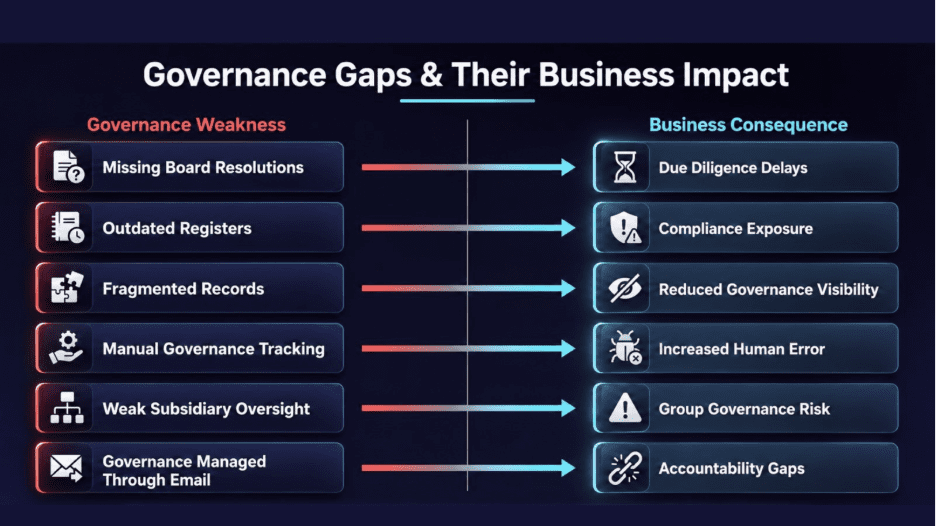
Key Insight:
Most governance failures are not caused by misconduct. They are caused by governance functions that were never properly operationalised.
The Governance Design Problem Most SMEs Ignore
The issue inside many SMEs is rarely capability. Most leadership teams are commercially capable and operationally experienced. The problem is governance design.
Many businesses build governance backwards. Operational work happens first while governance documentation follows later if time allows. Governance ownership becomes fragmented across finance teams, executive assistants, legal advisers and directors without clear operational accountability.
The result is governance that exists operationally but not structurally. It answers the question: what happened? But not the far more important question: can you prove it? In investor, regulatory and banking environments, that distinction matters enormously.
According to the Financial Conduct Authority, governance documentation, board accountability and record integrity increasingly form part of broader organisational oversight expectations in regulated and growth focused businesses.
Case Study: The Funding Round That Almost Failed
A technology company operating across two jurisdictions spent eight months preparing for a major growth equity raise. Commercial performance was strong, and investor demand exceeded expectations. Management assumed the transaction would proceed smoothly.
During due diligence, two governance problems surfaced. A subsidiary had failed to submit confirmation statements resulting in the company being dissolved by company house,, while key approvals for share redistribution contracts and major capital expenditure had never been formally documented through board resolutions.
The result was a four month delay. Legal costs increased significantly while investor confidence weakened during the remediation process. Senior management attention shifted away from operations towards reconstructing governance records retrospectively.
None of the issues related to commercial performance. All of them related to governance infrastructure weakness. This is how governance failures usually surface. Not during normal operations, but during scrutiny.
Why Informal Governance Eventually Fails
Many SMEs continue operating under informal governance models because they appear efficient during earlier business stages. The Finance Director handles filings when possible, the executive assistant organises meetings and legal advisers step in when problems emerge.
This model works temporarily because operational pressure often outweighs governance discipline inside scaling businesses. But governance is not a one time administrative exercise. It is a continuous operational function requiring structure, visibility, and accountability.
As organisations scale, set up subsidiaries, get involved in investor structures and expand across jurisdictions, fragmented governance processes become exponentially more difficult to manage. According to governance and compliance research from Deloitte, businesses without structured governance systems are significantly more likely to experience deal and transaction delays, governance related operational disruption and compliance exposure during periods of growth.
The Company Secretary Function Most Businesses Never Built
Most companies do not actually lack governance activity. What they lack is a functioning company secretary infrastructure capable of sustaining governance operationally.
This distinction matters. A company secretary function is not simply a person holding a title. It is a governance operating system with defined accountability, centralised records, compliance workflows, board administration processes, and governance continuity mechanisms.
As governance obligations become more complex, growing and scaling businesses relying entirely on manual administration, face increasing operational strain. Our own research (CoSec Digital Readiness) at Lumorus shows that, governance digitisation is accelerating globally because organisations increasingly recognise that governance continuity cannot depend entirely on fragmented manual processes and individual memory.
This is precisely the governance gap Lumorus CoSec Hub and the Governance Knowledge Center was built to solve.
How CoSec Hub Changes Governance Infrastructure
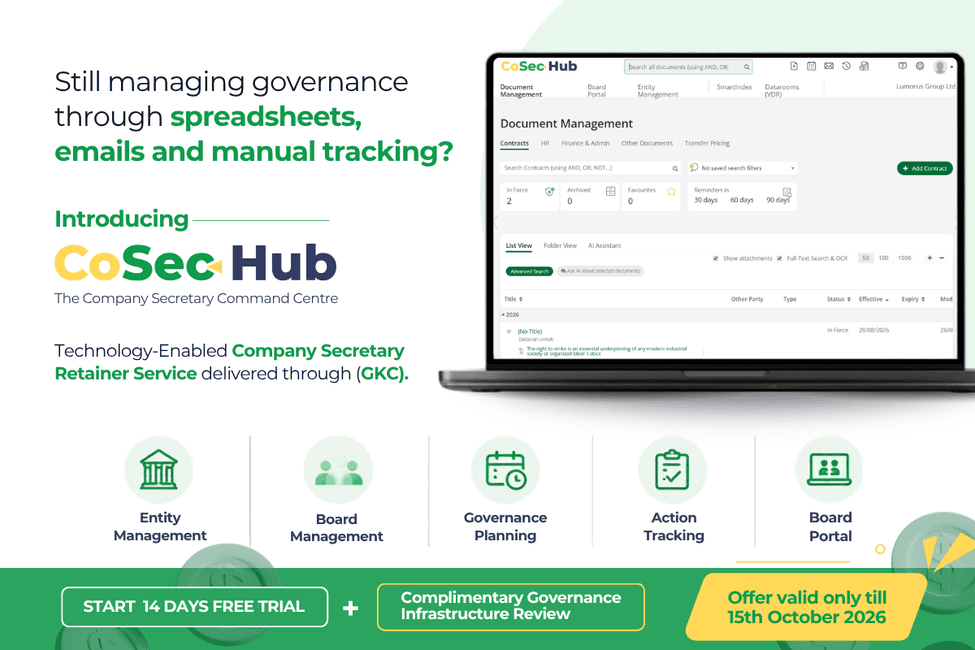
CoSec Hub is the Company Secretary Command Center. A managed digital company secretary platform designed to help scaling and growing businessess operationalise governance properly. It combines governance technology with a cadre of qualified company secretary professionals located globally in our Governance Knowledge Centers,(GKC) to create an integrated 24/7 company secretary and governance eco-system rather than fragmented, siloed governance administration.
This is not software alone. It is not advisory alone either. It is governance infrastructure designed to improve accountability, visibility, and operational continuity.
Through CoSec Hub+GKC, governance becomes assigned, tracked, documented and centrally visible. Every governance task submitted through the platform is managed through a structured workflow system with clear accountability, ownership and timelines. Board records, filings, minutes, actions, subsidiary management, statutory registers and governance documentation are work flowed, automated, stored centrally with a clear audit trail and governance visibility.
This helps organisations move away from reactive governance administration towards scalable governance infrastructure capable of supporting growth, investor readiness, and operational resilience.
Explore CoSec Hub: cosec.lumorus.com
What Happens When Governance Cannot Be Proven
A professional services firm operating across the UK and Canada entered a refinancing process expecting approvals within weeks. Commercially, the business was performing well, and leadership assumed governance processes were sufficiently organised.
The bank requested formal documentation confirming board approval of several strategic decisions. The approvals had happened operationally across meetings and calls, but they had never been formally documented through minutes, resolution or any other governance processes.
What should have taken two weeks took nearly three months and circa £15,000 . Not because decisions were missing, but because governance evidence was.
This is the hidden operational cost of weak governance infrastructure. Governance failures often remain invisible until organisations enter audits, refinancing exercises, acquisitions or investor due diligence. By then, remediation becomes expensive, disruptive and reputation damaging.
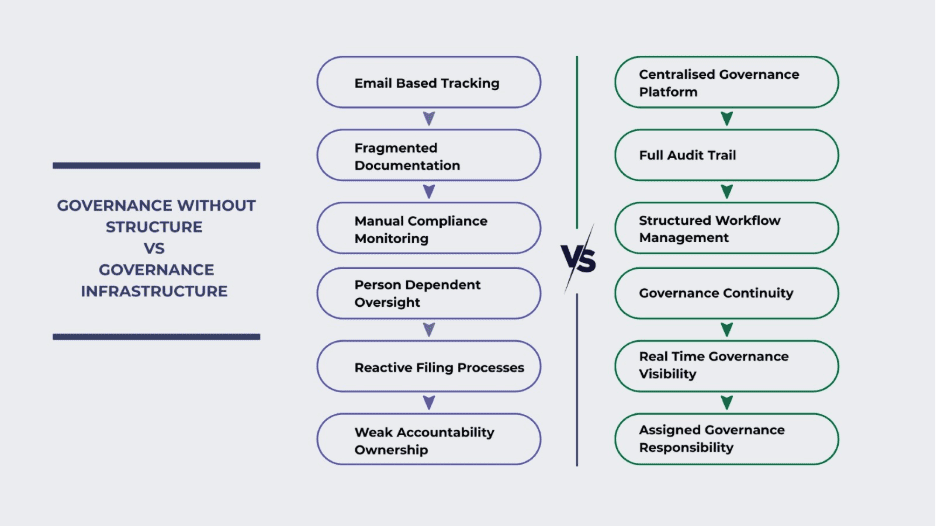
Governance Without Structure vs Governance Infrastructure
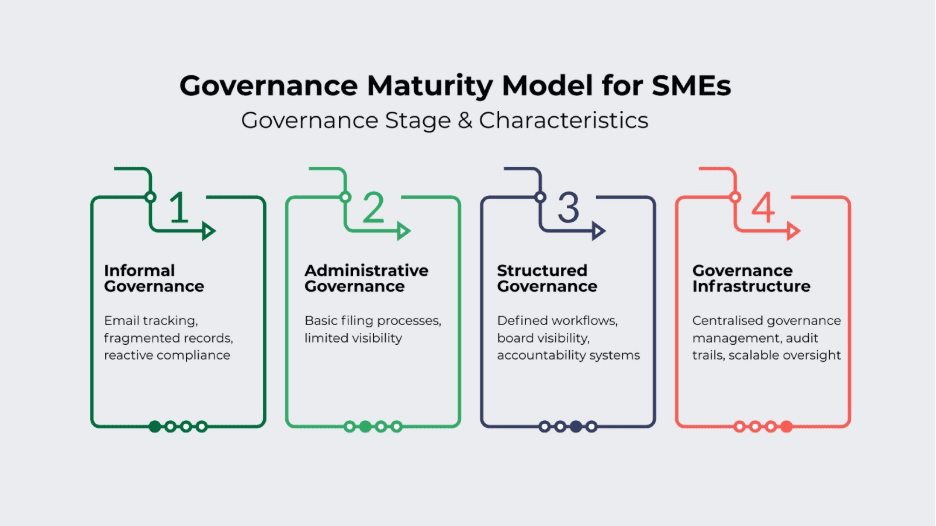
Governance Maturity Model for SMEs
Why Lumorus Built CoSec Hub
Lumorus is a UK headquartered global governance, ESG and advisory firm supporting organisations across Africa, Europe, Asia, the Caribbean, Canada and other international markets. For more than 10+ years, Lumorus has supported boards, SMEs, regulated entities and multinational organisations across governance, company secretarial operations, compliance and organisational accountability.
CoSec Hub was built because many growing businesses do not need more fragmented governance administration. They need operational governance infrastructure capable of supporting accountability, governance visibility, and investor readiness at scale.
Our work focuses on strengthening governance systems, board administration, governance continuity, entity management, compliance oversight, and operational governance resilience. We believe governance should not depend on memory, fragmented emails, or manual follow ups. It should function as structured operational infrastructure capable of standing up under scrutiny.
Explore More About Lumorus & CoSec Hub:
www.lumorus.com cosec.lumorus.com
CTA
Lumorus is a UK headquartered global governance and company secretarial advisory firm supporting organisations across multiple jurisdictions and regulated environments.
Through CoSec Hub, Lumorus helps SMEs, scaling businesses and multinational organisations centralise company secretarial operations, strengthen governance visibility and build governance infrastructure capable of supporting growth, funding readiness and regulatory accountability.
To explore CoSec Hub and Lumorus governance solutions, visit:
cosec.lumorus.com www.lumorus.com [email protected]