


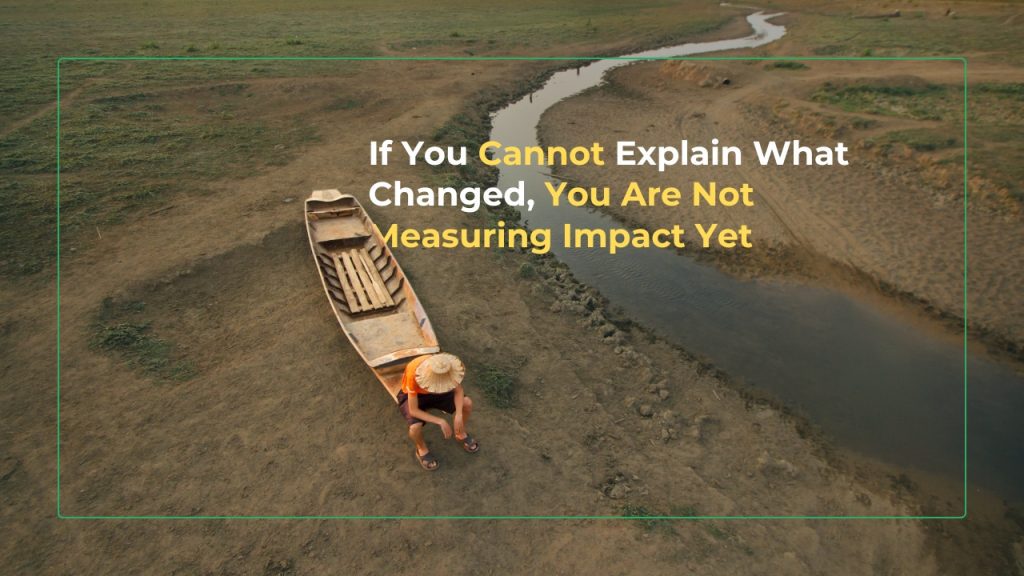
Organisations are becoming much better at describing what they do.
They can tell you how many people attended a programme, how much money was invested, how many employees volunteered or how many communities received support.
Those numbers have value, but they answer only one question.
What did we do?
Social impact measurement asks something more demanding:
What changed because we acted, for whom, and how confident are we that our intervention contributed to that change?
That distinction separates activity reporting from meaningful evaluation.
For businesses, investors, charities, foundations, development organisations and public bodies, the pressure to demonstrate impact is growing. Funders want evidence that resources are producing results, boards need to know whether programmes are working, communities expect accountability and investors increasingly want to understand the social consequences of capital allocation.
However, organisations often make impact measurement unnecessarily complicated. They begin with too many metrics, expensive technology or ambitious claims before deciding what they are actually trying to understand.
A better approach is simpler.
Start with the change you want to create, decide what evidence would demonstrate that change, collect only the information you can use and build greater sophistication as your evidence base develops.
According to Just Enterprise, social impact measurement is the systematic collection, analysis and reporting of information about the social, economic and environmental changes generated by organisational activity. Crucially, it focuses on outcomes rather than simply counting outputs and combines quantitative evidence with qualitative insight.
For organisations beginning this journey, that is the right place to start.
Read More: Social Impact Measurement and Management
Start with the decision, not the data
One of the most common mistakes in social impact measurement is collecting information simply because it can be collected.
Survey responses accumulate.
Spreadsheets expand.
Dashboards become more sophisticated.
Yet nobody is entirely sure what decision the information is supposed to improve.
Effective measurement works in the opposite direction.
Before selecting indicators, leadership should ask:
- What social or environmental problem are we trying to address?
- Which stakeholders are affected?
- What change do we reasonably expect our intervention to produce?
- What decisions will we make differently if the evidence shows the programme is, or is not, working?
- Who needs the information and why?
These questions force the organisation to connect measurement with strategy.
That matters because impact data should not exist solely for an annual report. Ideally, it should help leadership decide where to invest, what to improve, which initiatives to scale and which activities should stop.
Just Enterprise describes impact information as a form of business intelligence because organisations can use it to understand which interventions produce meaningful change and direct resources accordingly.
In other words, the objective is not more data.
It is better judgement.
Explore More: ESG Strategy Development
Understand the difference between inputs, outputs, outcomes and impact
A credible impact framework needs clear definitions because these concepts are often used interchangeably when they mean very different things.
Consider an organisation funding an employment programme.
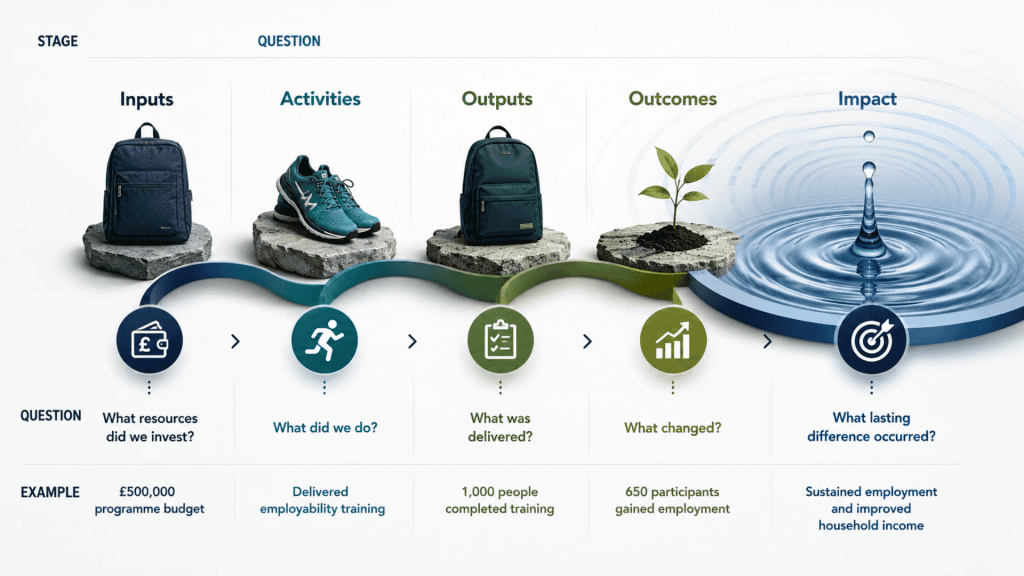
The distinction is important because organisations frequently stop at outputs.
A programme may train 1,000 people and still fail to improve employment outcomes. Equally, an organisation can plant thousands of trees without knowing how many survive or whether the project delivers the environmental and community benefits originally promised.
Activity is evidence that something happened.
Impact is evidence that something changed.
Therefore, before celebrating large numbers, organisations should determine where those numbers sit within the chain from resources to long-term outcomes.
Build a theory of change before choosing metrics
A useful starting point is a Theory of Change or logic model.
The concept is straightforward: set out the problem, explain what the organisation will do, identify the expected short and medium-term outcomes, then describe the longer-term impact those outcomes are intended to support.
The Stanford Social Innovation Review places the Theory of Change at the foundation of impact measurement because organisations need to understand not only the outcome they seek but the mechanism through which their intervention is expected to produce it.
For example, imagine a business investing in digital skills training for young people.
The intended impact may be greater economic opportunity.
However, the pathway towards that outcome might involve several stages:
- Participants gain digital skills.
- Confidence and employability improve.
- More participants secure employment.
- Employment is sustained.
- Household income and economic resilience increase.
Once that pathway is clear, measurement becomes more disciplined because the organisation can identify evidence at each stage.
It can also test assumptions.
Perhaps training completion is high but employment outcomes remain poor. That tells leadership something important: the problem may not be training quality but employer access, labour market conditions or another factor outside the programme’s original design.
A strong theory of change therefore does more than support reporting.
It gives organisations a framework for learning.
Read More: ESG Materiality & Risk Assessment
Do not measure everything
Once organisations become enthusiastic about impact measurement, another problem appears.
- They measure too much.
- Every activity has a metric.
- Every stakeholder receives a survey.
- Every project produces another dashboard.
Eventually, teams spend more time collecting data than learning from it.
The better approach is to identify a limited number of measures that genuinely explain whether the organisation is moving towards its intended outcomes.
The Stanford Social Innovation Review similarly argues that organisations should choose indicators based on what matters within their Theory of Change rather than simply accepting every available metric. Sometimes, less really is more.
Useful indicators should generally be:
- Relevant, because they relate directly to the intended outcome.
- Reliable, so the organisation can trust the information.
- Practical, because data must be collectable without disproportionate cost.
- Comparable, where trends over time or between groups matter.
- Useful, because someone will make a decision based on the result.
Just Enterprise suggests that organisations starting out can focus on a small set of core measures and combine quantitative information with qualitative evidence.
That balance is important.
Numbers can show the scale of change, while interviews, case studies and lived experience can help explain why the change occurred and how people experienced it.
Neither should automatically substitute for the other.
Stakeholders should help define what impact means
Impact cannot always be defined from the boardroom.
A programme may appear successful to the organisation funding it while producing a very different experience for the people affected.
For example, a workforce programme might report high job placement rates, yet participants may find that the jobs are insecure, poorly paid or unsustainable. A community investment programme might achieve its formal targets while local stakeholders believe the intervention failed to address their real priorities.
This is why meaningful Stakeholder Engagement should form part of impact measurement rather than being added after the evaluation is complete.
Stakeholders can help organisations:
- Identify the outcomes that matter most.
- Understand unintended consequences.
- Design more relevant indicators.
- Interpret results more accurately.
- Challenge assumptions about who benefits.
- Improve future programme design.
Moreover, engagement strengthens legitimacy because social impact should not become something organisations define entirely for themselves.
If communities, employees, beneficiaries or customers experience the consequences, their perspective belongs within the evidence.
Explore More: Stakeholder Engagement
Collect enough evidence for the claim you want to make
Not every organisation needs a complex evaluation.
This is an important point because impact measurement can become intimidating when organisations assume credible evidence always requires advanced statistical analysis.
It does not.
The appropriate level of evaluation depends on the question being asked and the strength of the claim being made.
The Stanford Social Innovation Review describes impact measurement as a spectrum. Organisations can begin with a Theory of Change, establish key indicators and develop routine data collection before moving, where necessary, towards more demanding forms of evaluation designed to test causation.
That means an organisation wanting to improve programme delivery may be perfectly well served by consistent outcome tracking and stakeholder feedback.
However, if it wants to claim that its intervention caused a particular outcome, the evidential requirement becomes considerably higher.
This distinction matters because one of the biggest credibility risks in social impact reporting is overclaiming.
If employment increased after a training programme, the programme may have contributed to the result, but wider labour market conditions could also have played a role.
Good evaluation acknowledges that uncertainty.
Weak evaluation turns correlation into causation because the stronger claim makes a better headline.
Credible organisations resist that temptation.
A practical starting framework
For organisations wondering where to begin, impact measurement can be organised into five manageable stages.
1. Define
Agree the problem, target stakeholders and intended outcomes, then build a simple Theory of Change.
2. Prioritise
Choose a small number of indicators that provide meaningful evidence of progress.
3. Collect
Gather quantitative and qualitative information consistently, while making ownership of each measure clear.
4. Evaluate
Analyse results against baselines, targets or relevant comparisons and remain open to unintended outcomes.
5. Act
Use the findings to improve strategy, reallocate resources, strengthen programmes and communicate progress honestly.
The fifth stage is frequently neglected.
Organisations collect information, publish it and then return to doing exactly what they did before.
That is reporting.
Evaluation becomes valuable when evidence changes decisions.
Read More: Social Impact Measurement and Management
Impact measurement should inform investment decisions
The connection between impact measurement and capital allocation is becoming increasingly important.
Investors, asset owners and fund managers are under pressure to understand not simply whether portfolio companies have ESG policies but whether those policies influence outcomes and long-term enterprise value.
This requires a stronger connection between impact evidence and investment analysis.
For example, social impact information may reveal issues involving workforce stability, community relationships, human capital development or stakeholder trust that conventional financial metrics capture only after problems have become material.
Consequently, integrating credible ESG evidence into ESG Integration in Investment Decisions can strengthen investment judgement, particularly where sustainability factors influence long-term risk and resilience.
The important principle is the same.
Impact data should affect decisions.
Otherwise, measurement risks becoming an expensive communications exercise.
Reporting should follow evidence, not replace it
Organisations understandably want to communicate positive impact.
However, the sustainability report should be the end of the evidence process, not the beginning.
Credible ESG Reporting and Disclosure should explain what the organisation sought to achieve, what evidence was collected, what changed and where uncertainty or limitations remain.
Strong reporting may include:
- Outcomes as well as outputs.
- Baselines and targets.
- Changes over time.
- Stakeholder perspectives.
- Methodological limitations.
- Positive and negative results.
- Lessons learned.
- Actions planned in response.
This approach requires maturity because not every result will be flattering.
Yet transparency about what did not work can strengthen credibility, particularly when the organisation shows how it has learned and adapted.
Impact reporting should therefore demonstrate accountability rather than simply success.
Common mistakes when getting started
The technical side of impact measurement matters, but many failures are surprisingly basic.
- Measuring activity instead of change
Counting participants is useful, although it does not tell you whether participants benefited.
- Starting with dozens of indicators
Too many measures create administrative burden and obscure what matters.
- Ignoring baseline information
Without understanding the starting position, it becomes difficult to demonstrate meaningful change.
- Collecting data nobody uses
Every measure should have a clear purpose, owner and decision attached to it.
- Excluding stakeholders
Organisations can misunderstand impact when they define success without listening to the people affected.
- Overclaiming causation
Evidence should support the strength of the claim being made.
- Reporting only positive outcomes
Credible impact measurement identifies unintended and negative effects as well as successes.
Just Enterprise makes a similar point in its discussion of common pitfalls, including measuring everything, collecting information without using it and overstating the organisation’s impact.
These are not merely technical errors.
They are governance failures because they distort the information on which boards, investors and stakeholders rely.
Make social impact measurement part of management
The most important shift occurs when impact measurement stops belonging solely to the sustainability team.
- Boards should use it.
- Executives should use it.
- Investment committees should use it.
- Programme managers should use it.
- Finance teams should understand it.
When evidence becomes part of routine management, organisations can compare initiatives, challenge assumptions and allocate resources with greater discipline.
This is where ESG Strategy Development and impact measurement should connect.
- Strategy establishes what the organisation intends to achieve.
- Measurement reveals whether it is happening.
- Evaluation explains why.
- Management then decides what to do next.
That cycle is far more valuable than producing a polished impact report once a year.
Start proportionately, then build confidence
Organisations do not need to create the perfect measurement framework on day one.
In fact, trying to do so can prevent them from starting at all.
A better approach is proportionality.
Begin with a clear Theory of Change and a manageable set of indicators, establish consistent data collection, learn how reliable the information is and then increase sophistication when the strategic or evidential need justifies it.
This is consistent with the approach described by both Just Enterprise and the Stanford Social Innovation Review: impact measurement works best as a developing capability rather than a one-off research project.
Regularity often matters more than complexity.
A modest framework used consistently can provide greater decision-making value than an elaborate evaluation conducted once and forgotten.
The objective is progress towards better evidence.
Not methodological perfection for its own sake.
The organisations that understand impact can manage it
Social impact measurement is sometimes discussed as though its main purpose is proving value to outsiders, that is too narrow; its greatest value may be internal.
It tells organisations whether they are delivering what they intended, where resources are producing meaningful outcomes and where assumptions need to change.
- Good measurement can strengthen strategy.
- Improve stakeholder relationships.
- Support funding.
- Inform investment decisions.
- Increase reporting credibility.
Most importantly, it can prevent organisations from spending years doing something that looks successful but creates very little meaningful change.
That is why impact measurement should not begin with a report.
- It should begin with curiosity.
- What are we trying to change?
- How would we know?
- What evidence would convince us?
- And what will we do differently when the evidence arrives?
Those questions are the foundation of credible social impact management.
Lumorus: Better Business, Built on Purpose
At Lumorus, we believe responsible business requires more than ambitious commitments. It requires evidence that organisations understand the outcomes they create and use that evidence to make better decisions.
Lumorus is a UK headquartered global governance, ESG, company secretary and advisory firm supporting organisations across Europe, Africa, Asia, the Caribbean, Canada, the Middle East and international markets.
For more than 10 years, we have helped boards, leadership teams, investors and organisations strengthen governance, accountability and organisational resilience while building credible approaches to sustainability and social impact.
Our sustainability and social impact expertise includes:
Whether your organisation is developing its first impact framework, strengthening an existing evaluation approach or trying to connect ESG evidence with investment and strategic decisions, Lumorus can help you build an approach that is practical, proportionate and credible.
Are you measuring what your organisation does, or understanding what actually changes because you do it?
Contact Lumorus to explore how our ESG and social impact services can help turn activity into evidence, evidence into insight and insight into better decisions.
Email: [email protected]
Together, we can build better business: one that performs with purpose, leads with integrity and creates lasting value.
Sources
- Just Enterprise – Measuring What Matters: A Guide to Getting Started with Social Impact Measurement
- Stanford Social Innovation Review – A Playbook for Designing Social Impact Measurement