


For years, many boards believed governance meant having the right committees, policies and compliance procedures in place.
That assumption is starting to break down.
Across industries, boards are discovering an uncomfortable reality: governance activity is not the same as governance infrastructure.
Meetings can happen regularly. Reports can be circulated. Policies can exist. Compliance filings can be completed. Yet underneath, governance systems may still be fragmented, reactive, and operationally weak.
The issue is becoming impossible to ignore because organisational complexity has changed faster than governance capability.
Boards are now expected to oversee:
- AI Governance
- Cybersecurity Risk
- ESG Accountability
- Cross border Operations
- Organisational Resilience
- Internal Controls
- Digital Reporting
- Stakeholder Trust
- Regulatory Complexity
Most governance models were never designed for this level of operational and regulatory pressure.
That is the governance infrastructure gap boards are finally starting to notice.
Governance Infrastructure Is Not the Same as Governance Administration
One of the biggest misconceptions in corporate governance is the belief that governance infrastructure simply means governance administration.
It does not.
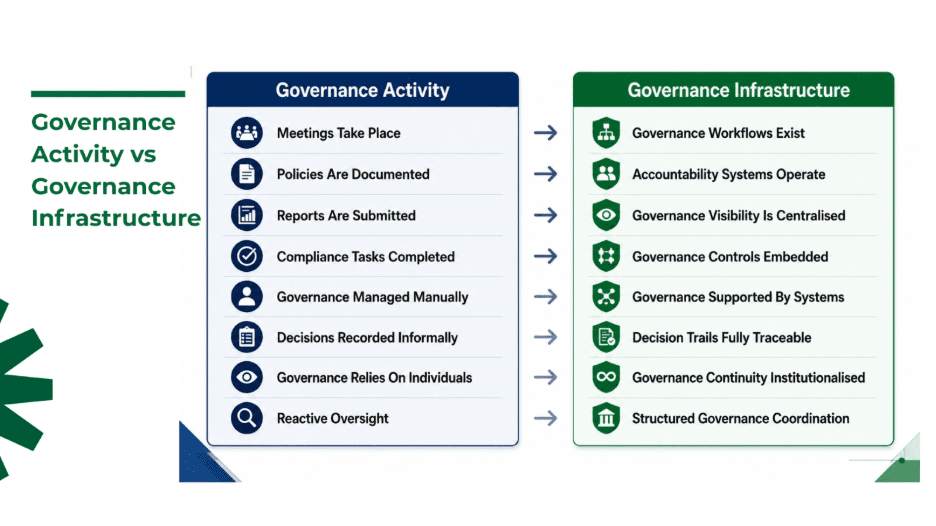
Governance administration focuses on tasks. Governance infrastructure focuses on systems.
Governance infrastructure is the operational architecture that allows accountability, oversight, reporting, escalation, and governance continuity to function consistently across an organisation.
It includes:
- Governance Workflows
- Accountability Structures
- Reporting Systems
- Board Oversight Mechanisms
- Governance Visibility
- Decision making Controls
- Audit Trails
- Risk Escalation Processes
- Governance Technology
- Company Secretarial Infrastructure
Without these systems operating cohesively, governance becomes dependent on fragmented coordination and institutional memory.
That approach becomes increasingly fragile as organisations scale.
Read More: Corporate governance infrastracture
Governance Activity vs Governance Infrastructure
Why Boards Are Becoming Concerned
Boards are increasingly facing pressures that expose governance weaknesses much faster than before.
What once remained hidden internally now surfaces quickly through:
- Investor Due Diligence
- Regulatory Reviews
- Internal Control Assessments
- Digital Reporting Requirements
- ESG Scrutiny
- Cyber Incidents
- AI Governance Questions
- Operational Disruption
- Multi-Jurisdiction Compliance Reviews
The challenge is not simply that governance obligations are increasing.
The challenge is that many organisations are still managing governance through structures designed for a less complex operating environment.
This creates several dangerous gaps simultaneously:
- Weak Governance Visibility
- Fragmented Accountability
- Delayed Escalation
- Poor Governance Coordination
- Weak Internal Control Assurance
- Governance Continuity Risk
- Limited Board Oversight Capacity
These are no longer theoretical governance weaknesses.
They are operational risks.
At Lumorus, governance is viewed not as paperwork, but as the infrastructure through which accountability, oversight and institutional trust operate. That distinction matters because organisations increasingly require governance systems capable of functioning under pressure, scrutiny, and complexity.
Common Signs of the Governance Infrastructure Gap
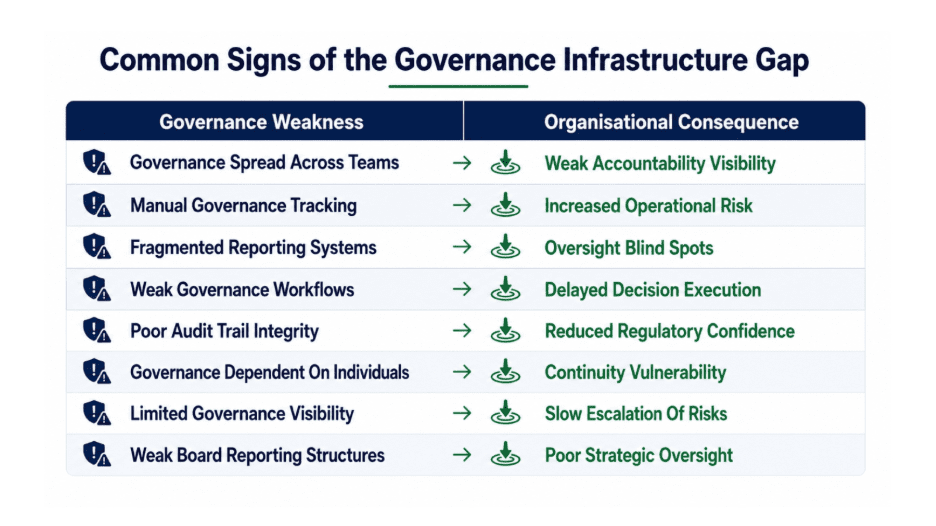
The Governance Infrastructure Gap Is Really a Resilience Problem
This issue extends far beyond compliance.
It is fundamentally about organisational resilience.
Strong governance infrastructure determines whether an organisation can maintain visibility, accountability, and decision quality under pressure.
Weak governance infrastructure often remains hidden during stable periods.
It becomes visible during:
- Crises
- Audits
- Acquisitions
- Regulatory Scrutiny
- Rapid Growth
- Operational Failures
- Investor Reviews
- Leadership Transition
This is one reason resilience and governance are becoming increasingly interconnected.
The organisations that govern most effectively are usually the organisations that have operationalised governance properly. They possess governance systems capable of sustaining accountability, reporting integrity and oversight continuity even when operational pressure increases.
That requires governance infrastructure, not simply governance intentions.
How Weak Governance Infrastructure Affects Organisations
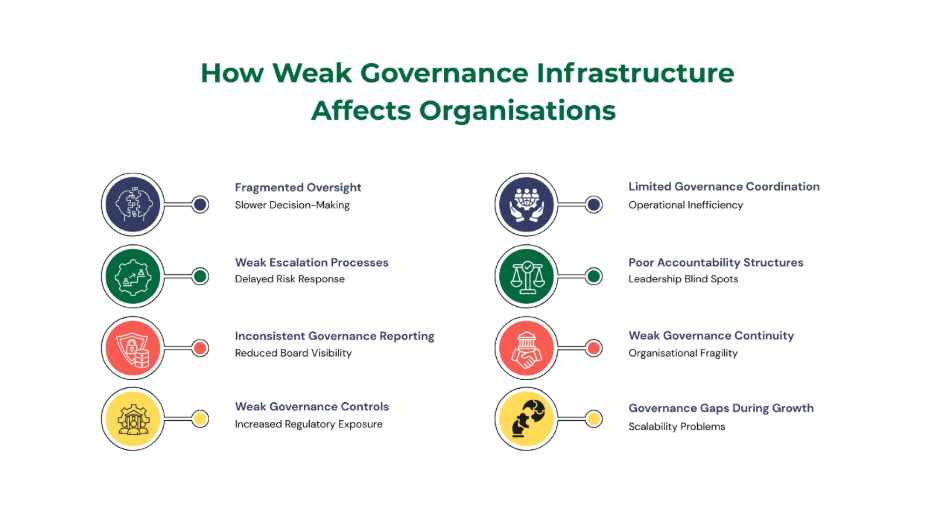
Why Governance Complexity Is Accelerating
The governance environment is becoming structurally more demanding.
Boards are no longer overseeing only financial performance and compliance.
They are increasingly expected to govern:
- AI And Emerging Technology
- Climate And Sustainability Risks
- Cybersecurity Resilience
- Stakeholder Accountability
- Supply Chain Exposure
- Organisational Culture
- ESG Reporting
- Data Governance
- Digital Operational Risk
This complexity requires far stronger governance coordination than many organisations currently possess.
The problem is that governance systems often evolve incrementally while organisational complexity scales exponentially.
As a result, governance infrastructure frequently lags behind operational reality.
The governance gap is therefore not simply a compliance issue.
It is an infrastructure maturity issue.
The Organisations Moving Ahead Are Operationalising Governance
The strongest organisations are responding differently.
They are moving beyond governance as administration and towards governance as operational infrastructure.
This means investing in:
- Governance Workflows
- Accountability Systems
- Governance Visibility Platforms
- Structured Escalation Processes
- Governance Technology
- Internal Control Architecture
- Board Reporting Systems
- Governance Continuity Infrastructure
These organisations understand something increasingly important:
Governance quality eventually becomes commercially visible.
Not only through crises.
But through investor confidence, organisational resilience, operational execution and long-term trust.
What Strong Governance Infrastructure Enables
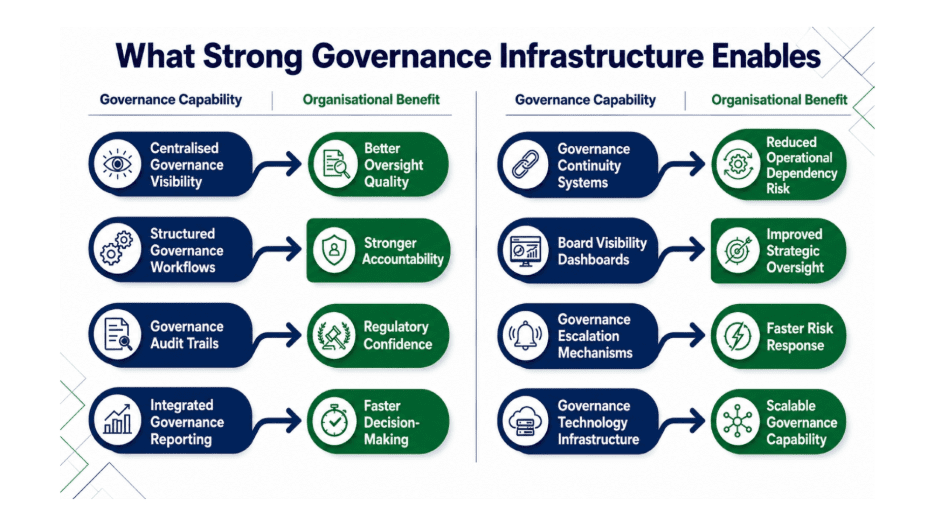
Why Lumorus Focuses on Governance Infrastructure
At Lumorus, we believe governance should function as institutional infrastructure, not fragmented administration.
That means helping organisations build governance systems capable of supporting:
- Accountability
- Board Oversight
- Governance Visibility
- Decision Integrity
- Risk Escalation
- Governance Continuity
- Organisational Resilience
- Long-Term Trust
Through our Governance Advisory, Company Secretary Service and Governance Infrastructure capabilities, Lumorus helps organisations operationalise governance in ways that are practical, scalable and aligned with modern organisational complexity.
Because increasingly, governance effectiveness depends not simply on policies or compliance activity, but on whether governance systems can operate reliably under scrutiny.
The Governance Infrastructure Gap Will Become More Visible
The governance infrastructure gap is no longer hidden.
Boards are increasingly recognising that governance quality is determined not simply by governance intent, but by governance capability.
And capability depends on infrastructure.
The organisations that adapt early will govern with greater visibility, stronger accountability and better resilience.
The organisations that do not will increasingly struggle under regulatory pressure, operational complexity and stakeholder scrutiny.
Because ultimately, governance is not paperwork.
It is the operational architecture of institutional trust.
Lumorus: Better Business, Built on Purpose
At Lumorus, we believe Being Good is Better for Business.
We help organisations lead with integrity, govern with confidence and create value that lasts. Our work supports boards, executives and leadership teams to strengthen governance infrastructure, improve accountability and build resilient organisations capable of operating effectively in increasingly complex environments.
Across our Governance Advisory, Company Secretary Service and ESG-Social Impact Consulting practices, we combine strategic insight with practical governance delivery. We work collaboratively with organisations to build governance systems that are proportionate, operationally effective and designed for long-term value creation.
With offices and expert teams across the UK, Africa, the Caribbean, Latin America and Canada, and clients operating globally, Lumorus brings international perspective, specialist expertise and practical judgement to every engagement.
Whether you are strengthening governance oversight, operationalising governance workflows or building governance infrastructure capable of supporting future growth and resilience, Lumorus is here to help you move from intention to action.
Together, we can build better business: one that performs with purpose, leads with integrity and creates lasting value for people, planet and profit.
To continue the conversation, visit: