


Board management has become one of the most complex responsibilities in governance
For many years, board management was largely viewed as an administrative responsibility.
Schedule the meetings.
Prepare the board papers.
Record the minutes.
Track the actions.
Ensure decisions were documented.
Today, that view is increasingly outdated.
Modern company secretaries are expected to do far more.
Boards require better information.
Regulators demand stronger governance.
Investors expect greater transparency.
Stakeholders scrutinise board effectiveness more closely than ever before.
As a result, board management has evolved from administration into a strategic governance function.
The challenge is that governance complexity is growing faster than many board management processes can keep pace with.
According to a joint report by Esade, Diligent and PwC, board secretaries increasingly identify ESG oversight, corporate conflicts, regulatory compliance, information management and the growing complexity of governance advisory responsibilities as some of their biggest challenges.
Read More: Company Secretary
The company secretary is increasingly at the centre of board effectiveness
Board effectiveness rarely depends solely on directors.
It also depends on the governance infrastructure supporting them.
Company secretaries increasingly act as:
- Governance coordinators
- Board advisers
- Information managers
- Compliance facilitators
- Governance intelligence providers
- Accountability enablers
The quality of board oversight is often directly influenced by the quality of governance support behind it.
This places company secretaries in a uniquely important position.
They are expected to support governance while simultaneously managing growing operational complexity.
Challenge 1: Managing information overload
One of the most significant challenges facing company secretaries is information management.
Board packs continue to grow.
Reporting requirements continue to expand.
Directors increasingly require information relating to:
- Risk
- ESG
- Strategy
- Cybersecurity
- Regulation
- Financial performance
- Stakeholder expectations
Yet more information does not necessarily improve board decision-making.
According to INSEAD’s Board ESG Pulse Check research, boards are becoming more confident in some governance areas while struggling to keep pace with emerging risks, geopolitical uncertainty and rapidly evolving business challenges.
The challenge for company secretaries is not simply distributing information.
It is helping boards receive the right information at the right time in a format that supports effective decision-making.
Challenge 2: Supporting stronger board oversight
Board expectations have changed significantly.
Directors increasingly expect:
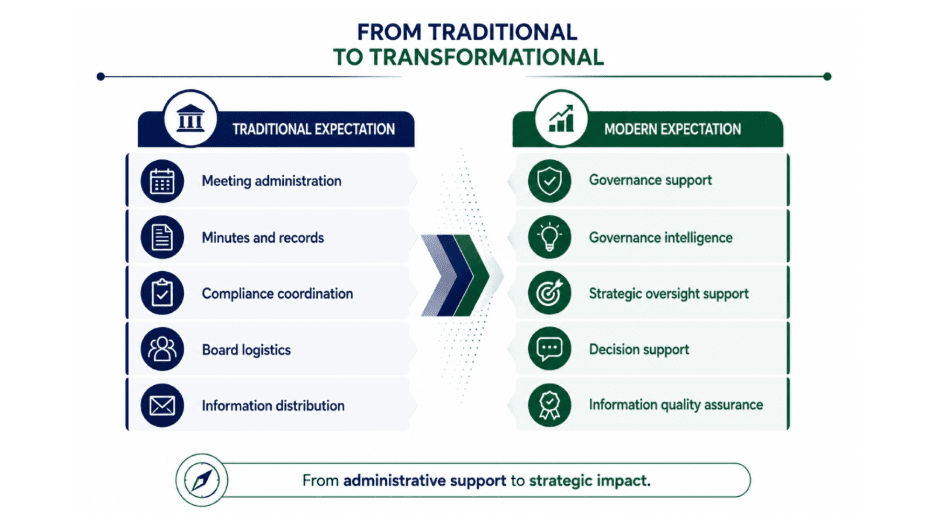
This evolution has expanded the scope of board management considerably.
Company secretaries are increasingly expected to help boards understand emerging governance risks, governance trends and accountability issues.
This requires both governance expertise and strong governance infrastructure.
Challenge 3: Managing board actions after the meeting
Many organisations focus heavily on board meetings.
Far fewer focus on what happens afterwards.
Yet governance effectiveness often depends on execution.
Board decisions that are not tracked become governance risks.
Actions that are not monitored weaken accountability.
Commitments that are not followed through undermine board effectiveness.
Common challenges include:
- Inconsistent action tracking
- Unclear ownership
- Delayed implementation
- Poor reporting
- Limited visibility
Good governance does not end when the meeting finishes.
In many respects, that is when governance begins.
Challenge 4: Navigating ESG and sustainability oversight
ESG has become a major board agenda item.
For company secretaries, this introduces new governance responsibilities.
According to Esade’s research, governance and ESG issues rank among the most significant challenges facing board secretaries today.
Boards increasingly require support relating to:
- ESG governance structures
- Sustainability oversight
- Stakeholder expectations
- ESG reporting
- Risk integration
- Governance accountability
The challenge is not simply reporting ESG information.
It is ensuring boards can effectively govern ESG-related risks and opportunities.
As ESG becomes more embedded within governance, company secretaries are increasingly expected to facilitate informed board oversight.
Challenge 5: Managing conflicts and governance tensions
Not all governance challenges are procedural.
Some are behavioural.
Boards must often navigate:
- Conflicts of interest
- Shareholder tensions
- Director disagreements
- Governance disputes
- Sensitive strategic decisions
According to the Esade Centre for Corporate Governance, the management of corporate conflicts is now considered one of the most significant challenges facing board secretaries.
These situations require more than administrative capability.
They require judgement, diplomacy and governance expertise.
Company secretaries often play a critical role in helping boards navigate difficult governance situations while maintaining trust and transparency.
Challenge 6: Regulatory complexity continues to increase
Regulatory obligations continue to expand across most sectors.
Boards increasingly require assurance that governance processes remain compliant and effective.
Company secretaries are often responsible for coordinating:
- Regulatory filings
- Governance documentation
- Board approvals
- Director obligations
- Compliance monitoring
- Governance reporting
According to governance experts and board research, increasing regulatory complexity remains one of the most significant pressures on modern boards and governance functions.
Managing these obligations manually becomes increasingly difficult as organisations grow.
Challenge 7: Maintaining governance visibility across multiple entities
Many organisations now operate across:
- Multiple subsidiaries
- International jurisdictions
- Complex ownership structures
- Regulated entities
This creates significant governance coordination challenges.
Company secretaries need visibility over:
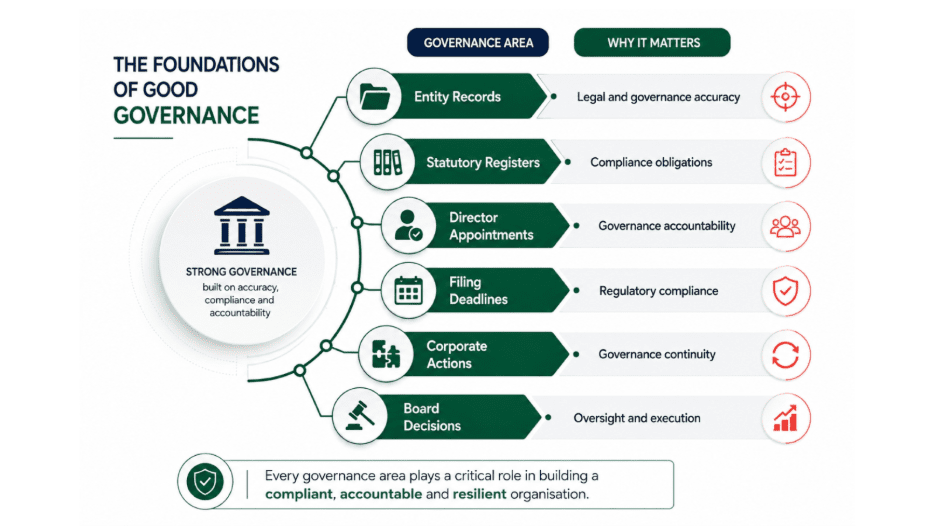
Without centralised governance information, board management becomes increasingly difficult.
Visibility is becoming one of the most important governance capabilities.
Why traditional board management approaches are under pressure
Many governance teams still rely heavily on:
- Spreadsheets
- Shared drives
- Email reminders
- Manual trackers
- Institutional memory
For smaller organisations these approaches may be sufficient.
As complexity increases, however, they often become governance risks.
The challenge is no longer simply coordinating board activity.
The challenge is maintaining governance visibility, accountability and control across increasingly complex organisations.
The future of board management is governance infrastructure
The most effective company secretaries increasingly recognise that board management is not just about meetings.
It is about governance infrastructure.
Strong governance infrastructure supports:
- Board Management
- Compliance Calendars
- Governance Forward Planning
- Board Action Tracking
- Meeting Lifecycle Management
- Governance Intelligence
- Entity Management
These capabilities allow company secretaries to move from reactive administration towards proactive governance support.
This shift is becoming one of the defining characteristics of high-performing governance functions.
Why CoSec Hub takes a different approach
CoSec Hub was built around a simple belief.
Modern company secretaries need more than software and more than outsourced administration.
They need governance infrastructure.
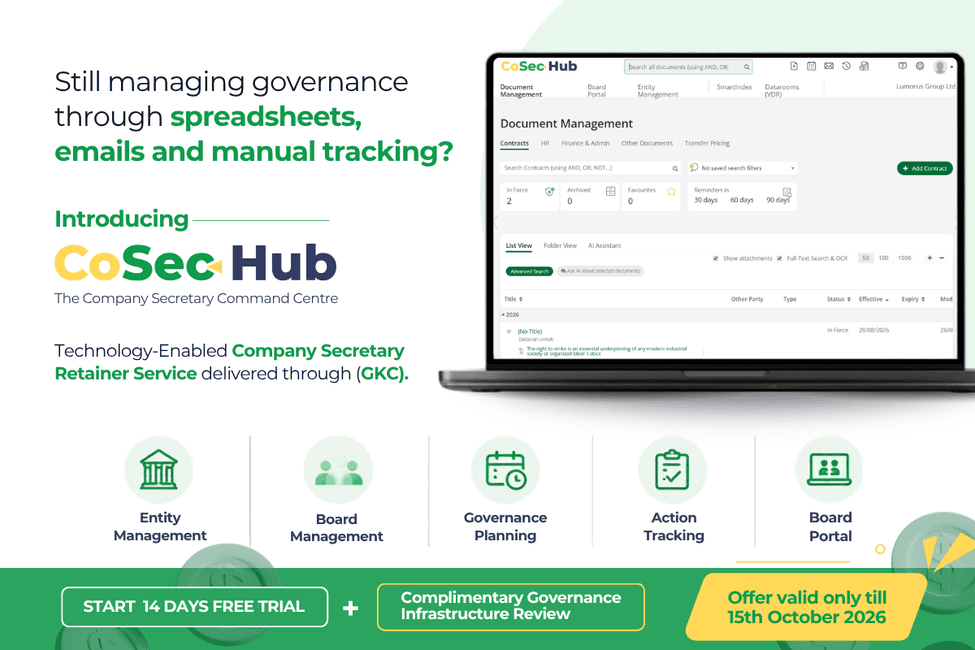
That is why CoSec Hub combines technology and governance expertise through a technology-enabled Company Secretary Retainer Service.
CoSec Hub
The Company Secretary Command Centre supporting:
- Board Management
- Compliance Calendars
- Governance Forward Planning
- Board Action Tracking
- Meeting Lifecycle Management
- Entity Management
- Contract Management
- Statutory Registers
Governance Knowledge Centre (GKC)
Providing:
- Company Secretary Expertise
- Governance Operations Support
- Board Administration
- Compliance Monitoring
- Governance Intelligence
- Multi-Jurisdiction Governance Support
- Governance Advisory Support
Together, CoSec Hub and the Governance Knowledge Centre (GKC) deliver governance infrastructure designed to help company secretaries manage growing board complexity with greater visibility, control and confidence.
About CoSec Hub
CoSec Hub is the Company Secretary Command Centre.
Built by Company Secretaries for Company Secretaries, CoSec Hub combines technology and governance expertise to support governance operations, board management, compliance oversight and entity management.
Delivered through CoSec Hub and the Governance Knowledge Centre (GKC), the service provides technology-enabled Company Secretary Retainer Services designed for modern company secretarial, legal governance and compliance teams.
Lumorus: Better Business, Built on Purpose
Lumorus is a UK-headquartered global governance, company secretarial, ESG and advisory firm supporting organisations across multiple jurisdictions and regulated environments.
We help organisations strengthen governance infrastructure, accountability systems and board oversight capability as governance complexity, regulatory expectations and stakeholder scrutiny continue to evolve.
Explore how CoSec Hub and the Governance Knowledge Centre (GKC) can help your organisation move from fragmented administration to connected, auditable and board-ready governance.
CoSec Hub: cosec.lumorus.com
Lumorus: lumorus.com
Email: [email protected]
CoSec Hub + Governance Knowledge Centre (GKC): Where Automation Meets Governance Authority.