


The Financial Reporting Council’s latest intervention on digital financial reporting may appear technical on the surface.
It is not.
It is a governance warning.
In concluding its annual review cycle, the FRC issued formal amendments to FRS 101 under the Reduced Disclosure Framework while simultaneously criticising widespread weaknesses in how listed companies digitally tag and submit financial data.
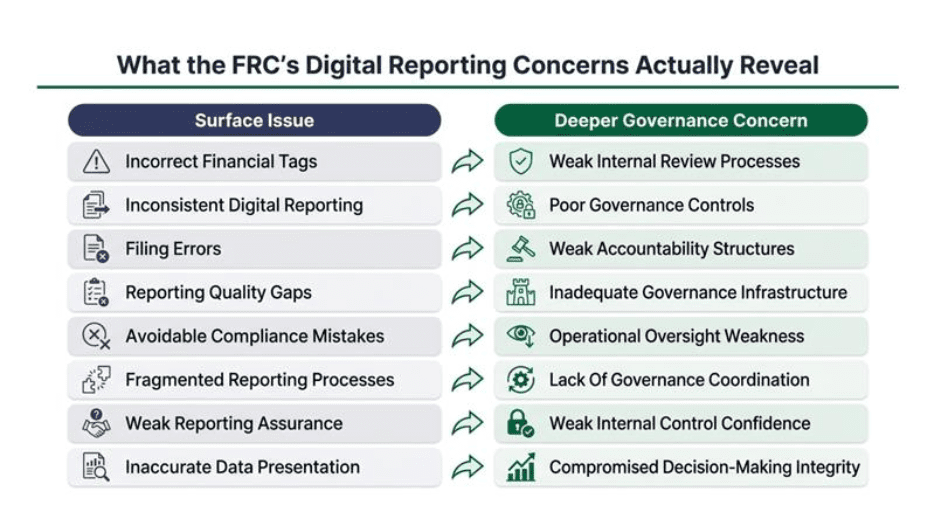
The regulator highlighted recurring tagging errors, inconsistent submissions and avoidable reporting mistakes, explicitly linking many of these failures to weak internal review processes and poor governance discipline.
That language matters.
Because beneath the technical issue of digital tagging sits a much larger governance problem: organisational control infrastructure.
The FRC is effectively signalling that if a company cannot reliably manage the accuracy, consistency and integrity of its own digital financial reporting, serious questions arise about the quality of the governance systems operating underneath the surface.
This connects directly to the revised UK Corporate Governance Code and the growing expectation that boards provide stronger assurance around internal controls, governance effectiveness and organisational resilience.
The implication is clear.
Weak digital reporting is no longer simply a finance or compliance issue. It is increasingly viewed as evidence of weak governance infrastructure.
Why digital financial tagging matters more than many boards realise?
For many boards, digital financial tagging still feels highly technical and operational.
It is often treated as a specialist reporting exercise delegated to finance teams, reporting advisers or external providers.
That mindset is becoming outdated.
Structured digital reporting is fundamentally about governance integrity.
Digital tagging determines how financial information is interpreted, analysed and assessed by regulators, investors, analysts and markets.
If the underlying tagging is inaccurate, inconsistent or poorly controlled, it creates several governance risks simultaneously:
- Weak Financial Reporting Integrity
- Poor Internal Control Visibility
- Increased Regulatory Scrutiny
- Reduced Investor Confidence
- Governance Credibility Concerns
- Operational Control Questions
The issue is not simply whether a tag was technically incorrect.
The issue is what the error reveals about the organisation’s governance systems, review controls and accountability structures.
According to FM Magazine’s analysis of the FRC review, the regulator specifically emphasised that many digital reporting errors were entirely avoidable and reflected deficiencies in governance review processes rather than purely technical mistakes.
What the FRC’s Digital Reporting Concerns Actually Reveal?
The Governance Shift Boards Cannot Ignore
The revised UK Corporate Governance Code has already moved governance expectations significantly beyond traditional compliance oversight.
Boards are increasingly expected to provide assurance around:
- Internal Control Effectiveness
- Governance Systems
- Risk Management Processes
- Reporting Integrity
- Operational Resilience
- Organisational Accountability
This changes the role of governance fundamentally.
Governance is no longer simply about approving policies and reviewing reports. It is increasingly about demonstrating that the organisation possesses functioning governance infrastructure capable of supporting reliable oversight under scrutiny.
That includes digital governance capability.
The FRC’s intervention makes one point increasingly difficult for boards to ignore:
A company cannot credibly assure markets about internal controls while basic reporting governance remains weak.
Most Organisations Still Operate Fragmented Governance Processes
The uncomfortable reality is that many organisations still manage governance and reporting through fragmented systems.
Responsibilities become spread across:
- Finance Teams
- Company Secretarial Functions
- External Advisers
- Compliance Teams
- Legal Departments
- Technology Teams
Often without central governance visibility.
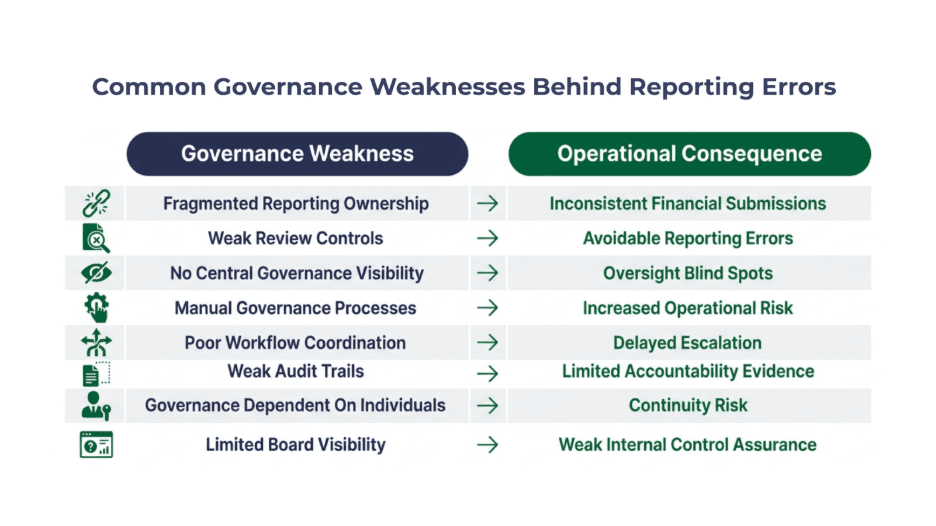
This creates operational fragmentation.
Reporting processes become disconnected. Governance workflows become inconsistent. Accountability ownership becomes unclear.
The result is governance activity without governance coordination.
That is precisely the type of weakness regulators are increasingly identifying.
Common Governance Weaknesses Behind Reporting Errors
Why This Matters Beyond Compliance?
The organisations most exposed by these weaknesses are not necessarily poorly managed organisations.
Many are commercially successful businesses operating with governance systems that failed to evolve alongside organisational complexity.
This is becoming increasingly common in organisations managing:
- Cross-Border Operations
- Multiple Entities
- Investor Reporting Obligations
- Complex Regulatory Environments
- Digital Reporting Requirements
- Rapid Growth Structures
Operational complexity grows faster than governance capability.
Boards continue receiving reports, meetings continue taking place and compliance tasks continue being completed. But underneath, governance coordination becomes increasingly fragile.
The FRC’s criticism of avoidable reporting errors reflects a broader regulatory concern about governance maturity itself.
The Link Between Digital Reporting and Governance Infrastructure
This is where governance infrastructure becomes critically important.
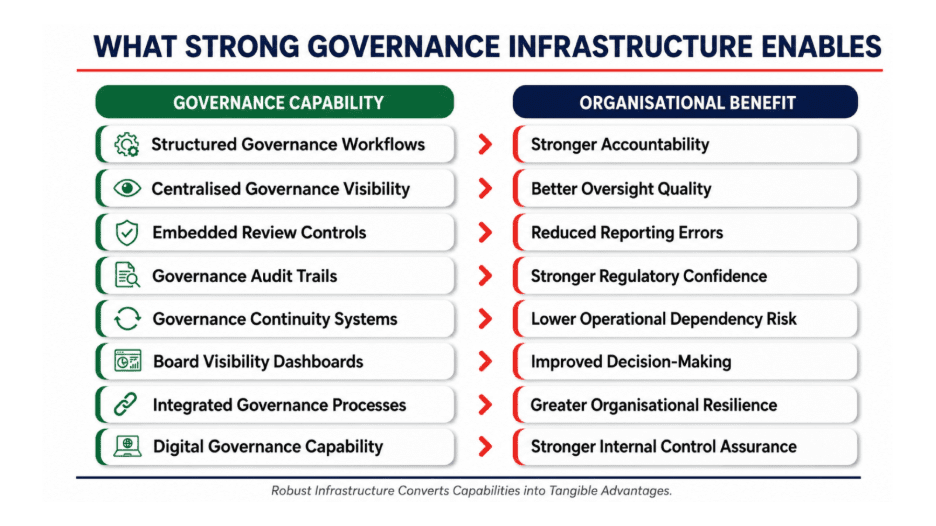
Strong governance infrastructure creates:
- Clear Accountability Ownership
- Structured Governance Workflows
- Reporting Visibility
- Centralised Governance Records
- Audit Trails
- Escalation Processes
- Internal Review Mechanisms
- Governance Continuity
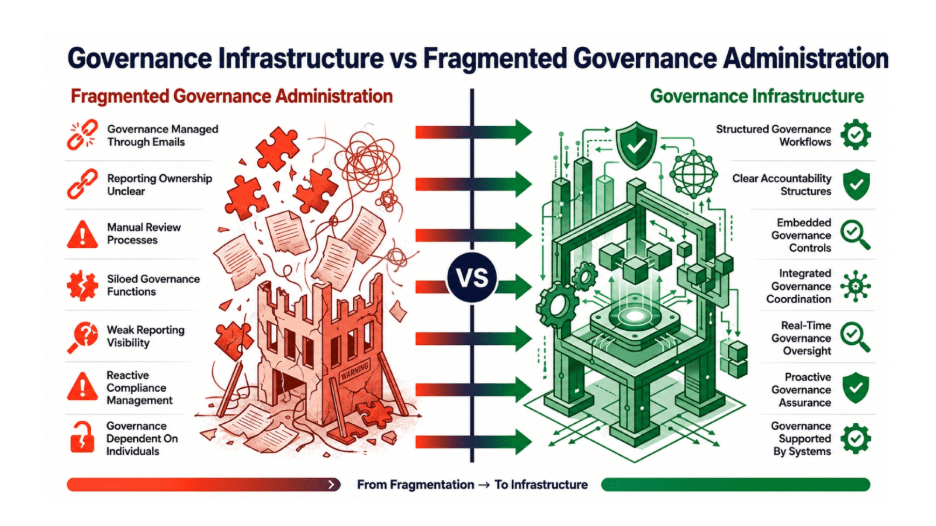
Without these systems, governance becomes heavily dependent on manual coordination and individual capability.
That model becomes increasingly unsustainable under modern regulatory expectations.
The FRC’s position effectively reinforces a broader governance reality:
Internal control assurance cannot exist credibly without operational governance infrastructure supporting it underneath.
Governance Infrastructure vs Fragmented Governance Administration
Why Boards Must Become More Digitally Governance-Literate?
The modern governance environment increasingly requires boards to understand not only governance policy, but governance systems.
That includes:
- Digital Reporting Governance
- Data Integrity Controls
- Workflow Visibility
- Governance Technology Risks
- Internal Control Architecture
- Operational Governance Infrastructure
Boards do not need to become technical specialists.
But they do need sufficient governance literacy to ask the right questions:
- How reliable are our reporting workflows?
- Where does governance visibility break down?
- Can we evidence governance accountability clearly?
- Are governance controls dependent on individuals or systems?
- Do we possess operational governance resilience?
These are no longer purely operational questions.
They are governance questions.
Why CoSec Hub Matters in This Environment?
This is precisely why governance infrastructure platforms like CoSec Hub are becoming increasingly important.
The governance challenge many organisations face today is not simply compliance execution. It is governance coordination, visibility and continuity.
CoSec Hub was built as a Company Secretary Command Centre designed to help organisations operationalise governance through:
- Structured Governance Workflows
- Governance Visibility
- Accountability Tracking
- Centralised Governance Records
- Audit Trail Management
- Governance Continuity Systems
- Board And Entity Oversight
- Governance Infrastructure Support
As governance expectations become more digital, integrated and evidence-driven, organisations require governance systems capable of supporting that complexity operationally.
Governance can no longer rely on fragmented administration and institutional memory alone.
Explore CoSec Hub:
cosec.lumorus.com
What Strong Governance Infrastructure Enables?
The FRC’s Message Is Bigger Than Financial Reporting
The deeper significance of the FRC’s intervention is not simply about technical reporting compliance.
It is about governance credibility.
Regulators are increasingly assessing whether organisations possess the governance infrastructure required to operate responsibly in modern, complex and digitally connected environments.
Weak digital reporting processes expose something larger:
Weak governance coordination.
And increasingly, boards will be judged not only by whether governance policies exist, but by whether governance systems function effectively under scrutiny.
That is the real message behind the FRC’s digital reporting crackdown.
Lumorus: Better Business, Built on Purpose
At Lumorus, we believe Being Good is Better for Business.
We help organisations lead with integrity, govern with confidence and create value that lasts. Through our work across Governance Advisory, Company Secretary Service and ESG-Social Impact Consulting, we support boards, executives and leadership teams to strengthen accountability, improve decision making and build resilient, responsible organisations.
With offices and expert teams across the UK, Africa, the Caribbean, Latin America and Canada, and clients operating globally, Lumorus brings international perspective, specialist expertise and practical judgement to every engagement.
Whether you are strengthening governance infrastructure, improving internal control oversight, operationalising governance workflows or enhancing governance resilience, Lumorus is here to help you move from intention to action.
Together, we can build better business: one that performs with purpose, leads with integrity and creates lasting value for people, planet and profit.
To continue the conversation, visit:
www.lumorus.com
cosec.lumorus.com
[email protected]
Sources
- Financial Reporting Council — FRC Concludes Annual Review of FRS 101