


Most organisations think they have governance infrastructure. Most do not.
Ask a board whether the organisation has governance in place and the answer is usually yes.
There are board meetings.
Policies exist.
Committees have been established.
Reports are produced.
Compliance obligations are managed.
From the outside, governance appears to be functioning.
Yet beneath the surface, a different reality often emerges.
Critical information sits in spreadsheets.
Entity records are scattered across multiple systems.
Board actions are tracked inconsistently.
Governance responsibilities depend on a handful of individuals.
Compliance visibility is fragmented.
Decision-making is difficult to evidence.
What many organisations describe as governance is often a collection of activities rather than a governance system.
And that distinction matters.
Because governance infrastructure is not about whether governance activities occur.
It is about whether governance can be executed consistently, monitored effectively and scaled as complexity increases.
Read More: Corporate governance infrastracture
Governance is not paperwork. It is infrastructure.
Most people think of governance as meetings, policies and compliance.
Those things matter.
But they are outputs.
Governance infrastructure is the underlying architecture that makes effective governance possible.
Just as an organisation needs financial infrastructure to manage money and technology infrastructure to manage information, it needs governance infrastructure to manage accountability, authority, oversight and decision-making.
At its simplest, governance infrastructure is the collection of systems, processes, controls, information flows and accountability mechanisms that allow governance to function.
Without it, governance becomes dependent on effort rather than design.
What governance infrastructure actually includes
Strong governance infrastructure extends far beyond board meetings and corporate policies.
It typically includes:
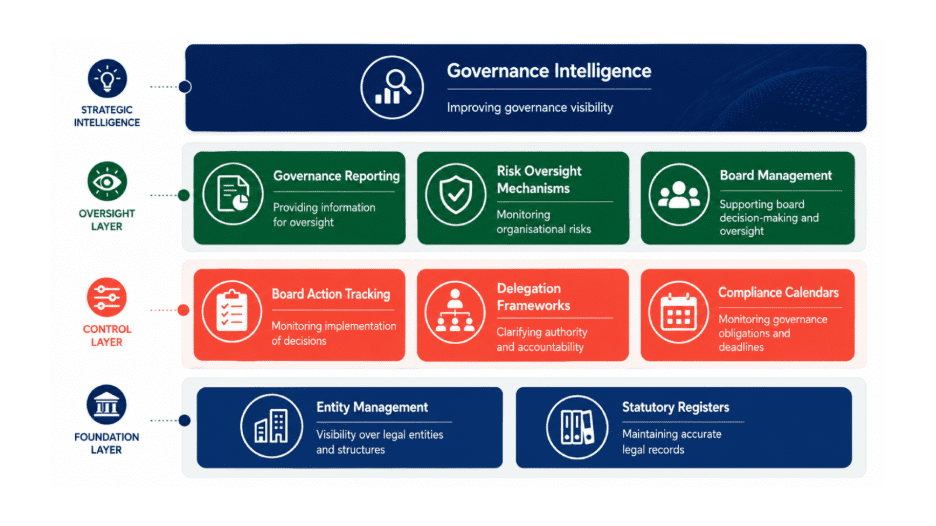
Each element performs a different function.
Together, they create governance capability.
Why most organisations do not have governance infrastructure
The answer is surprisingly simple.
Most organisations evolved faster than their governance systems.
As businesses grow, governance complexity increases incrementally.
A new subsidiary is added.
A new director joins the board.
Operations expand internationally.
Additional regulations emerge.
Investor scrutiny increases.
The governance burden grows.
What often does not grow at the same pace is governance architecture.
Instead, organisations compensate through effort.
More spreadsheets.
More emails.
More manual tracking.
More reliance on individual experience.
For a period, this works.
Eventually it does not.
Read More: Governanace Infrastructure Design
The hidden costs of weak governance infrastructure
Poor governance infrastructure rarely appears immediately on a profit and loss statement.
Its costs are often indirect.
They emerge through inefficiency, risk and poor visibility.
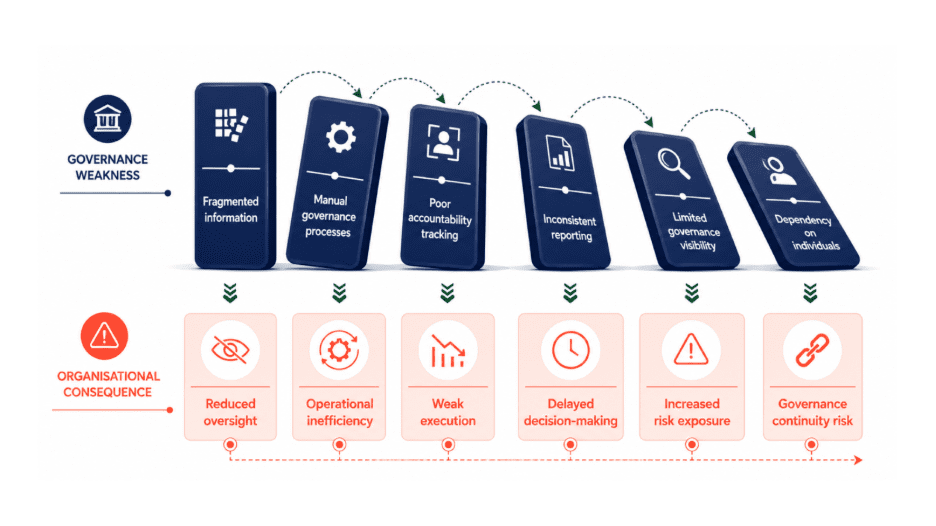
These problems become more significant as organisations grow.
Complexity magnifies governance weaknesses.
The board often sees the symptoms, not the cause
Many governance discussions focus on visible issues.
Missed filings.
Board information arriving late.
Compliance failures.
Delayed approvals.
Ineffective committees.
These are symptoms.
The underlying issue is frequently infrastructure.
A board cannot effectively oversee an organisation if governance information is fragmented.
Management cannot execute governance responsibilities consistently if accountability is unclear.
Company secretaries cannot maintain governance visibility if records are dispersed across multiple systems.
Governance failures are often infrastructure failures before they become compliance failures.
Governance infrastructure is ultimately about visibility
One of the most overlooked benefits of governance infrastructure is visibility.
Effective governance requires answers to simple questions.
What decisions have been made?
Who is accountable?
What actions remain outstanding?
What compliance obligations exist?
Which entities require attention?
What governance risks are emerging?
Without governance infrastructure, answering these questions becomes difficult.
With governance infrastructure, governance becomes observable, measurable and manageable.
That is a profound difference.
Why governance infrastructure matters more than ever
Several trends are increasing the importance of governance infrastructure.
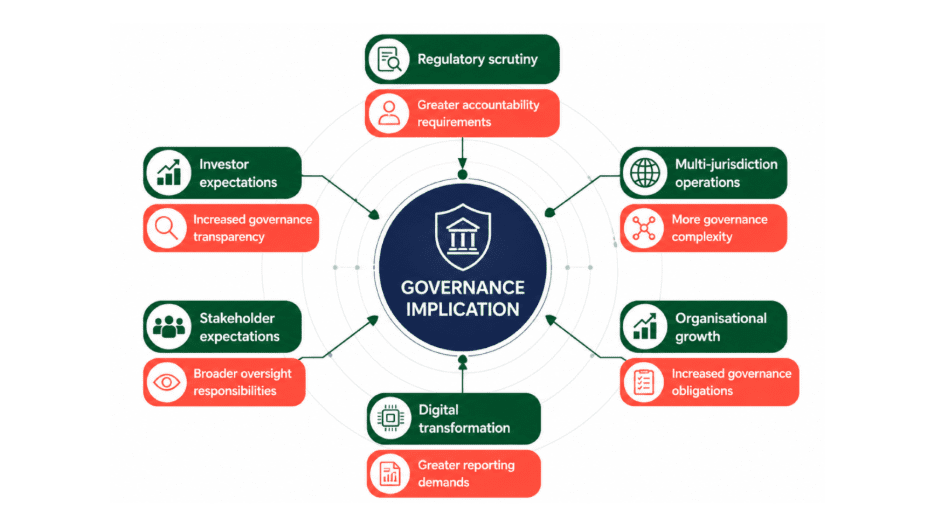
The organisations that manage these pressures most effectively are rarely those with the most policies.
They are usually those with the strongest governance systems.
Governance maturity is not measured by documentation
Many organisations confuse documentation with governance capability.
Policies matter.
Minutes matter.
Reports matter.
But governance maturity is determined by whether governance can function consistently under pressure.
Can the organisation maintain oversight as complexity increases?
Can governance survive leadership transitions?
Can accountability be demonstrated?
Can decisions be traced from approval to execution?
Can risks be identified before they become failures?
These are infrastructure questions.
And they reveal far more about governance quality than the number of policies stored on a shared drive.
The future belongs to organisations that treat governance as a system
The most effective organisations increasingly view governance differently.
They see governance not as a compliance requirement but as organisational infrastructure.
Just as no serious organisation would operate without financial systems, technology systems or operational systems, governance systems are becoming equally important.
This shift matters because governance ultimately determines how power is exercised, challenged, monitored and held accountable.
When governance infrastructure is strong, organisations become more resilient, more transparent and better equipped to manage complexity.
When governance infrastructure is weak, governance eventually becomes reactive.
And reactive governance is usually expensive governance.
Lumorus: Better Business, Built on Purpose.
At Lumorus, we believe Being Good is Better for Business.
We help organisations lead with integrity, govern with confidence and create value that lasts. Our work supports boards, executives and leadership teams to strengthen governance infrastructure, improve accountability and build resilient organisations capable of operating effectively in increasingly complex environments.
Across our Governance Advisory, Company Secretary Service and ESG-Social Impact Consulting practices, we combine strategic insight with practical governance delivery. We work collaboratively with organisations to build governance systems that are proportionate, operationally effective and designed for long-term value creation.
With offices and expert teams across the UK, Africa, the Caribbean, Latin America and Canada, and clients operating globally, Lumorus brings international perspective, specialist expertise and practical judgement to every engagement.
Whether you are strengthening governance oversight, operationalising governance workflows or building governance infrastructure capable of supporting future growth and resilience, Lumorus is here to help you move from intention to action.
Together, we can build better business: one that performs with purpose, leads with integrity and creates lasting value for people, planet and profit.
To continue the conversation, visit:
www.lumorus.com
[email protected]