



Most ESG programmes have a measurement problem
Organisations are investing more money, resources and leadership attention into ESG than ever before.
Sustainability strategies are expanding.
Social impact programmes are growing.
ESG reports are becoming longer and more sophisticated.
Stakeholder expectations continue to rise.
Yet a fundamental question often remains unanswered.
How do organisations know whether their ESG initiatives are actually working?
For many organisations, the answer is surprisingly unclear.
Boards receive ESG reports.
Investors review sustainability disclosures.
Leadership teams monitor performance indicators.
But many organisations still struggle to determine whether their ESG activities are creating meaningful outcomes.
This is where MEAL becomes critically important.
Monitoring, Evaluation, Accountability and Learning, commonly known as MEAL, is increasingly emerging as one of the most important but least understood disciplines within ESG.
Without it, ESG can become a reporting exercise.
With it, ESG becomes measurable, accountable and capable of driving genuine organisational improvement.
According to the Organisation for Economic Co-operation and Development (OECD), organisations are under increasing pressure to strengthen the credibility, transparency and effectiveness of sustainability and impact initiatives through stronger measurement and evaluation practices.
Read More: ESG Accountability & Measurable Impact
What does MEAL stand for?
MEAL stands for:
- Monitoring
Tracking activities, performance and progress over time.
- Evaluation
Assessing whether activities are achieving intended outcomes and objectives.
- Accountability
Ensuring organisations remain responsible to stakeholders, beneficiaries, investors, regulators and communities.
- Learning
Using evidence and experience to improve future decision-making and performance.
Originally developed within international development, humanitarian and social impact sectors, MEAL is increasingly being adopted by companies seeking to improve ESG performance and impact measurement.
The reason is simple.
Many organisations have ESG strategies.
Far fewer have systems capable of determining whether those strategies are effective.
Why ESG reporting alone is no longer enough
For many years, ESG reporting focused primarily on disclosure.
Organisations reported:
- Carbon emissions
- Community investment
- Diversity statistics
- Employee engagement
- Governance activities
While these disclosures remain important, stakeholders increasingly want something more.
They want evidence.
According to the Global Impact Investing Network (GIIN), investors are placing greater emphasis on outcome measurement and impact verification rather than simply reviewing ESG commitments and reported activities.
This reflects a broader shift.
The question is no longer:
What did the organisation do?
The question is becoming:
What difference did it make?
This is fundamentally a MEAL question.
Monitoring: Seeing what is happening
Many ESG programmes fail because organisations lack visibility.
Monitoring creates visibility.
It helps organisations track:
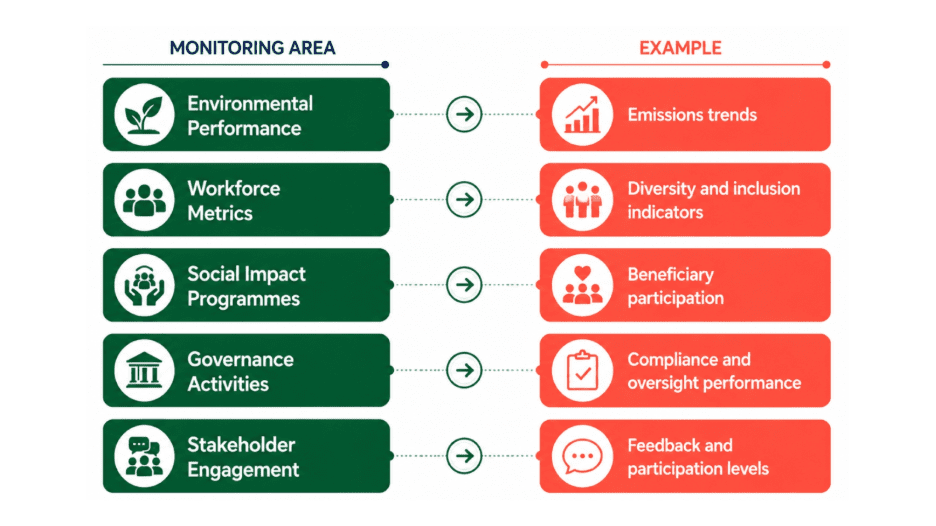
Without monitoring, organisations are often managing ESG initiatives based on assumptions rather than evidence.
Good monitoring provides the foundation for effective governance.
Without reliable information, neither management nor boards can exercise meaningful oversight.
Read More: ESG Reporting & Disclosure
Evaluation: Determining whether ESG initiatives work
One of the biggest weaknesses in ESG programmes is the assumption that activity automatically creates impact.
It does not.
An organisation may launch sustainability initiatives, employee wellbeing programmes or community investment projects.
The existence of these programmes does not prove effectiveness.
Evaluation helps answer critical questions:
- Did the programme achieve its objectives?
- Were resources used effectively?
- What outcomes were created?
- What needs improvement?
- What should be scaled or discontinued?
According to the International Finance Corporation (IFC), organisations often struggle to move from activity measurement to impact evaluation because robust evaluation frameworks are frequently absent.
This creates a gap between intention and evidence.
Accountability: The missing link in many ESG strategies
Many organisations talk about accountability.
Far fewer operationalise it.
Accountability means ensuring that commitments are linked to ownership, oversight and responsibility.
Effective accountability requires clarity around:
Without accountability, ESG commitments often become aspirations rather than obligations.
According to the World Economic Forum, accountability mechanisms remain one of the most important determinants of whether sustainability commitments translate into meaningful organisational change.
Learning: The most overlooked component of ESG performance
Many organisations focus heavily on reporting.
Few focus sufficiently on learning.
Yet learning may be the most valuable component of MEAL.
Learning allows organisations to:
- Identify what works
- Understand what does not
- Improve programme design
- Strengthen stakeholder engagement
- Allocate resources more effectively
- Improve long-term ESG performance
A learning culture transforms ESG from a compliance exercise into a continuous improvement process.
Organisations that learn systematically tend to improve systematically.
Those that do not often repeat the same mistakes.
Why boards should care about MEAL
MEAL is not simply an operational tool.
It is a governance issue.
Boards increasingly face questions regarding:
- ESG performance
- Social impact
- Sustainability commitments
- Stakeholder outcomes
- Responsible business practices
Answering these questions requires more than disclosures.
It requires evidence.
According to the Financial Reporting Council (FRC), effective governance depends on high-quality information that enables boards to exercise informed judgement and effective oversight.
MEAL provides that information.
Without it, ESG oversight becomes significantly more difficult.
The future of ESG belongs to organisations that can demonstrate impact
The ESG landscape is evolving rapidly.
Investors are becoming more sophisticated.
Stakeholders are becoming more demanding.
Regulators are increasing expectations.
Boards are facing greater scrutiny.
In this environment, organisations can no longer rely solely on commitments, narratives and reporting.
They need evidence.
They need accountability.
They need learning.
They need measurement systems capable of demonstrating whether ESG initiatives are creating real value.
That is precisely what MEAL was designed to provide.
The organisations that adopt strong MEAL frameworks will be better positioned to improve performance, strengthen trust and demonstrate meaningful impact.
Those that do not may increasingly struggle to prove that their ESG efforts are delivering the outcomes they claim.
Because ultimately, ESG credibility is not built through reporting.
It is built through evidence.
Read More
Lumorus: Better Business, Built on Purpose
At Lumorus, we believe Being Good is Better for Business.
Lumorus is a UK-headquartered global governance, ESG, social impact and advisory firm supporting organisations across Europe, Africa, Asia, the Caribbean, Canada, the Middle East and international markets.
For more than a decade, we have helped organisations strengthen governance, improve accountability and build ESG and social impact frameworks capable of delivering measurable outcomes.
Our expertise includes:
- ESG Strategy
- Social Impact Measurement & Management
- Monitoring, Evaluation, Accountability and Learning (MEAL)
- ESG Reporting & Disclosure
- Materiality Assessments
- Governance Advisory
- Board Effectiveness
- Sustainability Strategy
We help organisations move beyond ESG activity towards ESG accountability, measurable impact and long-term value creation.
To explore Lumorus ESG, sustainability and impact solutions, visit:
Together, we can build better business: one that performs with purpose, leads with integrity and creates lasting value for people, planet and profit.