


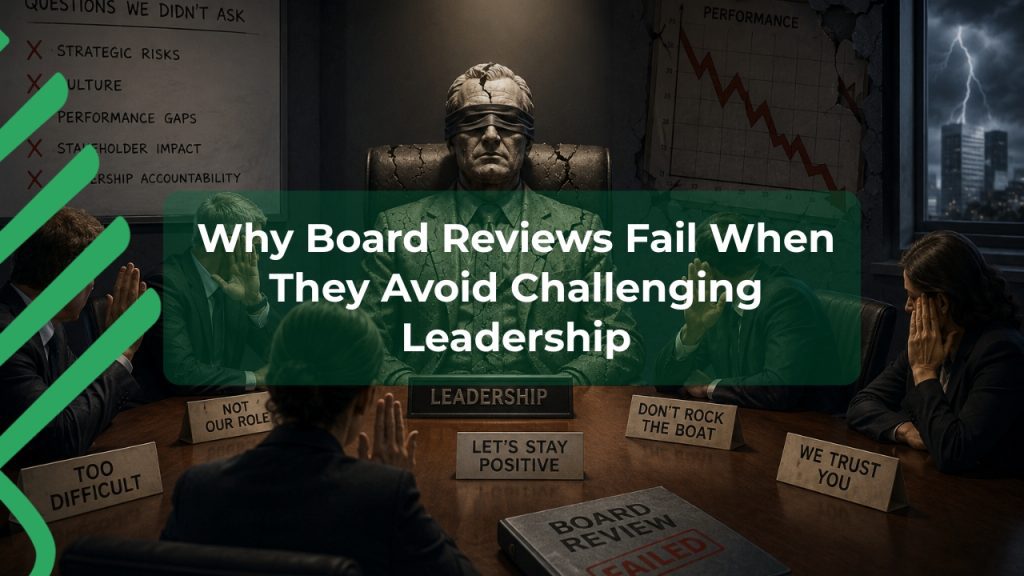
Most board reviews do not fail because the methodology is poor.
They fail because the process was never designed to surface uncomfortable truths in the first place.
In many organisations, board evaluations become carefully managed governance exercises designed to avoid tension, preserve relationships, and protect influential stakeholders from scrutiny.
The result is a board review process that produces documentation without producing governance improvement.
This creates a serious governance problem.
Boards increasingly operate under growing regulatory pressure, investor scrutiny, and accountability expectations. Regulators, shareholders and stakeholders expect boards to demonstrate genuine governance effectiveness, not procedural compliance.
Yet many board evaluations still function as low friction exercises focused on reassurance rather than challenge.
That creates governance blind spots.
Weak challenge inside the boardroom often leads to weak oversight outside it.
This is precisely why independent board evaluations are becoming increasingly important for regulated organisations, scaling businesses and governance focused boards seeking stronger accountability and governance performance.
Why Boards Conduct Reviews in the First Place
Board evaluations are intended to improve governance effectiveness.
Under the UK Corporate Governance Code, boards are expected to regularly assess their own effectiveness, committee performance, leadership dynamics and governance oversight.
The objective is not administrative compliance.
The objective is governance improvement.
A properly conducted board effectiveness review should help boards assess:
- Board Dynamics
- Decision making Quality
- Oversight Effectiveness
- Strategic Alignment
- Risk Governance
- Committee Performance
- Accountability Structures
- Leadership Behaviour
- Governance Culture
- Board Composition
Done properly, board evaluations help organisations identify governance weaknesses before they become governance failures.
However, many evaluations never reach that level of honesty.
The real reason many board reviews fail
Board reviews often fail because the process becomes politically constrained long before the evaluation begins.
In some organisations, there is an unspoken expectation that the evaluation should:
- Confirm Existing Leadership
- Avoid Boardroom Tension
- Protect Senior Relationships
- Reinforce Stability Narratives
- Produce Minimal Disruption
- Avoid Escalating Governance Concerns
That fundamentally changes the purpose of the evaluation.
Instead of becoming a governance diagnostic exercise, the review becomes a governance reassurance exercise.
This creates several predictable outcomes:
- Difficult Conversations Are Avoided
- Weak Board Dynamics Remain Unaddressed
- Underperformance Is Softened
- Dominant Personalities Escape Scrutiny
- Governance Blind Spots Persist
- Structural Weaknesses Remain Embedded
According to Board Outlook’s analysis on why board reviews fail, ineffective evaluations frequently suffer from lack of candour, insufficient independence and reluctance to confront difficult governance realities.
That creates a dangerous governance illusion.
The board appears compliant while underlying governance risks continue to grow.
Tick box Evaluations Create Governance Risk
Many boards still approach evaluations as procedural obligations rather than governance improvement mechanisms.
This often results in:
- Generic Survey Templates
- Superficial Interviews
- Limited Diagnostic Depth
- Low challenge Discussions
- Formulaic Reporting
- Minimal accountability follow through
The process becomes performative rather than transformational.
Board Excellence has consistently highlighted the limitations of inconsistent and tick-box board evaluations that fail to produce measurable governance improvement.
This matters because governance risk rarely emerges from what boards openly discuss.
It usually emerges from what boards avoid discussing.
A board evaluation that fails to surface difficult governance dynamics may unintentionally reinforce governance weakness rather than resolve it.
The Governance Risks Boards Often Avoid Discussing
Many board evaluations avoid the areas that matter most.
These often include:
- Weak Chair Leadership
- Ineffective Challenge Culture
- Dominant Executive Influence
- Poor Succession Planning
- Committee Dysfunction
- Inadequate Risk Oversight
- Weak Accountability Structures
- Limited Strategic Debate
- Information Asymmetry
- Director Underperformance
These issues are uncomfortable precisely because they involve people, influence and power dynamics.
However, avoiding them creates long-term governance exposure.
Boards rarely experience governance failure because nobody noticed the warning signs.
Governance failure often occurs because organisations chose not to confront them early enough.
Why Internal Board Reviews Often Lack Independence
Internal board reviews can provide operational insights, but they often struggle to achieve genuine independence.
This is particularly true when:
- Senior Leadership Controls The Scope
- The Chair Oversees The Process
- Participants Fear Political Consequences
- Governance Teams Moderate Findings
- External Scrutiny Is Limited
- Sensitive Issues Are Softened
The result is governance filtering.
Critical observations become diluted through organisational sensitivity and political caution.
Thomas Lusiyano’s analysis of board evaluation pitfalls highlights how weak independence, insufficient challenge and limited transparency can significantly reduce the effectiveness of board reviews.
Boards cannot meaningfully improve governance performance if the evaluation process itself avoids governance tension.
Strong Board Evaluations Require Psychological Independence
Effective board evaluations require more than governance frameworks and questionnaires.
They require psychological independence.
Directors must feel able to speak candidly about:
- Board Behaviour
- Governance Weaknesses
- Leadership Concerns
- Strategic Misalignment
- Accountability Failures
- Oversight Limitations
Without that level of openness, evaluations become heavily curated governance exercises.
True governance effectiveness depends on whether boards are willing to examine uncomfortable realities before external stakeholders force them to.
That is where independent governance reviewers create significant value.
Independent facilitators can:
- Surface Difficult Conversations
- Reduce Internal Political Pressure
- Strengthen Objectivity
- Improve Governance Transparency
- Identify Structural Weaknesses
- Increase Evaluation Credibility
- Enhance Board Accountability
This is increasingly important in regulated environments where governance effectiveness is closely linked to organisational resilience and regulatory confidence.
What High performing Board reviews actually look like
Strong board evaluations do not focus solely on compliance.
They focus on governance performance.
High-performing board reviews typically assess:
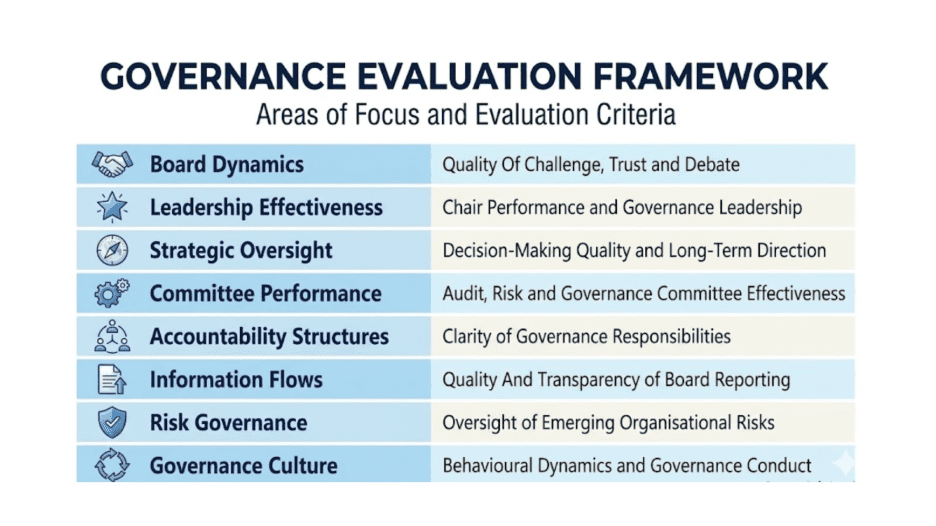
Importantly, effective evaluations also produce actionable governance outcomes.
That means:
- Clear Governance Recommendations
- Defined Accountability Actions
- Governance Improvement Priorities
- Follow-Up Monitoring
- Measurable Governance Development
Without implementation, even the strongest evaluation becomes another governance document sitting unread in a board portal.
Why Investors and Regulators Care About Board Effectiveness
Board effectiveness is no longer viewed as an internal governance issue alone.
Investors increasingly assess governance quality as part of organisational resilience, risk management and leadership credibility.
At the same time, regulators continue to place greater emphasis on governance accountability, oversight effectiveness and board responsibility.
This is particularly relevant for:
- FCA regulated firms
- Financial services organisations
- Multi-entity businesses
- Investor backed companies
- Regulated industries
- Scaling organisations preparing for growth
Weak governance oversight creates operational, reputational and regulatory exposure.
Boards that avoid governance challenge may unintentionally increase long-term organisational risk.
The Future of Board Reviews Will Be More Independent and More Rigorous
Governance expectations are changing.
Boards are under increasing pressure to demonstrate:
- Governance Transparency
- Oversight Effectiveness
- Accountability Structures
- Leadership Credibility
- Risk Governance Maturity
- Board Performance Improvement
As governance scrutiny increases, superficial evaluations will become increasingly inadequate.
The future of board effectiveness reviews will likely involve:
- Greater External Independence
- Stronger Governance Diagnostics
- Deeper Behavioural Assessment
- Increased Accountability Tracking
- More Measurable Governance Outcomes
Boards that treat evaluations as governance improvement mechanisms will be significantly better positioned than boards that continue treating them as procedural exercises.
How Lumorus Supports Stronger Board Effectiveness Reviews
Lumorus supports organisations through independent governance reviews designed to strengthen board effectiveness, governance accountability and organisational oversight.
Our board evaluation approach focuses on:
- Independent Governance Diagnostics
- Board Effectiveness Reviews
- Governance Structure Assessments
- Governance Risk Identification
- Board Dynamics Analysis
- Committee Effectiveness Reviews
- Governance Improvement Recommendations
- Governance Maturity Development
We believe board reviews should do more than confirm governance activity.
They should improve governance performance.
Conclusion
A board review should not exist to protect leadership comfort.
It should exist to strengthen governance accountability, improve board effectiveness and identify governance risks before they escalate.
Lumorus helps organisations conduct independent board evaluations that deliver meaningful governance insight, stronger oversight and actionable governance improvement.
Book a Consultation Today
Lumorus.com | [email protected]
Sources
- Financial Reporting Council (FRC) — UK Corporate Governance Code
- Board Excellence — Board Effectiveness & Performance Beyond Inconsistent Tick-Box Evaluations
- Board Outlook — The Six Reasons Board Reviews Fail
- Thomas Lusiyano — Board Evaluation: Seven Pitfalls to Avoid
- Harvard Law School Forum on Corporate Governance — Why Good Boards Make Bad Decisions
- Skadden — Effective Board Evaluations
- Diligent Institute — Best Practices for Board Evaluations
- London Business School — Disaster in the Boardroom: 6 Ways a Board Can Fail
- Advisory Board for Excellence — Governance & Board Effectiveness Insights