


The biggest ESG challenge facing boards is not reporting. It is oversight.
Over the past decade, ESG has become a boardroom issue.
Boards discuss it.
Investors ask about it.
Regulators increasingly expect it.
Annual reports contain more ESG disclosures than ever before.
Yet beneath the reporting activity lies a more uncomfortable reality.
Many boards still do not know what effective ESG oversight actually looks like.
Some boards review ESG reports quarterly and assume oversight is taking place.
Others delegate ESG responsibility to management and receive periodic updates.
Many approve ESG strategies without fully understanding the governance structures required to monitor execution.
The result is that ESG often exists within organisations as a reporting exercise rather than a governance discipline.
That distinction matters.
Because ESG failures are rarely reporting failures.
They are governance failures.
Read More: ESG Reporting & Disclosure
ESG is fundamentally a governance issue
The term ESG can sometimes obscure the real challenge.
Environmental issues involve operational risk, regulatory exposure and long-term resilience.
Social issues involve workforce management, stakeholder legitimacy, supply chain integrity and organisational culture.
Governance issues concern oversight, accountability, incentives, decision-making and control.
At their core, all three require governance.
This means boards should not ask:
- What is our ESG strategy?
They should ask:
- How do we govern ESG risks and opportunities?
- Who is accountable?
- What information reaches the board?
- How do we know whether management is performing?
- What decisions require board oversight?
These are governance questions.
And governance is ultimately the board’s responsibility.
Why many boards struggle with ESG oversight
The challenge is not a lack of interest.
Most boards understand ESG matters.
The problem is that many organisations adopted ESG reporting before developing ESG governance.
This creates several common weaknesses.
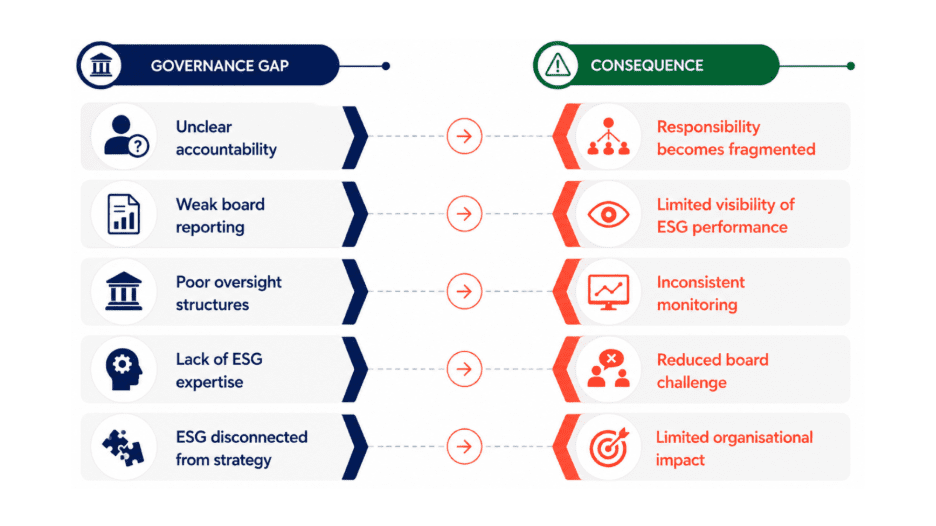
In many organisations, ESG sits across multiple functions.
Sustainability teams manage reporting.
Human resources oversee workforce initiatives.
Risk teams monitor compliance.
Legal teams address regulatory obligations.
Operations manage environmental impacts.
The board receives information from all of them but often lacks an integrated oversight framework.
Read More: Sustainability & Responsibility
What good ESG oversight actually looks like
Good ESG oversight is not measured by the length of a sustainability report.
It is measured by the quality of governance surrounding ESG decisions.
Effective boards typically demonstrate five characteristics.
ESG accountability is clearly defined
One of the most common governance failures is ambiguity.
Boards should know:
- Who owns ESG strategy
- Who manages implementation
- Who monitors performance
- Who reports to the board
- Who is accountable for outcomes
Without clear accountability, oversight becomes difficult and responsibility becomes diluted.
ESG is integrated into strategy
Many organisations treat ESG as a parallel programme.
Leading organisations integrate ESG into core business decision-making.
This means ESG considerations influence:
- Capital allocation
- Risk management
- Investment decisions
- Workforce strategy
- Supply chain decisions
- Long-term planning
When ESG sits outside strategy, boards often struggle to assess its relevance and impact.
The board receives meaningful information
More information does not necessarily mean better oversight.
Many boards receive extensive ESG reports containing large volumes of data but limited insight.
Good ESG reporting should help directors understand:
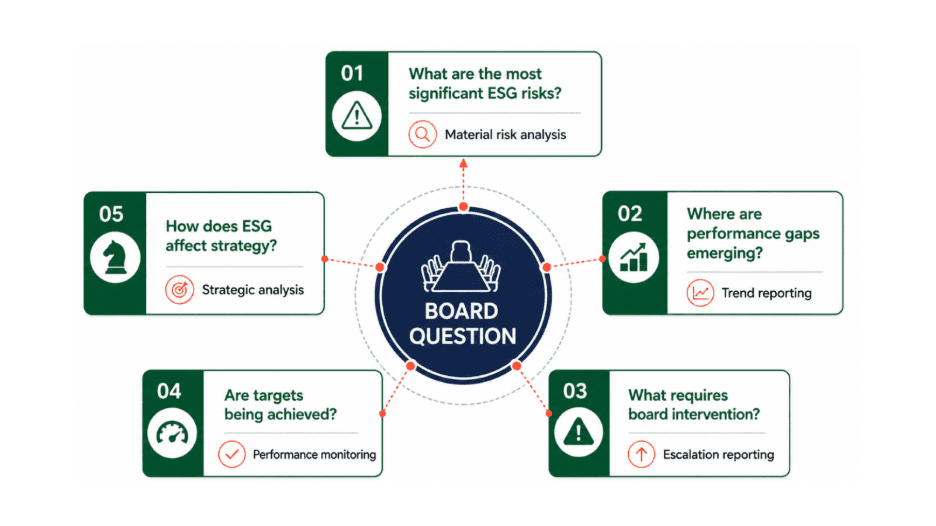
The objective is not reporting for its own sake.
The objective is informed board decision-making.
ESG oversight is embedded in governance structures
Effective oversight requires structure.
Boards should consider:
- Committee responsibilities
- Reporting lines
- Escalation processes
- Risk oversight frameworks
- Performance monitoring mechanisms
ESG should not depend on individual enthusiasm.
It should be embedded within governance architecture.
When governance structures are weak, ESG oversight often becomes inconsistent.
Incentives support long-term outcomes
One of the most overlooked aspects of ESG oversight is incentives.
Boards cannot expect management to prioritise long-term outcomes if reward structures encourage only short-term performance.
Effective oversight requires boards to consider:
- Executive remuneration
- Performance measures
- Risk incentives
- Cultural drivers
- Accountability mechanisms
Behaviour follows incentives.
Governance must recognise this reality.
The danger of confusing reporting with oversight
Many organisations continue to invest heavily in ESG reporting.
Reporting matters.
Transparency matters.
Disclosure matters.
But none of these are substitutes for governance.
A beautifully designed sustainability report does not guarantee effective oversight.
In some cases, extensive reporting can create a false sense of confidence.
The real question is not whether the organisation reports ESG information.
The real question is whether the board understands, challenges and governs ESG performance.
Those are very different standards.
What boards should be asking
Boards seeking stronger ESG oversight should focus on governance rather than disclosure alone.
Questions worth asking include:
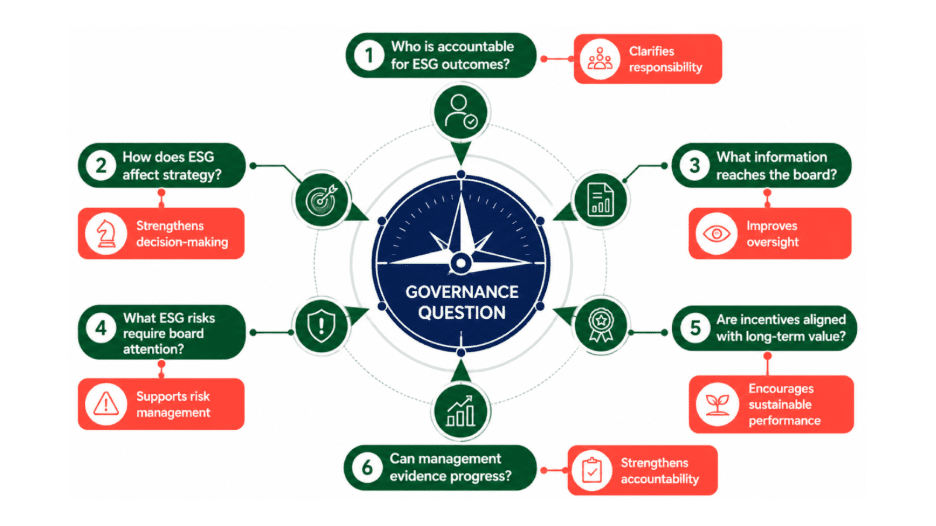
The quality of these discussions often determines the quality of ESG oversight.
ESG is ultimately about stewardship
The most effective boards understand that ESG is not a separate governance issue.
It is governance.
At its core, ESG asks a simple question.
Can the organisation create long-term value while managing its responsibilities to shareholders, employees, customers, communities and the wider environment?
Answering that question requires more than disclosure.
It requires judgement.
It requires challenge.
It requires accountability.
And above all, it requires governance.
Boards that view ESG primarily as a reporting exercise may satisfy disclosure requirements.
Boards that view ESG as a governance responsibility are more likely to strengthen resilience, protect organisational trust and support long-term value creation.
The difference is significant.
Because ultimately, ESG performance is rarely determined by what organisations say.
It is determined by how they are governed.
Read More:
Lumorus: Better Business, Built on Purpose
At Lumorus, we believe Being Good is Better for Business.
Lumorus is a UK headquartered global governance, ESG, social impact and advisory firm supporting organisations across Europe, Africa, Asia, the Caribbean, Canada, the Middle East and other international markets.
For more than 10 years, Lumorus has supported boards, leadership teams, regulated entities, NGOs, development organisations and multinational businesses in strengthening governance, improving accountability and building organisational resilience.
Our expertise spans:
- Governance Advisory
- ESG And Sustainability
- Social Impact Strategy
- Materiality Assessments
- ESG Reporting And Disclosure
- Social Impact Measurement
- Board Effectiveness
- Governance Infrastructure
We help organisations strengthen governance infrastructure, accountability systems and leadership oversight capability as stakeholder expectations, regulatory scrutiny and sustainability risks continue to evolve.
Is your ESG programme creating activity or credibility?
If the answer is unclear, it may be time to assess how ESG is governed, measured and evidenced across your organisation.
To explore Lumorus ESG, sustainability and social impact solutions, visit:
Together, we can build better business: one that performs with purpose, leads with integrity and creates lasting value for people, planet and profit