



Somewhere in your organisation right now, there is a someone, managing your governance function from a combination of email threads, spreadsheet trackers, calendar reminders and sheer force of will.
They are doing their best. That is not the problem.
The problem is that “doing their best” is not good governance practice nor is it a governance infrastructure. And at some point, the gap between what your governance function looks like and what is good modern governance practice will become visible – compliance failures, unforeseen risk, bad board and executive decisions.
These gaps have a way of showing there heads, usually happens at the worst possible moment. During a funding round. In the middle of due diligence. When a regulator asks a question, nobody can answer cleanly.
The numbers are stark. A 2024 governance benchmarking study found that 67% of SMEs with between 50 and 500 employees had no dedicated governance function in place. Of those, 81% described their current governance approach as “managed informally by an existing team member.” Only 19% could confirm that all statutory filings were current and all board decisions had been formally documented in the past 12 months.
That is not a minority problem. It is now the norm, and it is costing businesses more than they realize.
What Informal Governance Actually Looks Like
Most businesses do not set out to run governance informally. It happens gradually, almost invisibly, as the company grows faster than its processes.
It starts simply enough. You decide its time to have a board, so one is set up. No terms of reference or governance policies. Someone sends board papers by email. A resolution gets approved on a call and nobody records the votes or the who voted . A new director is appointed and the statutory register update gets added to a to do list that never quite reaches the top.
Then the company raises a round. Hires faster. Opens a subsidiary. Acquires property, takes debt etc etc., and suddenly the informal system that sort of worked at 20 people is carrying the weight of a business that looks nothing like it did when the system was built.
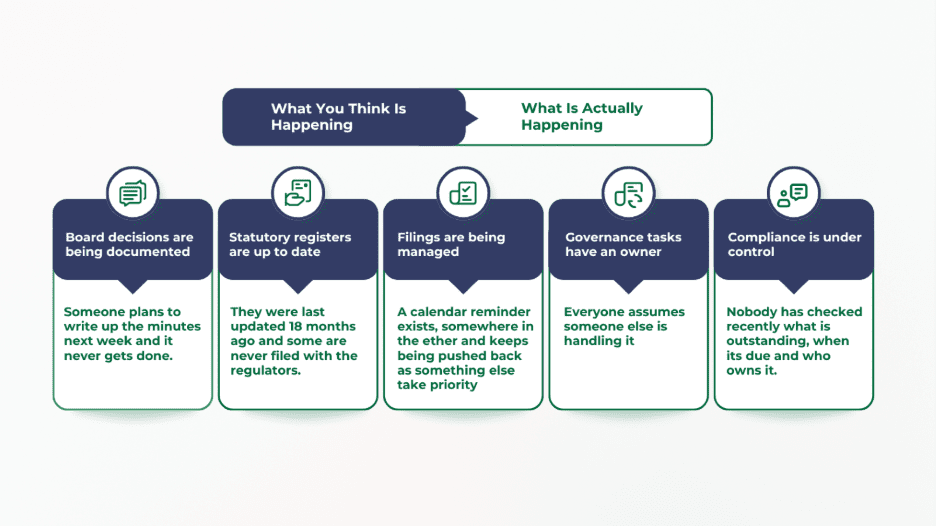
This is what informal governance looks like in practice:
Case Study: The Acquisition That Revealed Everything
A consumer goods business with four subsidiaries across two jurisdictions completed a bolt on acquisition in early 2023. During the post acquisition integration process, the acquiring team discovered that the target company had not formally documented any board resolution in over three years. Every significant decision had been made verbally, recorded nowhere, and approved by nobody on paper. The statutory registers were incomplete. Two directorships that had ended had never been formally resigned and removed at companies house. Remediation took five months and cost significantly more in legal fees than the governance infrastructure, that would have prevented it, ever would have.
Why Outlook Is Not a Governance System
Email is a communication tool. It is not a compliance record. It is not an audit trail. It is not a governance infrastructure.
And yet for the majority of growing businesses, it is exactly what governance runs on.
Tasks get sent by email and live in inboxes. Approvals happen by reply and exist nowhere searchable. Documents get attached to threads that are impossible to reconstruct twelve months later. Instructions to external advisors disappear when someone leaves the business.
The result is a governance function and infrastructure that is entirely dependent on individual memory, individual organisation and individual continuity. The moment any of those things breaks, the function breaks with it.
Research insight: A study of governance breakdowns in mid-market businesses, found that in 64% of cases, the primary cause was not wilful noncompliance but the absence of any structured system for capturing, tracking and completing governance obligations. (Source: ICSA Governance Benchmarking Report, 2023)
This is not a people problem. It is an infrastructure problem, andinfrastructure problems have infrastructure solutions.
Case Study: When the CoSec Left
A professional services firm with 180 employees had one person managing its entire governance function. When that person resigned, the business discovered it had no documented process, no organised filing system and no clear record of which statutory obligations were outstanding. The incoming replacement spent three months reconstructing records before they could begin operating the function semi-normally. During that period two filing deadlines were missed, triggering regulatory correspondence that took a further two months to resolve.
The firm had not done anything wrong deliberately. It had simply built a governance function entirely around one person rather than around a system and an infrastructure.
The Real Cost of Governance Running on Hope
Most businesses underestimate the cost of informal governance because the costs are largely invisible until they are not.
Cost category>> and how its shows up
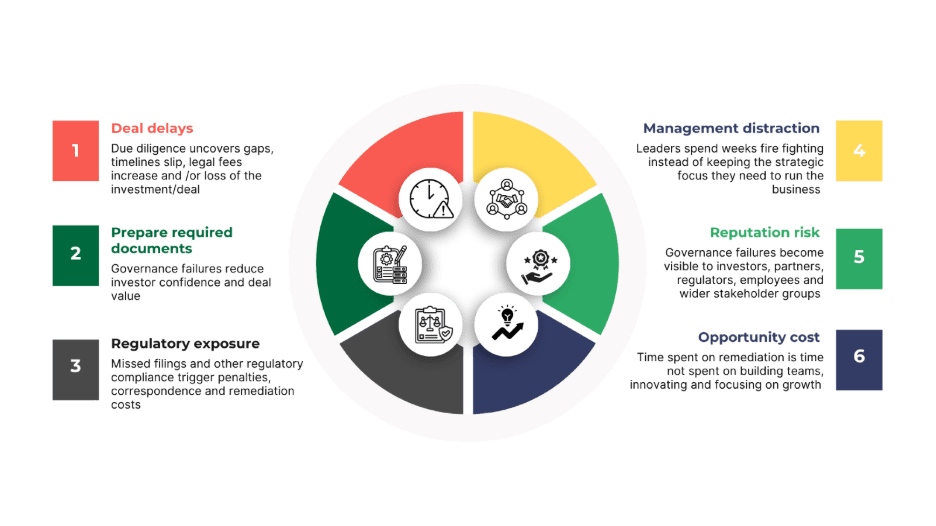
A governance function that runs on Outlook, word, excel, panic and hope, is not free. It is just expensive in ways that do not show up on a line item until something goes drastically wrong.
Research by a leading corporate governance advisory found that businesses that remediated governance failures during a funding process spent an average of three to four times more on legal and advisory fees than businesses that had maintained a structured governance function throughout. The governance infrastructure they were paying to fix retrospectively would have cost a fraction of the remediation.
What Real Governance Infrastructure Looks Like
Modern governance infrastructure is not complicated. But it does require three things that informal ways of working almost never have: a central place where everything lives, a clear process for every task, and a qualified professional accountable for outcomes.
The three pillars of a functional modern governance infrastructure:
- A single source of truth. Every document, resolution, filing, minutes, register and decision record lives in one place. Not across three shared drives, four email accounts and a folder on someone’s desktop. One place, version controlled, accessible to authorised users, with a full audit trail.
- A structured task and ownership system. Every governance obligation has a ticket, a timeline and a named owner. Not a calendar reminder that may or may not be seen. A system that tracks what needs to be done, who is doing it, and whether it has been completed.
- A qualified professional accountable for delivery. Not a finance manager doing their best alongside three other jobs. Not a PA or EA already over worked with managing busy executives. Not a junior staff members because you believe governance is just about taking meeting notes and writing it up. A chartered company secretary who knows what good corporate governance practice is, who understands what your regulatory obligations are, monitors them proactively, and acts on your behalf before deadlines become problems.
Conclusion
The question is not whether your business needs governance infrastructure. It already does. The question is whether the one you have is actually working.
Most businesses find out the answer to that question at the worst possible time. A filing missed. A decision that cannot be evidenced. A board that cannot account for what it agreed six months ago. By then the cost of informal governance has already landed.
The good news is that fixing it is not complicated. It requires the right structure, the right system, and the right professional. That is exactly what CoSec Hub was built to deliver.
If you want to understand what good governance practice looks like in practice, not in theory, we covered the fundamentals in depth in our webinar, Corporate Governance Essentials for Startups and Small Businesses.
What Lumorus CoSec Retainer
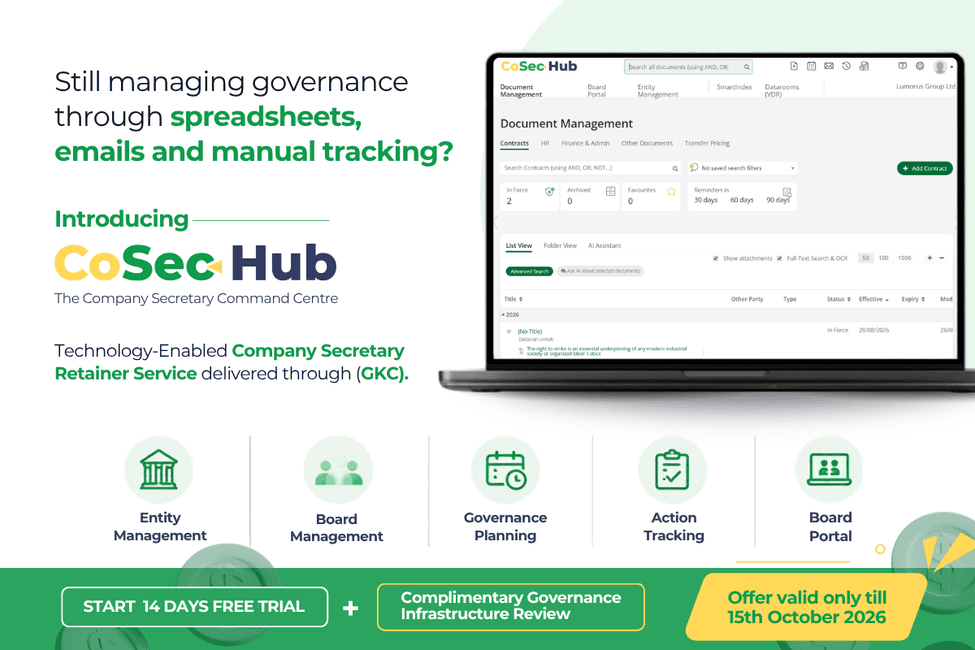
Lumorus CoSec Retainer Service is the answer to exactly this problem. It is a two layer governance infrastructure that combines smart technology – CoSec Hub, with qualified human expertise in our Governance Knowledge Centers, so that your governance function is never again dependent on one person, one inbox or one set of calendar reminders. Its your Governance Command Center offering 24/7 support by a team of governance specialist.
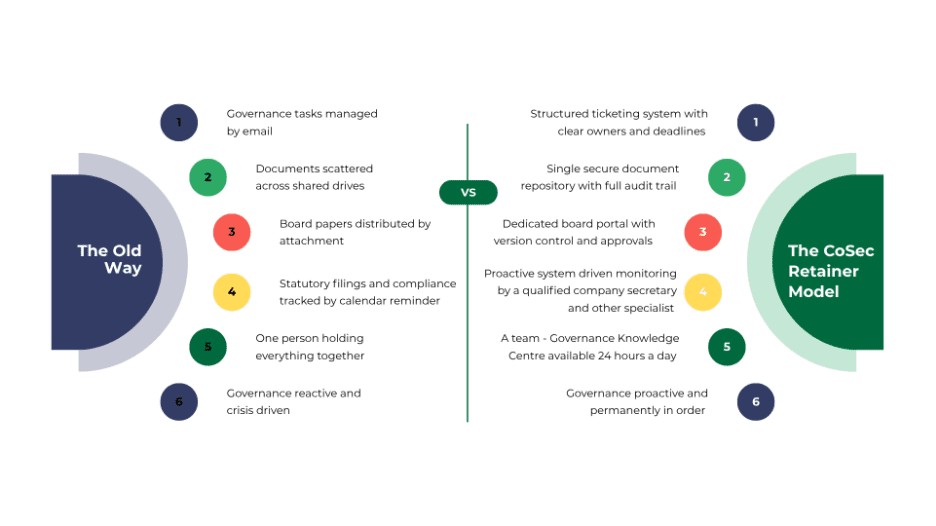
When you raise a task in CoSec Hub, it does not disappear into an inbox. It gets a ticket, a timeline, and an assigned expert who knows exactly what your regulatory obligations are. Every document is stored securely. Every filing is tracked. Every decision is recorded. Every meeting Action tracked and updated automatically. Every register updated and filled.
And when something changes, an urgent board meeting, when a director is appointed, a subsidiary is formed, a resolution needs to be passed at short notice, there is always a qualified professional ready to act.
The Question Every Business Leader Should Ask
Not “do we have a governance function?”
Almost every business will say yes to that.
The right question is: “if our governance function disappeared tomorrow, how long before something broke?”
If the honest answer is “immediately” or “we would not know for months,” you do not have a governance infrastructure. You have a person doing their best inside a system that was never properly designed and built.
Case Study: Governance Readiness That Closed a Deal
A technology business preparing for a Series B raise onboarded with Lumorus CoSec Retainer six months before going to market. By the time due diligence began, every resolution for the previous four years had been formally documented and stored. All statutory registers were current across three jurisdictions. Board minutes existed for every meeting. Board Goverance Manual and Committee Term of reference all drafted and approved with version control. The governance data room was complete before the investor even asked for it. The lead investor later noted that the quality of the governance documentation was one of the factors that accelerated their decision to proceed. The round closed in eleven weeks.
That is what good modern governance infrastructure looks like when it is built properly and robustly. Not a last minute scramble. Not a remediation exercise. A system that works quietly in the background so that when the moment comes, everything is already in order. That’s is Lumorus CoSec Retainer.
Getting Started
If you recognise your business in any of this, the starting point is not a full governance overhaul. It is simply getting the right infrastructure in place before the next deadline, the next raise, or the next moment when someone asks a question you cannot answer cleanly.
CoSec Retainer offers a free 30-day trial with a one time setup fee of $250 USD which goes towards your retainer if you continue after the trail period. You get full platform access, a qualified company secretary assigned to your account, a team in our Governance Knowledge center working for and supporting you 24/7, resulting in a clear picture of where your governance currently stands.
With 90% of the businesses that onboard, we usually find at least two or three things that need immediate attention within the first week. Better to find them now than when an investor or regulator does.
To get started, fill out this form: cosec.lumorus.com/application-form or contact the team directly at [email protected].
CoSec Hub is a product of Lumorus. Built for by chartered company secretaries and governance professionals for businesses that are serious about good modern governance infrastructure.
Find out more at cosec.lumorus.com or contact [email protected].
Citations
- Financial Reporting Council. UK Corporate Governance Code: Guidance on Board Effectiveness. 2024.
- Institute of Chartered Secretaries and Administrators (ICSA). Governance Benchmarking Report: SME Compliance Practices. 2023.
- Deloitte. Governance Failures in Mid Market Transactions: Causes and Costs. 2023.
- PwC. Due Diligence and Governance Readiness in Growth Stage Businesses. 2024.
- McKinsey and Company. The Governance Gap: How Growing Businesses Lose Value Through Informal Compliance. 2023.