


A Board Review Is Only as Valuable as What Changes Afterwards
A board can complete a rigorous performance review, accept every recommendation and still govern in much the same way six months later.
The evaluation may have been independent, the findings carefully considered and the recommendations unanimously supported. Management may subsequently prepare an action register, allocate responsibilities and report that implementation is progressing, creating the appearance of a board committed to continuous improvement.
Yet the next series of meetings can tell a different story.
Strategic proposals may still arrive without credible alternatives, directors might continue receiving lengthy papers that obscure the decisions requiring attention, while discussions about risk, succession and organisational performance remain largely unchanged.
The organisation has completed the review process without necessarily improving the quality of its governance.
This is one of the most important distinctions in board effectiveness. An action register can demonstrate that recommendations have been addressed administratively, but it cannot, on its own, establish that boardroom judgement, challenge or oversight has improved.
The real purpose of a Board Performance Review is to examine how effectively directors exercise their responsibilities and identify what should change. Its value therefore depends on whether the findings influence subsequent decisions, behaviours and governance practices.
The first 30 days following a review are particularly important, not because every weakness can be resolved within a month, but because this period should establish the conditions for meaningful improvement.
Priorities need to be agreed, responsibilities clarified and the evidence required to assess progress defined. Without these foundations, even a well-conducted evaluation can become another document that receives initial attention before gradually disappearing from the board agenda.
A structured Governance Action Plan helps prevent that outcome by connecting review findings to accountable decisions and observable changes in practice.
The challenge is to ensure that the plan becomes an instrument of governance rather than another administrative obligation.
Why Board Evaluation Follow-Through Matters More Than Ever
Board performance reviews have become an established feature of corporate governance, particularly among listed companies, regulated organisations and institutions operating across multiple jurisdictions.
However, the existence of a formal evaluation process does not guarantee that the board will address the weaknesses it identifies.
The UK Corporate Governance Code 2024 makes the importance of follow-through explicit. Provision 22 states that the Chair should act on the results of the board performance review by recognising strengths and addressing weaknesses, while individual directors should engage with the process and take appropriate action where development needs are identified.
Although the Code applies to companies within its scope rather than every organisation, the underlying principle has wider relevance.
A board should be able to demonstrate that its evaluation has influenced how it operates, not simply that the evaluation took place.
The Financial Reporting Council’s Corporate Governance Code Guidance reinforces the importance of considering how review outcomes are addressed and whether governance arrangements remain effective.
Research and commentary from Spencer Stuart similarly emphasise the importance of moving beyond evaluation findings towards practical board development.
The difficulty is rarely a complete absence of recommendations. More often, boards struggle to distinguish between actions that can be completed relatively quickly and improvements that require sustained changes in behaviour, information quality or decision making.
A revised board paper template may be introduced within weeks, while stronger strategic challenge may require several meetings before meaningful progress becomes visible.
Similarly, a succession planning framework can be approved without resolving underlying concerns about leadership readiness.
The essential question is not whether the board has completed its recommendations, but whether those recommendations have improved the way authority is exercised.
This requires a disciplined approach to prioritisation, implementation and review.
The 30-Day Governance Action Cycle
A useful improvement plan should concentrate on a manageable number of priorities and establish how each will be governed.
The following four-stage approach provides a practical framework for the first month after a Board Performance Review.
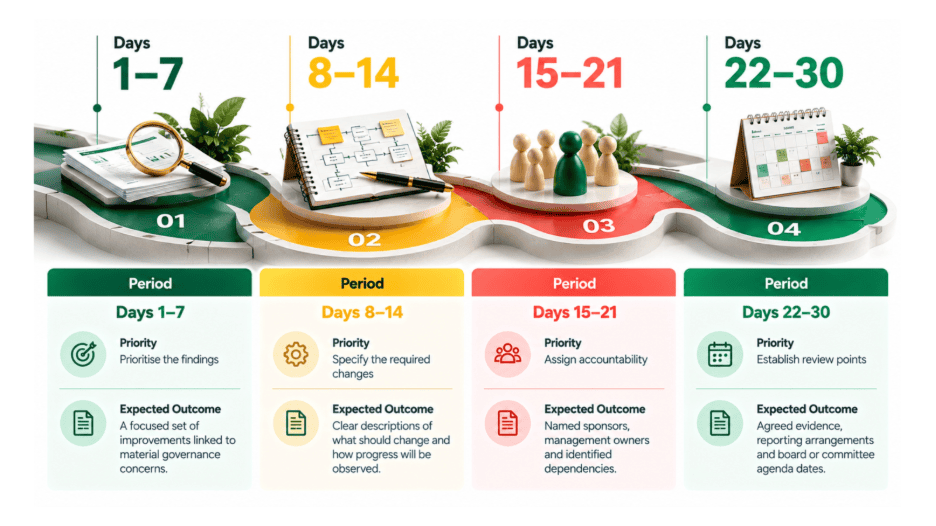
This is an illustrative management framework rather than a regulatory timetable. The pace should reflect the organisation’s circumstances, the seriousness of the findings and its governance calendar.
The objective is to establish an improvement process that the board can oversee, rather than attempt to complete every recommendation within 30 days.
1. Prioritise the Findings That Matter Most
A Board Performance Review may identify weaknesses across several areas, including strategic oversight, board composition, committee effectiveness, information quality, succession planning and organisational culture.
Not every recommendation deserves the same level of attention.
Some findings concern administrative processes that can be addressed through routine management action, while others reveal weaknesses capable of affecting major decisions or exposing the organisation to significant risk.
A board that attempts to implement every recommendation simultaneously may create an extensive improvement programme without giving sufficient attention to the matters that carry the greatest consequences.
Prioritisation should therefore begin with a clear assessment of materiality.
Where a review identifies weaknesses in the examination of major investment proposals, the potential consequences for capital allocation may justify immediate attention. Conversely, a minor inconsistency in meeting documentation may be important to correct without requiring sustained board-level discussion.
Urgency also matters.
An organisation preparing for an acquisition, regulatory review or leadership transition may need to accelerate particular improvements because the consequences of delay have increased.
However, boards should resist the temptation to select only those recommendations that are easiest to complete.
The most important governance weaknesses are not always the most convenient to address.
During the first week, the Chair and relevant committee leaders should consider the findings collectively, distinguish material priorities from routine improvements and agree why the selected issues require attention.
The Company Secretary can support this process by ensuring that decisions and responsibilities are recorded accurately.
A focused improvement agenda creates the conditions for deeper scrutiny, allowing the board to concentrate on changes that could materially improve its effectiveness.
2. Specify What Must Change in Practice
Governance recommendations often identify the right problem without defining the change required.
Improve strategic engagement, strengthen risk oversight and enhance board challenge may all describe legitimate concerns, but they offer limited guidance about what directors or management should do differently.
A meaningful Governance Action Plan should translate each recommendation into an observable change.
Consider a review that identifies insufficient challenge of management proposals.
The board could respond by asking management to include credible alternatives, principal assumptions and material risks in future strategic papers. Meeting agendas could also be adjusted to provide adequate time for discussion before significant decisions are made.
These are practical changes that can be implemented and examined.
However, the introduction of a revised paper format would not automatically establish that the original weakness had been resolved.
The board would still need to assess whether directors are examining alternatives more effectively, questioning important assumptions and exercising stronger judgement.
This distinction between implementation and effectiveness is fundamental.
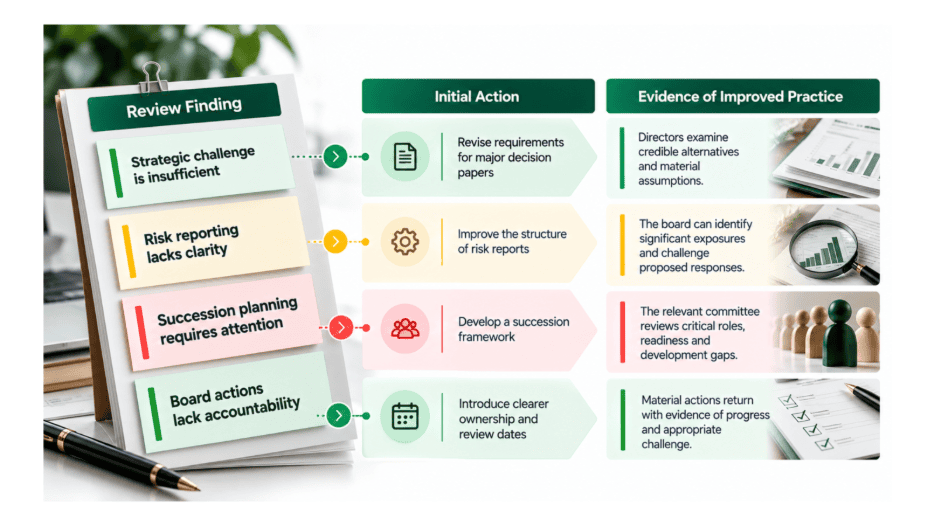
Not every improvement can be assessed through numerical measures.
Boardroom culture, constructive challenge and collective judgement often require qualitative evidence gathered over successive meetings.
A credible plan should recognise these differences rather than create artificial targets.
A completed activity is evidence that something happened. Improved governance requires evidence that something meaningful changed.
By the end of the second week, each priority should have a clear description of the intended improvement and the information that will help the board assess whether progress is occurring.
3. Assign Accountability Without Confusing Oversight and Delivery
One of the most persistent weaknesses in governance improvement programmes is unclear ownership.
Recommendations are sometimes allocated to a committee, management team or Company Secretary function without identifying who is responsible for ensuring that the required change occurs.
This can create the appearance of accountability while leaving responsibility dispersed.
A stronger approach distinguishes between board sponsorship, management delivery and governance coordination.
The Chair may sponsor improvements involving boardroom effectiveness, while the relevant committee could oversee changes relating to audit, risk, remuneration or nominations.
Where implementation requires management action, the appropriate executive should be responsible for delivery.
The Company Secretary can coordinate the Governance Action Plan, maintain records and ensure that outstanding matters return to the relevant governance forum.
However, the function should not become the default owner of recommendations that properly belong to management.
The G20/OECD Principles of Corporate Governance 2023 provide a useful international reference for the distinction between board oversight and executive management responsibilities.
For every significant recommendation, the improvement plan should establish the board or committee sponsor, the person responsible for operational implementation, the resources required and any dependencies that could delay progress.
These arrangements are particularly important when recommendations cross organisational boundaries.
A finding concerning the quality of risk reporting may require cooperation between finance, risk management, operational leadership and the Company Secretary.
Without clear ownership, each function may complete its individual tasks while the wider governance weakness remains unresolved.
Accountability becomes meaningful when one person is responsible for ensuring that the agreed response is delivered, while the board retains responsibility for examining its effectiveness.
By the third week, the organisation should have established these responsibilities and ensured that those involved understand what is expected.
4. Set a Review Point That Tests Improvement, Not Just Completion
A deadline can establish when an action should be completed, but it does not necessarily determine whether the action has achieved its intended purpose.
Management may deliver a revised policy on time while the underlying practice remains unchanged.
Similarly, directors may attend a development session without demonstrating stronger collective challenge at subsequent meetings.
An effective Governance Action Plan should therefore distinguish between implementation milestones and effectiveness reviews.
The board needs to know what evidence will return, when it will be considered and what decision may follow.
For example, a recommendation to improve strategic discussion could be reviewed after two or three material proposals have been considered using revised reporting arrangements.
Directors would then examine whether the quality of information and challenge had improved.
If progress remains insufficient, the board may need to refine the original action, request additional evidence or address a deeper behavioural issue.
The review process should be proportionate.
Routine administrative improvements may require straightforward confirmation, while changes affecting board dynamics or risk oversight may warrant more sustained examination.
An action should not be considered successful simply because its deadline has passed and the responsible person reports completion.
The more important test is whether the evidence supports a reasonable conclusion that the intended improvement is taking place.
By day 30, significant recommendations should have agreed review points reflected in the board or committee forward agenda.
The improvement process is then ready to be governed over subsequent meetings.
Worked Example: When Better Board Papers Do Not Produce Better Decisions
Consider an illustrative investment organisation whose independent Board Performance Review identifies weaknesses in strategic challenge.
Questionnaire responses suggest that directors are broadly satisfied with the quality of board discussions.
However, confidential interviews reveal concerns about the limited consideration of alternative investment strategies.
A review of selected board papers supports those concerns, showing that management proposals generally provide extensive financial analysis but relatively little examination of credible alternatives.
The board accepts the finding and agrees that the quality of strategic papers should improve.
The Administrative Response
Management introduces a revised reporting template requiring additional information about strategic options.
The Company Secretary records the change, and the action is subsequently marked complete.
However, directors continue to spend most of their time examining the preferred recommendation rather than testing the underlying strategic choices.
The reporting process has changed, but the quality of challenge may not have improved.
The Governance Response
Under a structured 30-day action cycle, the board first identifies strategic challenge as a priority because of its importance to investment decisions and risk.
Directors then agree what stronger practice should involve, including credible alternatives, clearer assumptions and sufficient time for deliberation.
The Chair sponsors the improvement, while the Chief Executive and investment leadership assume responsibility for the quality of management submissions.
A review point is scheduled after the next two significant investment discussions, allowing the board to examine whether the revised approach has produced more substantive challenge.
The first month does not establish that decision making has improved.
However, it creates a clear basis for testing that proposition.
This is the difference between an administrative action plan and a governance improvement process.
The purpose is not to make the board appear more active, but to strengthen the quality of the decisions for which it is accountable.
This is an illustrative scenario, not a claim about a specific Lumorus client engagement.
The Governance Action Plan: Connecting Findings With Follow-Through
A credible Board Performance Review should conclude with more than a collection of observations and recommendations.
The findings need to be translated into a structured improvement programme that reflects the organisation’s governance responsibilities, strategic priorities and capacity for change.
Through its Board Evaluation & Assessment service, Lumorus examines board effectiveness using an approach informed by questionnaires, interviews, documentation and the circumstances of the organisation.
The resulting Governance Action Plan is designed to connect review findings with practical recommendations and a roadmap for improvement.
Its importance lies in providing a framework through which the board can distinguish between immediate actions, longer-term development priorities and changes requiring executive implementation.
A well-designed plan should make accountability visible without reducing governance effectiveness to a series of completed tasks.
It should also recognise that certain findings require collective development.
For example, a recommendation concerning boardroom challenge cannot be resolved entirely through management action because directors themselves must change how they engage with information and one another.
Similarly, a weakness in committee effectiveness may require changes to reporting, membership, leadership or the allocation of responsibilities.
The plan should reflect the nature of the finding rather than force every recommendation into an identical implementation model.
A Board Performance Review creates insight. The Governance Action Plan establishes how that insight will influence future practice.
Board Performance Reviews and Boardroom Intelligence
Lumorus’s Board Performance Reviews provide an independent basis for examining board effectiveness and identifying practical improvements.
Boardroom Intelligence forms part of Lumorus’s forthcoming conversation about board insight and governance effectiveness, with further details to be introduced separately.
For now, the immediate priority remains the disciplined translation of review findings into accountable action and evidence-based follow-through.
Explore Board Evaluation & Assessment
The Company Secretary Connection: Making Governance Improvement Sustainable
Many board review recommendations depend on reliable governance processes.
Improvements in information quality, committee effectiveness, decision records and action tracking require coordination across directors, management and supporting functions.
The Company Secretary plays an important role in maintaining that continuity.
However, the function should not become responsible for every action simply because it coordinates the board’s records and agendas.
A recommendation concerning financial reporting should remain accountable to the appropriate executive, while the Company Secretary ensures that the board receives the necessary information and that agreed review points are maintained.
This distinction becomes more important as organisations expand across jurisdictions or operate through increasingly complex corporate structures.
Fragmented records, unclear responsibilities and inconsistent processes can undermine the implementation of otherwise sensible governance recommendations.
Lumorus addresses these needs through two distinct offerings.
CoSec Retainer
The CoSec Retainer provides professional Company Secretary support within an agreed scope, helping organisations maintain governance records, coordinate statutory responsibilities and support board processes.
Its value lies in providing professional continuity and judgement alongside the organisation’s existing responsibilities.
CoSec Hub
CoSec Hub provides a structured environment for governance documentation, entity information, board operations and related coordination.
Reliable infrastructure can support visibility and continuity, although technology alone cannot establish whether directors have improved their judgement or whether management has delivered meaningful change.
The Company Secretary function helps make governance accountability visible, while the board and management remain responsible for exercising it.
Explore CoSec Retainer and CoSec Hub
The Responsible-Impact Connection: When Evaluation Findings Must Change Programme Design
The challenge of turning evaluation findings into practical improvements extends beyond the boardroom.
Corporate responsibility programmes, foundations and NGOs regularly collect information about activities, outcomes and stakeholder experiences.
However, a programme can meet its reporting targets without necessarily achieving its intended impact.
For example, an employment initiative may record strong participation while interviews reveal that graduates struggle to secure work because the training does not match local employment opportunities.
The appropriate response is not simply to increase participation.
Instead, programme leadership should examine whether the intervention needs to change.
This is where monitoring, evaluation, accountability and learning, commonly known as MEAL, becomes important.
The OECD’s guidance on applying evaluation criteria emphasises the importance of understanding effectiveness, relevance, context and the factors influencing results.
For responsible-impact programmes, the same four-stage discipline can be applied.
A material finding should be prioritised, the required programme adaptation specified, accountability assigned and a review point established to examine whether the change is producing the intended result.
However, the evidence required will differ from a board review.
Programme adaptation may need to draw on monitoring indicators, participant interviews, observation and contextual information, while recognising missing data and the limitations of causal claims.
MEAL Services and ImpactOS
Lumorus’s Social Impact Measurement and Management services provide a relevant starting point for organisations examining how they measure and manage programme outcomes.
ImpactOS is part of Lumorus’s forthcoming responsible-impact offering, with further details to be introduced separately.
The wider governance principle remains consistent: evaluation should inform decisions rather than simply document activities.
Explore Social Impact Measurement and Management
Five Signs That a Board Review Has Become an Administrative Exercise
The following warning signs suggest that a governance improvement programme may be recording activity without adequately testing effectiveness.
Recommendations are marked complete without evidence of changed practice. A revised policy, reporting template or training session is treated as sufficient even where the underlying governance concern remains unresolved.
Accountability is spread across several functions without a clear lead. Multiple individuals contribute to implementation, but nobody is responsible for ensuring that the intended improvement occurs.
The board receives progress updates without meaningful challenge. Reports describe actions as progressing, yet directors cannot establish what has changed or whether the response is adequate.
Important findings disappear from the forward agenda. Recommendations are accepted following the evaluation but are not scheduled for substantive review.
The next evaluation identifies the same weaknesses. Similar findings recur because the organisation has addressed symptoms rather than the underlying governance problem.
These signs do not necessarily indicate a lack of commitment.
However, they suggest that the organisation may need a stronger connection between review findings, accountability and evidence of improvement.
A Practical 30-Day Board Improvement Checklist
Before the first month following a Board Performance Review concludes, consider whether the organisation can answer the following questions:
- Have we identified the findings with the greatest implications for governance effectiveness?
- Can we explain why each priority matters now?
- Have we defined the board or management practice that should change?
- Do we know what observable evidence would indicate progress?
- Is there a named board or committee sponsor for each significant priority?
- Have operational responsibilities been assigned to the appropriate executives?
- Are important dependencies and resource requirements understood?
- Have implementation milestones been distinguished from effectiveness reviews?
- Does each priority have a confirmed board or committee review point?
- Can directors explain what decision may follow if progress is insufficient?
A board that can answer these questions has established a stronger basis for improvement, even where the changes themselves will take longer to become visible.
The Lumorus View: Governance Improvement Must Be Judged by What Changes
The success of a Board Performance Review should not be measured by the number of recommendations accepted or the speed with which an action register is closed.
Those measures may demonstrate administrative progress, but they offer limited insight into whether the board has improved its ability to exercise judgement, challenge management or oversee organisational risk.
Meaningful improvement requires a closer connection between findings and practice.
The board must identify what matters, establish the change required and retain ownership of the issues that fall within its responsibilities.
Management should implement the operational actions it is accountable for, while the Company Secretary supports continuity, information quality and reliable follow-through.
The same discipline applies when organisations evaluate responsible-impact programmes or review governance arrangements across complex corporate structures.
Evidence must inform decisions, while recommendations need to be translated into accountable action.
At Lumorus, the Governance Action Plan is an important part of this process because it connects the conclusions of a Board Performance Review with a practical improvement agenda.
However, the plan is only the beginning.
Its real value emerges when directors revisit the evidence, challenge the progress reported and determine whether the intended changes are taking hold.
Better governance is not demonstrated by a completed action register. It is demonstrated by better decisions, stronger oversight and more accountable institutional behaviour.
The Bottom Line
A Board Performance Review should create a clear understanding of how governance can improve.
However, the review itself does not deliver that improvement.
The first 30 days should establish a manageable set of priorities, specify the changes required, assign accountability and agree how progress will be examined.
Some actions may be completed quickly, while others will require sustained development across several meetings.
Both deserve appropriate oversight.
The important distinction is between implementing a recommendation and demonstrating that the underlying governance weakness has been addressed.
A board should never have to wait for its next evaluation to discover that the previous one changed very little.
The purpose of a Governance Action Plan is to ensure that insight leads to decisions, decisions lead to action and action is tested against meaningful evidence.
That is how a board review becomes an improvement in governance rather than another exercise in governance administration.
Prepare for Your Next Board Performance Review
Will your next board review produce recommendations, or will it establish a credible path towards better governance?
Lumorus’s Board Performance Review Readiness Toolkit provides a practical starting point for organisations preparing to examine board effectiveness.
The resource can help frame the questions that should be addressed before an evaluation begins, including its scope, the evidence required and how findings will be translated into improvement.
Download the Board Performance Review Readiness Toolkit
For organisations seeking a more detailed assessment, Lumorus’s Board Evaluation & Assessment service provides an independent approach to examining board effectiveness and developing a tailored Governance Action Plan.
A review-scoping conversation offers an opportunity to consider the organisation’s governance priorities, the appropriate assessment methodology and the outcomes the review should support.
Explore Board Evaluation & Assessment and Arrange a Review-Scoping Conversation
A stronger board review should lead to stronger governance, not simply a longer list of actions.
Read More: Related Governance Insights
Evidence Confidence: How Leaders Can Test Quality Without Demanding False Certainty
Explore why governance assessments should combine questionnaires, interviews, documents and observed processes rather than rely on a single source of evidence.
Would Every Director Know the Status of Each Agreed Board Action?
Understand why significant governance recommendations need clear accountability, observable progress and a confirmed review date.
Explore Lumorus Governance Articles
Board Evaluation & Assessment
Discover how independent board reviews can examine governance effectiveness and support practical improvement.
Explore Board Evaluation & Assessment
Company Secretary Services and Governance Operations
Examine how professional Company Secretary support and reliable governance infrastructure contribute to board effectiveness.
Explore More Lumorus Services
Governance Review
Examine governance structures, decision processes, committee arrangements, risk oversight and institutional accountability through a structured governance assessment.
Board Evaluation & Assessment
Assess board effectiveness and identify priorities for improvement through an independent Board Performance Review and Governance Action Plan.
Explore Board Evaluation & Assessment
CoSec Retainer and CoSec Hub
Strengthen Company Secretary operations through professional support and governance infrastructure suited to organisational requirements.
Social Impact Measurement and Management
Improve the connection between programme evidence, organisational learning and responsible-impact decisions.
Explore Social Impact Measurement and Management
About Lumorus
Lumorus is a UK-headquartered global governance, Company Secretary, ESG and advisory firm supporting organisations across international markets.
We believe effective governance requires more than well-designed structures, formal compliance and periodic assessments.
It depends on clear accountability, informed judgement, constructive challenge and the ability to translate recommendations into meaningful improvements.
Through Board Performance Reviews, Governance Reviews, Company Secretary services and responsible-impact advisory, Lumorus supports organisations seeking to strengthen governance effectiveness and institutional trust.
Our approach recognises that recommendations have limited value unless they influence decisions, responsibilities and organisational practice.
A Board Performance Review should therefore provide more than a report.
It should establish a credible foundation for better governance.
Download the Board Performance Review Readiness Toolkit
Discuss Your Board Review Requirements
Lumorus: Better Business, Built on Purpose.
Sources and References
1. Financial Reporting Council: UK Corporate Governance Code 2024
The Code establishes expectations for board leadership, accountability and performance reviews. Provision 22 addresses the responsibility to act on evaluation findings.
Source: UK Corporate Governance Code 2024
2. Financial Reporting Council: Corporate Governance Code Guidance
Provides supporting guidance on board effectiveness, performance reviews, information quality, decision making and the importance of acting on evaluation outcomes.
Source: FRC Corporate Governance Code Guidance
3. OECD: G20/OECD Principles of Corporate Governance 2023
Provides an international framework for board responsibilities, management oversight, accountability and effective corporate governance.
Source: G20/OECD Principles of Corporate Governance 2023
4. Spencer Stuart: Board Effectiveness and Evaluation Research
Spencer Stuart publishes research and commentary on board evaluation, board effectiveness, director development and the translation of assessment findings into improvement.
Source: Spencer Stuart Research and Insight
5. OECD: Applying Evaluation Criteria Thoughtfully
Provides guidance on assessing relevance, effectiveness, impact and sustainability, including the importance of context and evidence when evaluating interventions.