



A board can receive a beautifully presented report, supported by charts, percentages and reassuring conclusions, yet still lack the evidence needed to make a sound decision.
The problem is not necessarily that the information is inaccurate. More often, the underlying evidence is narrower than the conclusion leadership is being invited to accept.
Consider a Board Performance Review in which most directors rate the quality of boardroom challenge positively. The questionnaire results suggest that the board is functioning effectively, and management may reasonably interpret the findings as encouraging.
However, confidential one-to-one interviews reveal that several directors hesitate to question the Chief Executive on strategic matters. A review of board papers shows that major proposals rarely contain credible alternatives, while observation of meetings suggests that difficult assumptions receive limited scrutiny.
Which evidence should the Chair believe?
The questionnaire is not necessarily wrong, but it captures perceptions that require interpretation alongside other evidence.
Equally, interviews may reveal important concerns without establishing how frequently those concerns affect board decisions.
The mistake would be to treat either source as definitive when the real governance question requires several forms of evidence.
Similar challenges arise in Company Secretary operations and responsible-impact programmes.
An entity register may appear complete while containing outdated information. A compliance dashboard may show that obligations have been satisfied without demonstrating the quality of the underlying records.
Meanwhile, a sustainability report may present detailed activity figures without sufficient evidence that the organisation has achieved its intended environmental or social outcomes.
For Chairs, CEOs, CFOs and non-executive directors, the central challenge is not to eliminate uncertainty.
It is to establish whether the evidence is sufficiently reliable for the decision being made.
That requires a different approach from demanding ever more information.
Strong governance does not require leaders to know everything. It requires them to understand what they know, what they do not know and whether the difference matters.
Read More: Why Most Board Reviews Fail to Improve Board Effectiveness
Executive Takeaway
Evidence confidence is the degree to which leadership can reasonably rely on information for a particular decision, having considered its source, completeness, consistency, limitations and relevance.
It should not be confused with certainty.
A board may have high confidence that a statutory filing was completed because reliable records and confirmation are available. By contrast, directors may have only moderate confidence that boardroom challenge has improved, particularly where the available evidence relies heavily on perceptions and limited observation.
Both judgements can be responsible if the limitations are understood and appropriately documented.
A proportionate evidence quality test should examine five questions:
- Relevance: Does the evidence address the decision leadership needs to make?
- Reliability: Can the source, method and underlying information be trusted?
- Corroboration: Do other sources support the conclusion, or reveal meaningful differences?
- Limitations: What is missing, uncertain, outdated or potentially biased?
- Decision consequence: Could those weaknesses materially change the decision?
The same principles apply across three leadership settings, although the evidence requirements differ.
Board Performance Reviews need to compare questionnaires, confidential interviews, documents and observed board processes. Company Secretary operations require reliable records that can be tested for completeness, access, timeliness and traceability, while responsible-impact programmes must distinguish activities, outputs and outcomes.
The objective is not to manufacture confidence. It is to establish a defensible basis for judgement.
1. Why More Evidence Does Not Always Mean Better Evidence
Boards frequently respond to uncertainty by requesting additional information.
A strategic proposal attracts more financial analysis, a governance review generates further questionnaires or an ESG programme produces another set of indicators.
These responses may be appropriate, but information volume is not the same as evidence quality.
Ten reports based on the same incomplete data may provide less assurance than one carefully verified source.
Similarly, a high questionnaire response rate does not establish that respondents share a common understanding of board effectiveness.
The value of evidence depends on what it can legitimately demonstrate.
A board reviewing succession planning may need information about critical roles, potential successors and development requirements. Historical recruitment statistics could provide context, but they would not independently establish succession readiness.
Leadership should therefore begin with the decision rather than the available data.
What needs to be decided, what evidence would materially inform that judgement and how much uncertainty can reasonably be tolerated?
This is a question of proportionality.
A routine administrative decision may require straightforward documentary confirmation, while a major acquisition, governance restructuring or significant sustainability claim may justify more extensive testing.
The IFRS Foundation’s sustainability reporting guidance offers a useful parallel. In explaining the reasonable and supportable information requirements of IFRS S1 and IFRS S2, it recognises that information can involve measurement uncertainty and that an exhaustive search is not always necessary.
Those provisions apply within their specific reporting context, rather than establishing a general rule for every governance decision. Nevertheless, the underlying discipline is relevant: leaders should seek information that is reasonable, supportable and appropriate to the decision, rather than assume that perfect data is always obtainable.
The right standard is sufficient evidence for responsible judgement, not an impossible demand for complete certainty.
2. The Five-Part Evidence Confidence Test
A practical evidence confidence framework should be simple enough for executives to use, but sufficiently rigorous to expose weaknesses that matter.
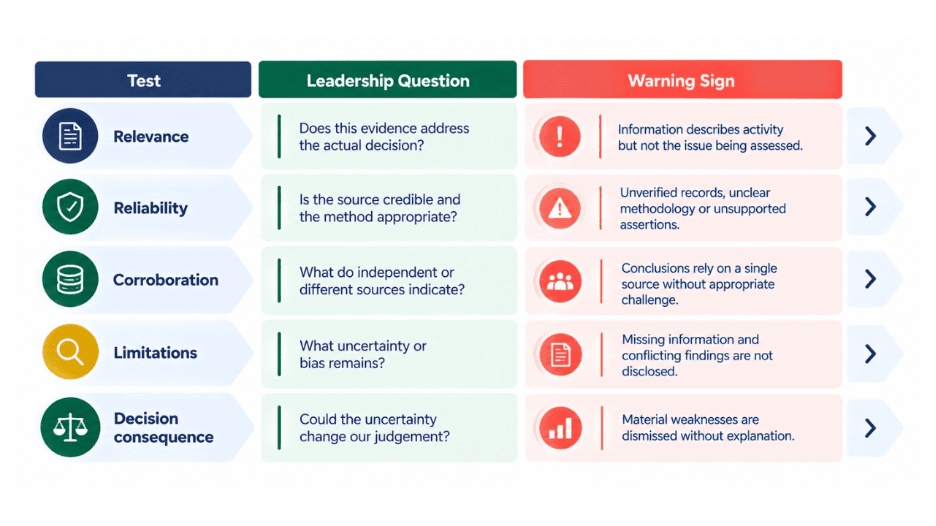
The framework should not become a mechanical scoring exercise.
Different decisions require different standards of evidence, and the significance of each test will vary.
For example, a board reviewing its own effectiveness should give considerable attention to differences between reported perceptions and observed behaviour.
A Company Secretary function assessing statutory compliance may place greater emphasis on documentary completeness, currency and traceability.
Responsible-impact decisions may require careful examination of whether reported changes can reasonably be associated with the organisation’s intervention.
The essential discipline is to make the evidence judgement explicit.
Rather than declaring that information is reliable, leadership should be able to explain why it is sufficiently reliable for the decision under consideration.
Three Practical Confidence Categories
Organisations may find it useful to distinguish between three evidence confidence categories.
High confidence: Relevant evidence is reliable, appropriately corroborated and sufficiently complete for the decision, with no unresolved limitation likely to materially change the conclusion.
Qualified confidence: The evidence supports a reasonable judgement, but identifiable limitations require disclosure, monitoring or additional testing.
Insufficient confidence: Material gaps, contradictions or reliability concerns prevent leadership from reaching a defensible conclusion.
These categories are an illustrative management tool, not a regulatory rating system.
Importantly, qualified confidence does not necessarily mean the decision must be postponed.
Leadership may be able to proceed with safeguards, further monitoring or a defined review point.
Good governance is not the absence of uncertainty. It is the disciplined treatment of uncertainty before authority is exercised.
3. Board Performance Reviews: Why Questionnaires Are Only the Starting Point
Board Performance Reviews frequently use questionnaires to gather directors’ assessments of governance effectiveness.
These instruments can reveal patterns, identify differences in perception and provide a structured starting point for discussion.
However, they cannot independently establish how a board behaves.
A director may rate challenge positively because meetings are courteous and disagreements are rare. Another may provide the same rating because the board regularly subjects management proposals to rigorous scrutiny.
Identical responses can therefore reflect different understandings of effectiveness.
The problem becomes more significant when relationships, authority and boardroom culture influence how directors answer sensitive questions.
Some respondents may hesitate to criticise the Chair or Chief Executive, while others may overestimate the quality of collective discussion because they have limited exposure to alternative board practices.
A credible evaluation should recognise these limitations rather than interpret questionnaire results as definitive evidence.
The Lumorus Board Evaluation & Assessment approach combines surveys, interviews and document reviews, with its broader governance review methodology also incorporating board observations where appropriate.
This allows different forms of evidence to be examined together.
Comparing Four Sources of Board Evidence
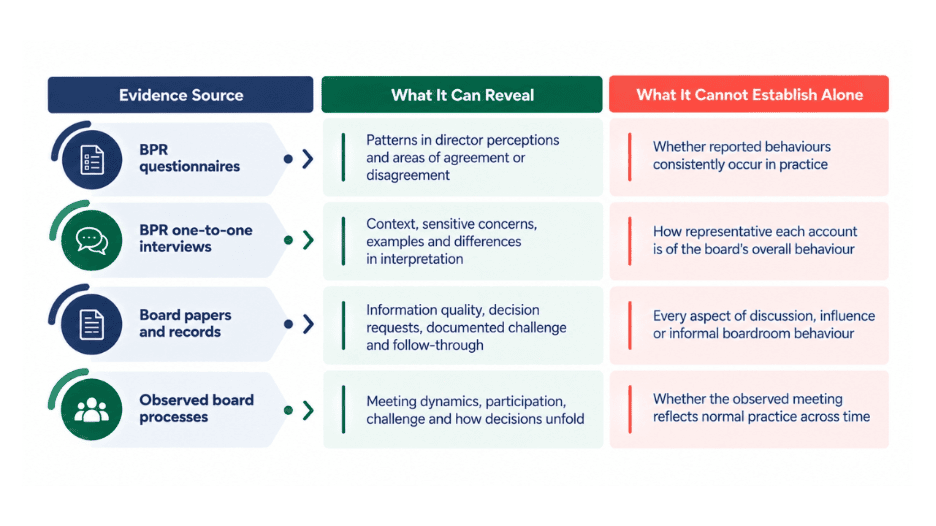
The strength of a review comes from interpreting these sources together.
Where evidence converges, confidence in the finding may increase.
However, disagreement between sources can be equally valuable.
A board that rates its decision making highly but routinely receives weak strategic papers may have normalised an inadequate process.
Similarly, directors who report that disagreement is encouraged may behave differently when the Chair or Chief Executive expresses a strong preference.
The purpose of triangulation is not to make every source agree. It is to understand why the sources may tell different stories.
The FRC Corporate Governance Code Guidance addresses board performance reviews and their role in examining board effectiveness, relationships, decision making and governance processes.
For Chairs and CEOs, the practical implication is that a credible evaluation should test the conditions under which decisions are made, rather than rely solely on directors’ satisfaction with those conditions.
4. Worked Example: When a Positive Board Questionnaire Conceals a More Difficult Finding
Consider a fictional international business undertaking an independent Board Performance Review.
Questionnaire responses indicate broad satisfaction with the quality of strategic debate. Directors generally believe that the board encourages constructive challenge and gives sufficient attention to important decisions.
At first glance, the results appear reassuring.
However, confidential interviews reveal a more complicated picture.
Several non-executive directors explain that strategic proposals tend to arrive after management has already settled on a preferred option. Although directors can ask questions, the discussion rarely changes the underlying recommendation.
A review of recent board papers supports part of this concern.
Major proposals contain financial projections and risk summaries, but alternative options receive limited analysis.
Observation of a strategic meeting adds further context, as directors engage actively with management yet spend relatively little time examining whether the preferred course of action is the right one.
What Should the Evaluator Conclude?
The evidence does not establish that the board is ineffective in every respect.
Questionnaire results suggest that directors perceive the environment as constructive, while interviews and documentary evidence raise a specific concern about the depth of strategic challenge.
The observed meeting provides additional support, although one meeting cannot prove a consistent pattern.
A proportionate conclusion would therefore identify a credible weakness requiring further examination and improvement.
It would not claim certainty about every board discussion.
What Should Leadership Do?
The Chair and board could agree to strengthen the requirements for strategic proposals, including clearer alternatives, assumptions and decision requests.
Management would be responsible for improving the papers, while directors would need to demonstrate more deliberate scrutiny of the options presented.
A follow-up review after several strategic meetings could examine whether the quality of discussion has changed.
The evidence is strong enough to justify action, even though it is not sufficient to claim that every board decision has been affected.
This is the practical value of evidence confidence.
Leadership can act on a defensible finding without pretending that the evaluation has eliminated uncertainty.
Read More: Board Evaluation Recommendations: Why Some Need More Than Action Plans
5. Board Performance Reviews and Boardroom Intelligence: Two Distinct Conversations
Board Performance Reviews
A Board Performance Review should provide directors with an independent, proportionate assessment of how effectively the board exercises its responsibilities.
The review needs to examine both formal governance arrangements and the less visible dimensions of board performance.
Questionnaires can identify perceptions, while one-to-one interviews explore the reasoning behind them. Document reviews and appropriate observation provide further evidence of how governance operates.
Lumorus’s Board Evaluation & Assessment service supports main board, committee and subsidiary board evaluations, with a tailored approach informed by the organisation’s circumstances.
For leadership, the value lies in understanding which findings are well supported, which require qualification and what actions should follow.
A useful review report should therefore explain not only what the evaluator concluded, but also the basis and limitations of significant conclusions.
Boardroom Intelligence: Looking Ahead
Boardroom Intelligence is part of Lumorus’s forthcoming conversation about board insight, judgement and governance effectiveness.
Further details will be introduced at the appropriate stage.
For now, the underlying principle remains important: board leaders need evidence that supports informed challenge without creating an illusion of certainty.
Explore: Lumorus Board Evaluation & Assessment
6. Company Secretary Evidence: Four Tests That Reveal Whether Records Can Be Trusted
Company Secretary operations present a different evidence challenge.
The question is often less about interpreting perceptions and more about establishing whether records reliably demonstrate what occurred.
A board resolution, statutory filing or director appointment should be supported by appropriate documentation.
However, the presence of a record does not automatically establish its completeness or reliability.
A proportionate CoSec evidence test should examine four dimensions.
Completeness: Is Anything Material Missing?
The organisation should be able to establish whether the required information and supporting documents exist.
For example, a director appointment may require evidence of the relevant approval, updates to corporate records and applicable statutory filings.
A register that records the appointment but lacks supporting evidence may be incomplete for the purpose of an audit or transaction.
Completeness should be assessed against the actual legal and governance requirements rather than a generic document checklist.
Access: Can Authorised People Retrieve the Evidence?
Governance records must be available to the people who legitimately need them.
A document may exist but remain practically inaccessible because it is stored in a personal mailbox, local drive or disconnected repository.
The test is not whether everyone can access everything.
Instead, it is whether authorised users can retrieve appropriate evidence securely and efficiently.
Timeliness: Was the Information Available and Updated When Required?
Accurate information can still be misleading if it is outdated.
A subsidiary register may correctly reflect a director appointment made several months ago but fail to include a subsequent resignation.
Similarly, an action tracker may report a matter as outstanding after management has completed it, creating unnecessary uncertainty.
Timeliness therefore concerns both compliance with applicable deadlines and the currency of information used for decisions.
Traceability: Can the Organisation Reconstruct What Happened?
A reliable governance record should allow an authorised reviewer to understand the relevant decision, approval, action and supporting evidence.
This does not require excessive documentation.
However, material governance events should be sufficiently traceable to establish how authority was exercised and whether required steps occurred.
The Four-Part CoSec Evidence Test
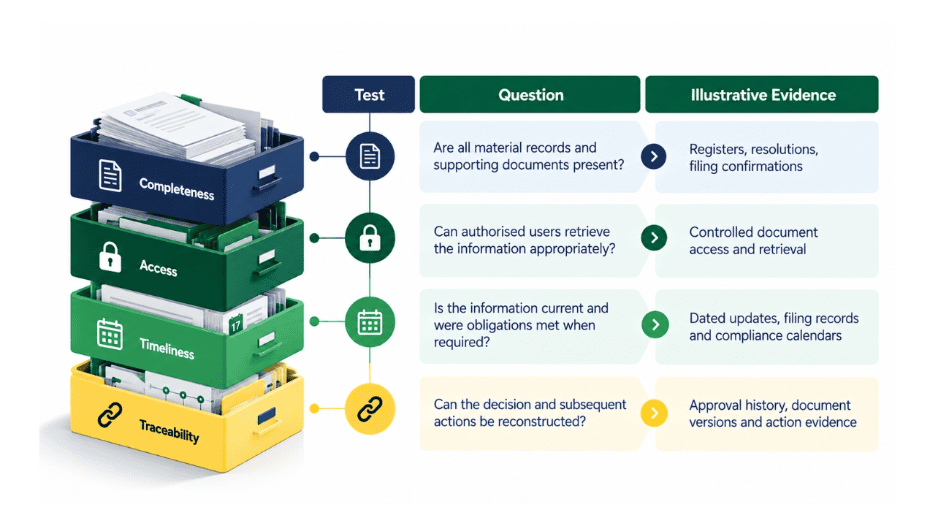
A governance record is not reliable merely because it exists. It must be sufficiently complete, accessible, current and traceable for the purpose it serves.
Read More: Board Effectiveness: The Company Secretary’s Strategic Role
7. Worked Example: A Complete-Looking Entity Register That Cannot Support a Transaction
Consider a fictional multinational group preparing for a financing transaction.
The Chief Financial Officer requests confirmation of the directors and ownership arrangements for several subsidiaries.
The central entity register appears complete, and management initially assumes that the information is ready for external review.
However, a sample check identifies inconsistencies.
One subsidiary’s director information has not been updated following a recent change. Another entity’s supporting approval documents are stored with a local adviser, while a third record lacks a clear link to the filing confirmation.
The organisation may possess most of the required information, but its ability to demonstrate reliability is weaker than the apparent completeness of the register suggests.
Applying the Four Tests
Completeness: Some supporting evidence is missing from the available records.
Access: Important documents cannot be retrieved promptly by the central team.
Timeliness: At least one entity record is outdated.
Traceability: The relationship between approval, record update and filing cannot be demonstrated consistently.
What Should the CEO or CFO Conclude?
The information may be usable for preliminary planning, but it should not be treated as fully verified for a transaction requiring reliable corporate evidence.
Management should reconcile the material discrepancies and confirm the appropriate legal position before relying on the affected records.
The Company Secretary can coordinate the process, while local management, legal advisers and other accountable functions provide the required evidence.
Once corrections are complete, a sample of subsequent entity changes should be tested to determine whether the underlying process has improved.
The objective is not to demand perfect records across every historical event. It is to establish whether material information can be relied upon for the decision at hand.
This distinction prevents leadership from confusing the appearance of completeness with genuine evidence confidence.
8. CoSec Retainer and CoSec Hub: Professional Judgement and Governance Infrastructure
CoSec Retainer
The CoSec Retainer provides ongoing professional Company Secretary support, including governance administration, statutory coordination, compliance oversight and related services within the agreed scope.
Professional expertise matters because evidence quality often requires interpretation.
A filing confirmation may establish that a document was submitted, but it does not necessarily resolve whether the underlying information was accurate or whether the relevant approval process was properly followed.
Experienced Company Secretaries can help organisations identify such distinctions and coordinate appropriate corrective action.
Nevertheless, the retainer should not become a substitute for management ownership of operational responsibilities.
CoSec Hub
CoSec Hub provides Lumorus’s governance infrastructure environment, supporting entity management, board operations, governance documentation and related workflows.
The published model combines governance infrastructure with professional Company Secretary support and Governance Knowledge Centres.
These elements address different aspects of governance operations.
Infrastructure supports the organisation and availability of information, while professional expertise helps interpret requirements, coordinate processes and advise on governance matters.
However, no platform should be assumed to guarantee that information is complete or accurate merely because it is stored centrally.
Reliable evidence still depends on clear ownership, appropriate controls and disciplined review.
Technology can improve the conditions for evidence confidence, but professional judgement remains necessary to determine whether the evidence is sufficient.
Explore: CoSec Hub, The Company Secretary Command Centre
9. Responsible Impact: The Difference Between Evidence of Activity and Evidence of Change
Responsible-impact programmes introduce a third form of evidence uncertainty.
Organisations may report extensive activity while remaining less certain about the outcomes achieved.
A business might describe the number of community engagement meetings conducted, employees trained or environmental initiatives introduced.
These measures can demonstrate that activities occurred.
However, they do not necessarily establish whether the intended environmental or social conditions improved.
For example, a company may provide skills training to a group of participants.
Attendance records can confirm participation, while assessment results may indicate that knowledge increased.
Nevertheless, demonstrating improved employment outcomes would require additional evidence, and attributing those outcomes solely to the training programme may be more difficult.
The distinction is between activity, output, outcome and contribution.
Four Levels of Responsible-Impact Evidence
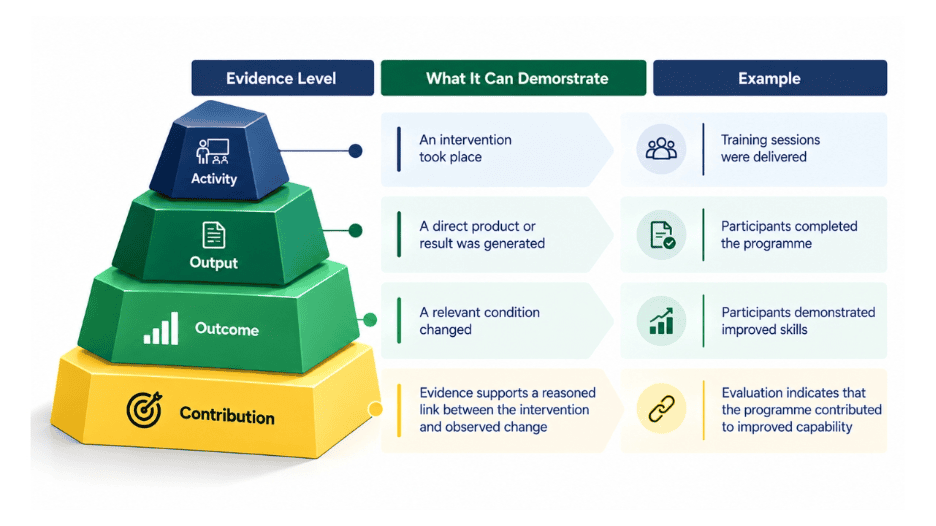
A stronger causal claim may require comparison groups, longitudinal evidence or other appropriate evaluation methods.
Not every programme needs an elaborate impact study.
However, organisations should avoid claiming more than the evidence can reasonably support.
The IFRS Foundation’s sustainability guidance recognises measurement uncertainty within sustainability-related financial disclosures and the need for reasonable, supportable information.
Although responsible-impact measurement extends beyond those specific disclosure standards, the same discipline is valuable.
Leadership should disclose meaningful limitations rather than convert estimates or assumptions into statements of certainty.
ImpactOS: Looking Ahead
ImpactOS forms part of Lumorus’s forthcoming responsible-impact conversation.
Further details will be introduced at the appropriate stage.
For now, the governing principle is that credible responsible-impact decisions should distinguish what has been delivered, what has changed and what remains uncertain.
Read More: Lumorus Social Impact Measurement and Management
10. When Evidence Sources Disagree, Leadership Should Investigate Rather Than Average Them
One of the most important tests of governance maturity is how leaders respond to contradictory evidence.
A board questionnaire may indicate strong confidence in decision making, while confidential interviews suggest that directors hesitate to challenge management.
A Company Secretary dashboard may report full compliance, while a sample review reveals incomplete supporting records.
Similarly, an impact programme may report successful delivery against its activity targets while stakeholder feedback suggests that intended outcomes have not materialised.
These differences should not automatically be resolved by selecting the most favourable result.
Neither should leadership simply average the findings.
Different sources may be measuring different things.
The appropriate response is to identify the nature of the disagreement.
Does one source capture perception while another examines observable practice? Is the difference explained by timing, incomplete records, sampling limitations or inconsistent definitions?
Sometimes, further evidence will be necessary.
In other cases, leadership may already have sufficient information to act cautiously while commissioning targeted verification.
Conflicting evidence is not always a failure of the assessment. It may be the most useful finding the assessment produces.
The Lumorus article on board evaluation weaknesses makes a related point about the need for independent reviews to examine uncomfortable governance issues rather than merely confirm reassuring perceptions.
For CEOs and Chairs, the discipline is to preserve meaningful disagreement until it has been properly understood.
A premature consensus can be more dangerous than a clearly documented uncertainty.
11. How Much Evidence Is Enough for a Board Decision?
The answer depends on the consequences of being wrong.
A routine governance process change may require limited evidence, particularly where the decision is reversible and the potential downside is modest.
By contrast, a major acquisition, material control assessment or significant public impact claim may justify stronger verification.
Leadership should therefore consider three dimensions.
Materiality
How significant is the decision for strategy, financial performance, compliance, stakeholders or organisational trust?
Greater potential consequences generally justify more rigorous evidence testing.
Reversibility
Can the decision be corrected easily if subsequent information changes the assessment?
Irreversible or difficult-to-reverse decisions warrant greater caution.
Uncertainty
What material limitations remain, and how likely are they to affect the conclusion?
The organisation should distinguish uncertainty that can be managed through monitoring from uncertainty that prevents a responsible decision.
A Proportionate Decision Framework
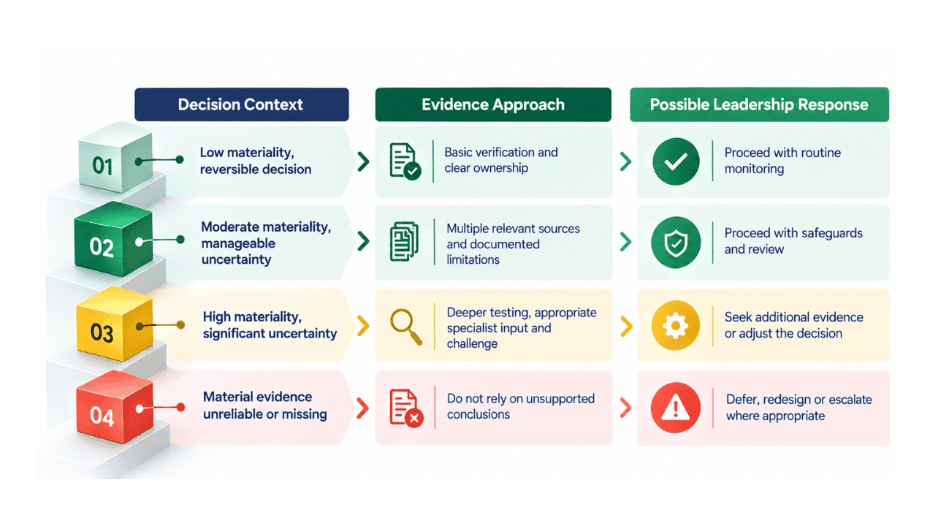
The framework is illustrative rather than a formal assurance standard.
Its purpose is to ensure that evidence requirements remain proportionate to the decision.
The board’s responsibility is not to remove every uncertainty. It is to prevent material uncertainty from being hidden, misunderstood or ignored.
12. Why Evidence Confidence Should Be Recorded at the Point of Decision
Organisations often document what was decided without recording why the available evidence was considered sufficient.
That omission can create problems later.
When circumstances change, directors may struggle to distinguish between a decision that was poorly informed and one that was reasonable on the evidence available at the time.
A decision log can preserve this distinction.
It should identify the decision, evidence considered, important limitations, accountable owner and planned review point.
The log need not reproduce every discussion or confidential contribution.
Instead, it should provide a concise, reliable record of the material basis for the decision.
This is particularly useful where leadership proceeds despite acknowledged uncertainty.
For example, a board may approve a governance improvement plan based on qualified evidence, provided that management conducts additional testing before the next review.
Similarly, an executive may approve corrective action to address incomplete Company Secretary records while requiring further reconciliation before those records are used for a transaction.
The key is to make the limitation and response visible.
A defensible decision record should show not only what leadership believed, but why that belief was reasonable at the time.
Read More: Board Action Tracking: Can Directors See What Has Changed?
13. What a Strong Governance Review Should Reveal About Evidence Quality
A Governance Review should not be limited to examining whether policies, committees and reporting processes exist.
It should also assess whether the organisation can rely on the information those arrangements produce.
That includes the quality of board papers, decision records, risk information, committee reporting and evidence of follow-through.
Through its Governance Review service, Lumorus examines governance frameworks, board structures, decision processes, risk management and related practices.
Its published methodology includes interviews, surveys, document reviews and board observations, providing opportunities to compare formal arrangements with how governance operates.
For executive leadership, this creates an important distinction.
A policy may be well drafted while its implementation remains inconsistent.
A committee may receive comprehensive reports without being able to challenge the assumptions behind them.
Similarly, a board may accept a recommendation without defining the evidence needed to demonstrate improvement.
An effective review should identify these weaknesses and establish which require immediate action, further testing or longer-term development.
The purpose of governance assessment is not to produce the most reassuring account of the organisation. It is to provide leadership with the clearest defensible understanding of how the organisation actually works.
Seven Warning Signs That Leadership Is Demanding Certainty Instead of Testing Evidence
1. Every Report Presents a Definitive Conclusion
Material assumptions, limitations and disagreements are rarely disclosed.
2. Questionnaire Scores Are Treated as Proof of Board Effectiveness
Director perceptions are not compared with interviews, board papers or observed processes.
3. Governance Dashboards Are Trusted Without Sampling the Records
Leadership assumes that a completed status automatically means the underlying evidence is reliable.
4. Impact Claims Exceed What the Data Can Demonstrate
Activities and outputs are presented as evidence of outcomes without appropriate explanation.
5. Contradictory Findings Are Removed From Executive Summaries
The desire for a clear message overrides the need to explain material differences.
6. Further Evidence Is Requested Without a Defined Decision Purpose
Teams spend time producing more information without knowing what uncertainty the additional work is intended to resolve.
7. Decisions Are Recorded Without Their Evidence Limitations
Future reviewers cannot establish which uncertainties were known and how leadership addressed them.
These warning signs suggest that an organisation may need to improve how it assesses evidence rather than simply increase the volume of reporting.
A Short Evidence Confidence Checklist for Chairs and CEOs
Before relying on a material governance finding, ask:
- Does the evidence directly address the decision we need to make?
- Do we understand how the information was collected and verified?
- Have we compared relevant sources rather than relied on one perspective?
- Are important disagreements or limitations clearly disclosed?
- Is the information sufficiently current and complete?
- Could the remaining uncertainty materially change our decision?
- Have we distinguished evidence of activity from evidence of effectiveness?
- Is additional testing proportionate to the potential consequences?
- Have we documented our confidence judgement and the reasons for it?
- Is there a clear owner and review point for unresolved matters?
A board that can answer these questions is better positioned to make responsible decisions without pretending that every uncertainty has been resolved.
The Lumorus View
The quality of governance depends partly on the quality of evidence leaders are willing to question.
Boards should not accept positive questionnaire results as proof of effectiveness when interviews, documents or observed behaviour suggest a more complicated reality.
Company Secretary functions should not assume that records are reliable simply because they are stored in an organised system.
Responsible-impact teams should distinguish completed activities from demonstrated outcomes and avoid making causal claims that the available evidence cannot support.
These are different professional settings, but they share a common governance challenge.
Leadership must establish what the evidence can demonstrate, identify its limitations and determine whether those limitations matter to the decision.
At Lumorus, this principle connects our work across Board Performance Reviews, Company Secretary services and Responsible Impact.
Our Board Evaluation & Assessment and Governance Review services provide opportunities to examine how governance operates beyond formal reporting.
The CoSec Retainer and CoSec Hub address distinct professional and infrastructure needs within Company Secretary operations, while our responsible-impact services support organisations examining material issues and the evidence associated with their responses.
The objective should never be to replace uncertainty with reassuring language.
Instead, leadership needs the discipline to recognise uncertainty, test what matters and act on evidence that is appropriate to the decision.
Institutional confidence should come from the quality of the judgement, not the certainty of the presentation.
The Bottom Line
A board can make a responsible decision without possessing perfect information.
However, it cannot exercise sound judgement if material limitations are concealed or evidence is accepted without appropriate challenge.
Questionnaires should be compared with interviews, documents and observed processes.
Company Secretary records should be tested for completeness, access, timeliness and traceability, while responsible-impact claims should reflect what the underlying evidence can genuinely demonstrate.
Across all three settings, the governing principle is the same.
Evidence should be strong enough to support the decision, transparent enough to reveal its limitations and proportionate enough to avoid unnecessary delay.
That is the foundation of evidence confidence.
The strongest leaders do not demand that every report remove uncertainty.
They insist that uncertainty is understood before it influences a decision.
Prepare for Your Next Board Performance Review
Would your board reach the same conclusions about its effectiveness if questionnaire results were compared with confidential interviews, board papers and observed behaviour?
That question is worth considering before the next evaluation begins.
Lumorus’s complimentary Board Performance Review Readiness Toolkit provides a practical starting point for Chairs, CEOs, Company Secretaries and non-executive directors preparing for a board review.
The resource can help organisations examine the questions that matter before an evaluation gets underway, including the scope of the review, the quality of available evidence and how findings will inform improvement.
Download the Complimentary Board Performance Review Readiness Toolkit
Where deeper independent examination is appropriate, Lumorus’s Board Evaluation & Assessment and Governance Review services can be considered according to the organisation’s circumstances.
A review-scoping conversation provides an opportunity to discuss the board’s priorities, relevant governance concerns and the evidence needed to support a meaningful assessment.
Explore Board Evaluation & Assessment and Arrange a Review-Scoping Conversation
Better board reviews begin with better questions about evidence, not more confident assumptions.
Continue Exploring
Examine board effectiveness through questionnaires, interviews and governance evidence:
Review governance structures, decision processes and the effectiveness of oversight:
Understand why board evaluations must test uncomfortable findings:
Why Most Board Reviews Fail to Improve Board Effectiveness
Explore why some board evaluation recommendations require collective development:
Board Evaluation Recommendations: Beyond the Action Plan
Strengthen the connection between board decisions and follow-through:
Board Action Tracking: Can Directors See What Has Changed?
Explore Company Secretary support and governance infrastructure:
Prepare for an upcoming Board Performance Review:
Board Performance Review Readiness Toolkit
Lumorus: Better Business, Built on Purpose
Lumorus is a UK-headquartered global governance, Company Secretary, ESG and advisory firm supporting organisations across international markets.
We believe responsible governance requires more than reliable reporting and formal compliance.
It depends on the quality of information, the independence of judgement and the willingness of leaders to confront uncertainty before important decisions are made.
Through Board Performance Reviews, Governance Reviews, Company Secretary services and Responsible Impact advisory, we support organisations seeking to strengthen governance effectiveness and institutional accountability.
Our approach recognises that evidence must be examined in context.
A questionnaire can reveal perceptions, a document can demonstrate that a process occurred and an impact assessment can identify meaningful changes, but leadership must still determine what those findings justify.
For organisations preparing their next board evaluation, the first step is to examine whether the evidence available can support the conclusions the board expects to draw.
Download the Board Performance Review Readiness Toolkit
Discuss Your Board Review Requirements
Good governance does not demand false certainty. It demands the discipline to make sound decisions with evidence that has been properly tested.
Lumorus: Better Business, Built on Purpose.
Sources and References
1. Financial Reporting Council: UK Corporate Governance Code 2024 and Supporting Guidance
The Code and its guidance address board performance reviews, board effectiveness, decision making, internal controls and governance accountability.
Sources: UK Corporate Governance Code 2024 and Corporate Governance Code Guidance
2. IFRS Foundation: Sustainability Disclosure Standards Guidance
The IFRS Foundation explains reasonable and supportable information, measurement uncertainty and proportionality in the context of IFRS S1 and IFRS S2.
Source: IFRS Sustainability Knowledge Hub FAQs
3. Lumorus: Board Evaluation & Assessment
The published service methodology includes questionnaires, interviews, document reviews and independent analysis of board effectiveness.
Source: Board Evaluation & Assessment
4. Lumorus: Governance Review
Lumorus’s governance review methodology includes surveys, interviews, document examination and board observations, providing a basis for examining formal governance arrangements alongside actual practice.
Source: Governance Review
5. Lumorus: Why Most Board Reviews Fail to Improve Board Effectiveness
This article examines the risks of evaluations that prioritise reassuring findings rather than meaningful challenge and institutional improvement.
Source: Why Most Board Reviews Fail to Improve Board Effectiveness
6. Lumorus: Board Evaluation Recommendations Beyond the Action Plan
The article distinguishes operational recommendations from collective board development priorities, emphasising the need to assess changes in boardroom behaviour.
Source: Board Evaluation Recommendations: Beyond the Action Plan
7. Lumorus: Board Action Tracking
This article examines ownership, observable evidence and review dates as foundations for accountable board action follow-through.
Source: Board Action Tracking: Can Directors See What Has Changed?
8. Lumorus: Board Effectiveness and the Company Secretary’s Strategic Role
The article explores board information quality, meeting processes, decision records and the governance architecture supporting board effectiveness.
Source: Board Effectiveness: The Company Secretary’s Strategic Role
9. CoSec Hub: Governance Infrastructure and Professional Support
The published CoSec Hub model combines governance infrastructure, professional Company Secretary retainer support and Governance Knowledge Centres.
Source: About CoSec Hub