



A programme can achieve every reporting target and still fail to deliver the change that matters most to its participants.
Imagine a corporate foundation funding an employment programme for young people. Its quarterly dashboard reports strong enrolment, high attendance and successful completion rates, giving executives and trustees understandable reasons to feel encouraged.
Yet interviews with participants reveal that many cannot afford transport to available jobs, while employers report that the training does not adequately reflect local recruitment requirements. Field observations also suggest that participants with caring responsibilities struggle to attend the most important practical sessions.
The monitoring data may be accurate, but the programme’s performance is less convincing than its dashboard suggests.
For CSR directors, foundation CEOs and NGO leaders, this is where the real value of monitoring begins. Indicators establish what is happening against agreed measures, while participant experience and contextual evidence help explain why results differ from expectations.
Neither should be treated as a substitute for the other.
An organisation that relies entirely on numbers risks overlooking the conditions shaping people’s experiences. Conversely, one that responds to every compelling interview without examining broader patterns may redesign programmes around evidence that is not representative.
The leadership challenge is to bring these sources together and use them to make better decisions, rather than simply produce more convincing reports.
This is the distinction between monitoring as a reporting obligation and monitoring as a management capability.
A credible monitoring, evaluation, accountability and learning (MEAL) system should help an organisation recognise when its assumptions are no longer holding, identify whose needs are being overlooked and determine what needs to change.
The question for executive leadership is therefore not simply whether the programme is on track.
It is whether the organisation has sufficient evidence to know when the track itself needs reconsideration.
Executive Takeaway: Monitoring Should Lead to a Decision
A well-designed MEAL approach combines three forms of evidence: routine indicators showing patterns of delivery and results, contextual information explaining the conditions affecting performance, and participant feedback revealing how people experience the intervention.
The evidence should lead to a practical management decision, supported by clear ownership and a defined review point.
For CSR teams, foundations and NGOs, five principles matter:
- Begin with the decision: Identify what leadership may need to continue, change, stop or investigate.
- Use complementary evidence: Combine indicators with interviews, observation and appropriately gathered feedback.
- Examine differences: Disaggregate results where useful and safe, while recognising missing data and small sample limitations.
- Protect participants: Obtain appropriate consent, minimise unnecessary data collection and provide safe routes for feedback.
- Record adaptation: Explain what changed, why it changed and how the organisation will assess the result.
These principles reflect the wider emphasis on evidence-informed adaptive management discussed by BetterEvaluation. Its work distinguishes deliberate learning and adaptation under uncertainty from simply adjusting plans when circumstances change.
The strongest MEAL system is not the one that produces the largest dataset. It is the one that improves the quality of decisions.
1. Why Traditional Monitoring Can Miss the Real Problem
Most programmes need routine performance indicators.
Without them, leadership may struggle to establish how resources are being used, whether activities are reaching intended participants or whether implementation is progressing.
However, indicators are selective representations of reality.
A completion rate measures the proportion of participants who finish a programme under a defined methodology. It does not necessarily explain whether the programme was accessible, relevant or effective for different groups.
Similarly, the number of businesses supported may demonstrate programme reach without establishing whether those businesses became more resilient.
These distinctions are central to credible impact measurement.
The OECD’s Applying Evaluation Criteria Thoughtfully encourages evaluators to examine relevance, coherence, effectiveness, efficiency, impact and sustainability according to the purpose and context of the assessment.
Its guidance also recognises the importance of understanding different experiences across groups.
For programme leaders, this means a positive overall result should not automatically end the enquiry.
An intervention may perform well on average while delivering limited benefits to the participants facing the greatest barriers.
Equally, an apparent decline in performance may reflect changing external conditions rather than poor implementation.
Indicators reveal patterns, but interpretation requires an understanding of the people and circumstances behind them.
2. A Decision-Led MEAL Framework: Measure, Understand, Decide, Adapt
The most useful starting point for programme monitoring is the management decision that evidence needs to inform.
Rather than collecting every potentially interesting measure, leadership should establish which decisions are likely to arise during implementation.
For example, a foundation may need to decide whether to expand a programme, redesign its delivery model or concentrate resources on particular communities.
An NGO may need to determine whether an intervention remains appropriate following changes in local conditions.
A corporate CSR team might need to assess whether its programme is reaching intended groups and producing results consistent with its stated purpose.
A practical framework can connect evidence to those decisions.
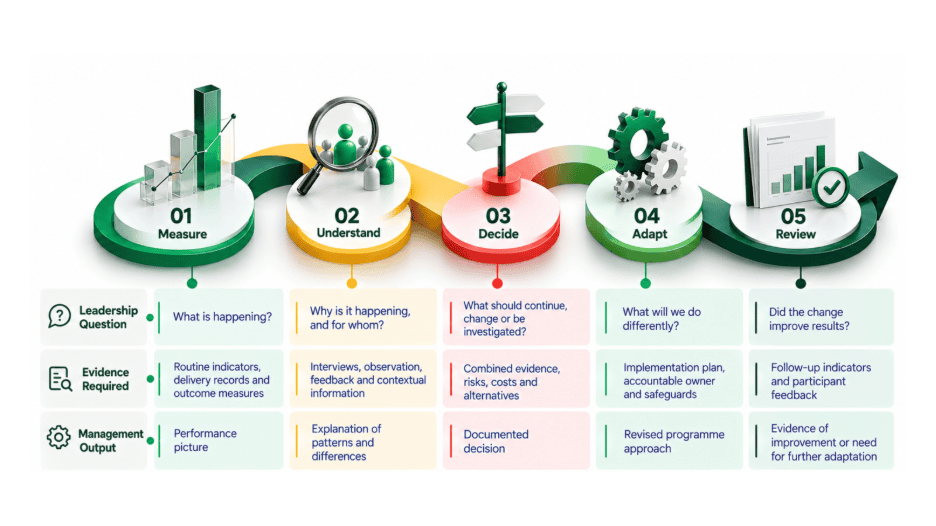
The framework is deliberately cyclical.
Programme adaptation should not be treated as an admission that the original design was defective. In uncertain environments, responsible management involves testing assumptions and adjusting interventions when credible evidence warrants it.
However, flexibility should not become an excuse for constantly changing objectives without accountability.
Adaptation requires discipline because every material change should have a reason, an owner and a test of whether it worked.
3. Combining Indicators With Interviews, Observation and Participant Feedback
Different evidence sources answer different questions.
Routine monitoring can identify changes in attendance, completion, service delivery or reported outcomes. Interviews may explain barriers that the indicators cannot reveal, while observation can establish whether the programme operates as intended.
Participant feedback adds another dimension by examining whether the intervention reflects the priorities and experiences of those it is supposed to benefit.
A credible MEAL design should therefore identify which evidence sources are appropriate to the decision.
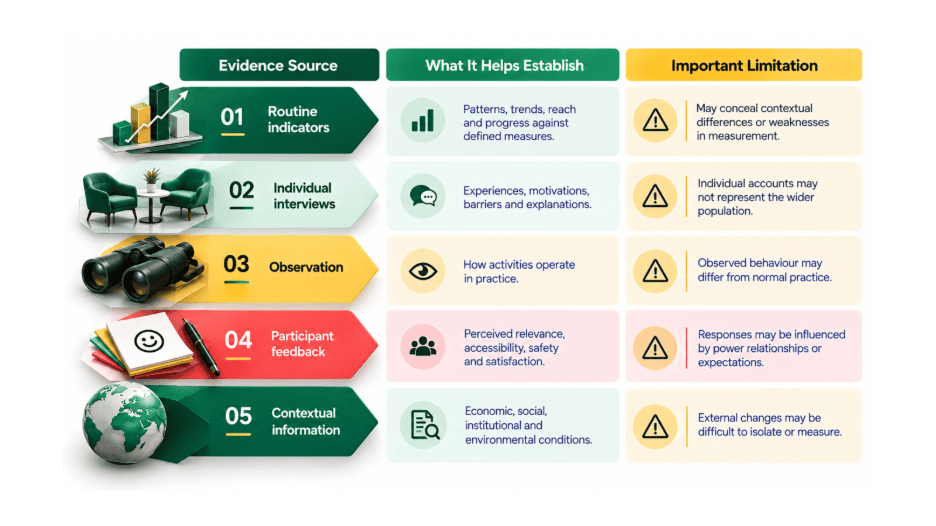
Combining evidence is not simply a matter of gathering one source from each category.
The purpose is to examine whether the sources reinforce, qualify or contradict one another.
For example, a decline in attendance might initially suggest that participants are disengaging.
However, interviews could reveal that seasonal employment has increased, while observation shows that programme schedules conflict with working hours.
Leadership would then have a stronger basis for considering a scheduling change rather than concluding that demand has weakened.
The BetterEvaluation guidance on monitoring emphasises using information throughout implementation to understand changing needs, context, activities and results.
Good monitoring tells management where to look. Good learning helps management understand what it is seeing.
4. Worked Example: When Strong Completion Rates Conceal Weak Outcomes
Consider a fictional foundation supporting a six-month enterprise development programme for women-owned small businesses.
Its dashboard shows that most enrolled participants have completed the scheduled training modules, while mentoring sessions and financial literacy workshops have been delivered broadly as planned.
Programme management proposes expanding the intervention into additional communities.
Before approving expansion, the foundation’s leadership requests a closer examination of participant outcomes.
Interviews reveal that some business owners value the training but struggle to apply what they have learned because they lack access to affordable working capital.
Others explain that the sessions are scheduled during their busiest trading periods.
Field observations suggest that participants with lower levels of formal education find parts of the financial management material difficult to use.
Meanwhile, available business performance data is incomplete, making it difficult to determine whether the programme has improved profitability.
What Does the Combined Evidence Show?
The delivery indicators support a reasonable conclusion that planned activities occurred.
Participant interviews and observation reveal barriers that could limit the programme’s effectiveness.
However, the incomplete financial data does not support a confident claim that the intervention has increased business profitability.
These findings should not be collapsed into a single judgement of success or failure.
Instead, leadership can distinguish what has been established from what remains uncertain.
What Should the Foundation Decide?
A proportionate response could involve testing revised session schedules, adapting the financial training materials and examining whether participants need additional support in accessing appropriate finance.
The foundation might also improve its outcome measurement approach before committing to large-scale expansion.
Management should assign an accountable owner to each change and establish a review date.
The next monitoring cycle would then examine whether participation patterns, reported usefulness and relevant business outcomes have improved.
The programme does not need to be abandoned because its evidence is incomplete, but neither should it be expanded on the assumption that successful delivery proves successful impact.
This is adaptive management in practice.
5. Disaggregation: The Average Can Hide the People Most in Need
Aggregate performance measures are useful, but they can conceal important differences.
A programme may report that overall participation is increasing while participation among people with disabilities remains low.
Similarly, an intervention could demonstrate positive employment outcomes overall while delivering weaker results for rural participants or particular age groups.
Disaggregation helps leadership examine whether results differ across relevant characteristics.
Depending on the programme, these may include location, age, gender, disability status, income group or other contextually appropriate factors.
However, collecting sensitive characteristics requires a clear purpose, appropriate safeguards and consideration of applicable law.
The OECD’s evaluation guidance explicitly addresses differential results across groups, recognising that effectiveness should consider who benefits and whether interventions contribute to or exacerbate inequalities.
For CSR and foundation leaders, this has direct implications for resource allocation.
A programme that appears effective overall may require targeted adaptation if particular groups face barriers to participation or benefit.
Nevertheless, disaggregation must be handled carefully.
Small groups can create confidentiality risks, while limited sample sizes may make comparisons unreliable.
Leadership should therefore avoid presenting differences as meaningful where the available data cannot support that interpretation.
The purpose of disaggregation is not to produce more charts. It is to understand whether the programme is serving people equitably and where its design may need to change.
6. Missing Data Is a Governance Question, Not Just a Technical Problem
Missing information is often treated as an inconvenience to be corrected during reporting.
However, the reasons data is missing may reveal something important about programme design.
Participants may leave a programme because of dissatisfaction, economic pressure, safety concerns or barriers to access.
Others may decline to answer questions because they do not trust how their information will be used.
A dataset that excludes these experiences can create an overly favourable picture of performance.
For example, an employment programme that measures outcomes only among participants who complete training may overstate the relevance of its results to everyone who enrolled.
The problem is not necessarily deliberate manipulation.
Rather, the measurement process may systematically exclude people whose experiences are most important to understanding programme weaknesses.
A responsible MEAL system should therefore document missingness, examine whether it is concentrated among particular groups and consider how it affects conclusions.
Where appropriate, teams can use follow-up interviews, alternative data sources or sensitivity analysis to understand the potential implications.
However, statistical adjustments should not be presented as a substitute for reliable underlying information.
Missing data should be treated as part of the evidence, especially when its absence may reflect exclusion, dissatisfaction or programme failure.
7. Participant Voice: Listening Must Carry the Possibility of Change
Many organisations collect participant feedback.
Fewer establish a clear process for explaining how that feedback influences decisions.
Surveys are conducted, consultations take place and comments are summarised in reports, but participants may never learn whether their concerns were considered.
This creates a weakness in accountability.
Participant voice should not be reduced to a source of quotations that make impact reports more compelling.
Its purpose is to help organisations understand the lived experience of an intervention and challenge assumptions made by those designing or funding it.
That requires attention to power.
A participant receiving essential support may hesitate to criticise the organisation delivering it.
Likewise, employees participating in a corporate community programme may feel pressure to provide positive feedback if the organisation controls future opportunities.
Programme teams should therefore provide appropriate opportunities for confidential feedback and ensure that participation in monitoring does not improperly affect access to services.
Where possible, organisations should also communicate what they heard, what they changed and what they could not change.
This is particularly important for programmes serving vulnerable communities.
The UNICEF Policy on Ethics in Evidence Activities Involving People emphasises meaningful consent, privacy, confidentiality, safeguarding and ethical risk management throughout evidence activities.
Listening becomes accountability when participants can see that their experiences are taken seriously, even when leadership cannot adopt every suggestion.
8. Consent, Privacy and the Hidden Cost of Collecting More Data
A sophisticated MEAL system is not necessarily an ethical one.
Organisations may collect extensive personal information in pursuit of more detailed reporting without adequately considering whether every question is necessary.
Participants can be asked repeatedly about income, household circumstances, disability, health or personal experiences, sometimes by multiple funders and implementing partners.
Such requests can create fatigue, discomfort and risks to privacy.
For individuals in vulnerable circumstances, the consequences may be more serious.
A responsible approach should establish why each category of information is needed, how it will be used, who can access it and how long it will be retained.
Consent must be meaningful rather than a formality.
Participants should understand the purpose of the activity and the relevant implications of taking part, including any limits on confidentiality.
Special care is required when working with children or people who may face heightened risks.
The UNICEF ethical evidence policy provides a useful international reference, particularly in its treatment of safeguarding, consent and the responsibilities of organisations commissioning evidence activities.
Five Questions Before Adding Another Data Requirement
A programme team should ask whether the proposed information is necessary for a defined decision, whether it is already available from a reliable source, whether collection creates risks or unreasonable demands, whether participants can provide it safely and whether the organisation has the capacity to use it responsibly.
If the information is unlikely to influence a decision, the justification for collecting it should be challenged.
The right to measure programme performance does not create an unlimited entitlement to participants’ personal information.
9. Data Burden: When Monitoring Starts Competing With Delivery
Monitoring requires resources.
Staff need time to collect information, verify records, interview participants, analyse findings and prepare reports.
For NGOs working with multiple funders, different reporting frameworks can create duplication.
A programme officer may spend substantial time entering similar information into separate systems, while frontline teams struggle to balance reporting demands with service delivery.
The result can be a paradox.
An organisation collects more evidence about its work while reducing the time available to perform that work.
A proportionate MEAL design should therefore consider the cost of information.
Leadership should distinguish between essential measures, useful diagnostic information and data collected primarily because it has always been requested.
Where appropriate, reporting requirements can be aligned across programmes and funders.
Existing administrative data may also be used responsibly, provided that its quality, purpose and privacy implications are understood.
However, reducing data burden should not mean abandoning difficult questions.
The objective is to collect information that has genuine decision value.
The measure of a good monitoring system is not how much information it demands, but how much useful learning it creates relative to the burden it imposes.
10. Avoiding False Causal Claims: Contribution Is Not the Same as Attribution
One of the most consequential weaknesses in impact reporting is the tendency to present observed change as proof that a programme caused it.
A foundation may support a community where employment subsequently increases.
A corporate initiative may operate in an area where educational attainment improves.
These changes may be encouraging, but other factors could have contributed.
Economic conditions, government policies, other interventions and individual circumstances may all influence outcomes.
A credible evaluation should therefore distinguish between observed results, plausible contribution and demonstrated causal effects.
The OECD’s evaluation guidance recognises the importance of examining how results arise and the factors that explain achievement or underachievement.
Different methods support different strengths of conclusion.
Routine monitoring may establish that an outcome changed, while interviews and contextual analysis can help explain the mechanisms involved.
Stronger causal attribution may require comparison groups, appropriate counterfactual analysis or other rigorous evaluation designs.
Not every programme needs an experimental evaluation.
Nevertheless, the strength of the claim should reflect the strength of the evidence.
An organisation may reasonably conclude that its programme contributed to improved outcomes when supported by credible evidence, without asserting that it was solely responsible.
Responsible impact reporting is not weakened by acknowledging uncertainty. Its credibility depends on doing so.
11. From Learning to Adaptation: Who Has the Authority to Change the Programme?
Even excellent evidence has limited value if nobody is authorised to act on it.
A monitoring team may identify persistent barriers, while programme managers remain bound by budgets, delivery commitments or funding conditions that leave little room for adaptation.
Similarly, a foundation may encourage learning but require rigid adherence to the original programme design.
These tensions are governance issues.
Leadership should establish which decisions can be taken by programme managers, which require executive approval and which need funder or board involvement.
Routine scheduling adjustments may fall within delegated authority.
A material change in target population, intended outcomes or funding allocation may require a more formal decision.
A practical adaptation record should capture the following information.
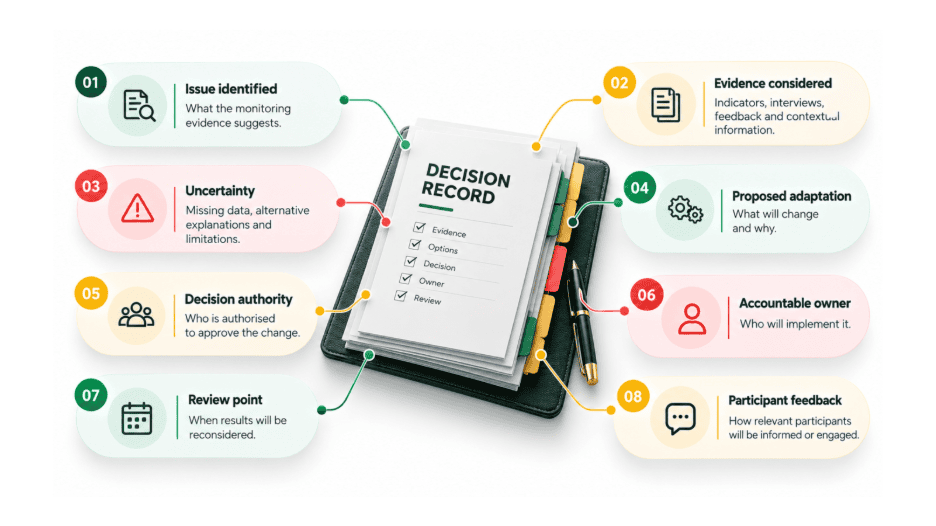
The record need not be elaborate.
However, material decisions should remain traceable.
A programme that repeatedly changes direction without documenting its reasoning may struggle to distinguish adaptive management from inconsistent management.
Learning becomes organisational capability when it changes decisions, responsibilities and future practice.
12. ImpactOS and the Importance of a Shared Impact Language
Impact measurement becomes more difficult when organisations use different definitions, indicators and classifications for similar activities or outcomes.
A foundation may describe an intervention as economic empowerment, while a corporate CSR programme classifies comparable work under livelihoods or financial inclusion.
Such differences are not necessarily wrong, but they can complicate comparison, portfolio analysis and communication.
A well-designed impact taxonomy can help establish a shared language for organising impact information.
However, classification is not the same as evidence of effectiveness.
A programme can be accurately classified while its outcomes remain uncertain.
ImpactOS: Looking Ahead
Lumorus is developing ImpactOS, including what it describes as the world’s largest Impact Taxonomy Database.
That scale claim is presented here as Lumorus’s stated positioning and has not been independently verified against competing global taxonomy databases.
Further details about ImpactOS will be introduced through Lumorus’s forthcoming product communications.
For now, the strategic question is broader than any particular platform.
Can an organisation organise its impact information consistently while preserving the contextual and participant evidence needed to understand what the information means?
A shared taxonomy may provide a useful conceptual foundation, but no classification system can replace sound programme design, ethical data collection or careful evaluation.
13. What Boards, CEOs and Funders Should Expect From MEAL Reporting
Executive leaders should not need to examine every survey response or monitoring record.
However, they should receive enough information to understand programme performance, significant risks, emerging differences and the case for adaptation.
A useful executive report should explain whether the programme is delivering planned activities, what outcomes are emerging and which participant groups may be experiencing different results.
Contextual changes should be identified where they affect interpretation.
Material data limitations and safeguarding concerns must also be made visible.
Most importantly, the report should distinguish between information presented for awareness and matters requiring a decision.
For example, leadership may need to approve a revised delivery model, authorise additional evaluation or reconsider funding allocations.
The board’s role is not to direct every operational adjustment.
Rather, directors and trustees should ensure that management has appropriate decision rights, resources and accountability arrangements.
This distinction reflects the wider governance principle that oversight should examine whether evidence is being used responsibly, without displacing management’s responsibility for programme delivery.
A useful MEAL report should leave leadership clearer about what to do, not simply better informed about what has happened.
14. The Lumorus View: Evidence Should Serve People Before It Serves Reporting
Responsible-impact programmes should not be designed around the convenience of their reporting frameworks.
Indicators matter because organisations need to understand performance, demonstrate accountability and allocate resources responsibly.
However, the people affected by an intervention are not merely sources of data.
Their experiences help establish whether the programme is relevant, accessible and responsive to the circumstances in which they live.
For Lumorus, the connection between monitoring and adaptation is therefore a matter of governance as well as evaluation.
Executives need reliable information, programme teams need the authority to respond and boards need assurance that important decisions are supported by credible evidence.
Our Social Impact Measurement and Management advisory work forms part of Lumorus’s wider Sustainability and Responsibility practice, supporting organisations seeking to understand and manage the consequences of their activities.
The starting point should be a clear theory of change, proportionate indicators and an evidence approach that combines measurable results with contextual understanding.
Equally important is the willingness to revise assumptions when the evidence challenges them.
The purpose of MEAL is not to prove that the original programme design was right. It is to help the organisation make better decisions as reality becomes clearer.
A Practical MEAL Adaptation Checklist
Before the next programme review, CSR directors, foundation executives and NGO leaders should consider:
- Have we identified the decisions our monitoring information needs to support?
- Do our indicators distinguish activities, outputs and outcomes?
- Have we combined routine data with appropriate interviews, observation or participant feedback?
- Are results disaggregated where relevant, reliable and safe?
- Have we examined missing data and its potential effect on our conclusions?
- Do participants understand and consent appropriately to evidence collection?
- Are we collecting only information with a legitimate purpose?
- Have we considered the burden imposed on participants and delivery teams?
- Do our impact claims reflect the strength of the available causal evidence?
- Is every material adaptation assigned to an accountable owner with a review date?
An organisation that cannot answer these questions may have a functioning reporting system without a sufficiently effective learning system.
The Bottom Line: Better Monitoring Should Change Something
A dashboard can tell leadership that attendance has declined.
Participant interviews may explain that programme schedules conflict with work and family responsibilities, while observation can reveal that the delivery model is not operating as intended.
Contextual evidence may show that local economic conditions have changed.
Taken together, these sources can support a more intelligent response than simply demanding improved attendance figures.
The same principle applies across corporate CSR programmes, foundations and NGOs.
Monitoring becomes valuable when it helps leadership decide what to preserve, what to change and what requires further investigation.
Better evidence does not eliminate uncertainty.
Instead, it enables organisations to act responsibly despite uncertainty, while remaining accountable for the decisions they make.
For executives, funders and trustees, that is the real measure of a mature MEAL system.
The ultimate test of monitoring is not whether the organisation can explain its results. It is whether those results have improved its judgement and changed its actions.
Strengthen Your MEAL Design and Impact Measurement Approach
Does your organisation collect more programme data than it uses to make decisions?
If monitoring reports are comprehensive but programme adaptation remains difficult, it may be time to examine the design of your MEAL framework.
Lumorus works with organisations seeking to strengthen responsible-impact measurement, governance and management.
A focused MEAL design conversation can explore whether your indicators reflect intended outcomes, how participant feedback informs decisions, where evidence gaps exist and what would make monitoring more useful to leadership.
The objective is not to add another reporting layer.
It is to establish an evidence approach that supports better programme decisions and credible accountability.
Explore Lumorus Sustainability and Responsibility Services
Contact Lumorus to Discuss Your MEAL Design and Impact Measurement Requirements
Continue Exploring
Explore international guidance on adaptive management and learning:
BetterEvaluation: Monitoring and Evaluation to Support Adaptive Management
Understand how to evaluate relevance, effectiveness, impact and sustainability:
OECD: Applying Evaluation Criteria Thoughtfully
Examine ethical approaches to collecting evidence from participants:
UNICEF: Ethics in Evidence Activities Involving People
Explore Lumorus’s responsible-business and impact advisory capabilities:
Lumorus Sustainability and Responsibility
Read the week’s related governance article on evidence confidence:
Evidence Confidence: How Leaders Can Test Quality Without Demanding False Certainty
For boards reviewing oversight of evidence and accountability:
Board Performance Review Readiness Toolkit
Lumorus: Better Business, Built on Purpose
Lumorus is a UK-headquartered global governance, Company Secretary, ESG and advisory firm supporting organisations across international markets.
We believe responsible business requires more than ambitious commitments and polished impact reports.
It requires credible evidence, clear accountability and the willingness to adapt when experience challenges expectations.
Through our Sustainability and Responsibility practice, we support organisations seeking to strengthen their approach to impact measurement, responsible-business strategy and governance.
Our work recognises that meaningful impact cannot always be reduced to a single indicator.
Programme performance must be understood in context, while the experiences of participants should inform how organisations evaluate success.
For CSR leaders, foundations and NGOs, the central question is whether monitoring has become an instrument of learning or remains primarily a reporting obligation.
Discuss Your MEAL Design and Impact Measurement Requirements With Lumorus
Better Business, Built on Purpose.
Sources and References
1. BetterEvaluation: Monitoring and Evaluation to Support Adaptive Management
Explains adaptive management as deliberate learning and adjustment under uncertainty, with monitoring and evaluation supporting decisions throughout implementation.
Source: Monitoring and Evaluation to Support Adaptive Management
2. BetterEvaluation: Monitoring
Examines monitoring as an ongoing process for collecting, analysing and using information about activities, context and results.
Source: Monitoring
3. OECD: Applying Evaluation Criteria Thoughtfully
Provides detailed guidance on relevance, coherence, effectiveness, efficiency, impact and sustainability, including differential results and the importance of context.
Source: Applying Evaluation Criteria Thoughtfully
4. OECD: Better Criteria for Better Evaluation
Sets out the revised OECD DAC evaluation criteria and principles for applying them according to the purpose and circumstances of an intervention.
Source: Better Criteria for Better Evaluation
5. UNICEF: Policy on Ethics in Evidence Activities Involving People
Addresses ethical responsibilities in research, evaluation, monitoring and data collection, including consent, confidentiality, safeguarding and risk management.
Source: UNICEF Ethics in Evidence Activities Policy
6. UNICEF Innocenti: Ethical Research Involving Children
Provides guidance on respecting participants’ rights, managing risks and addressing ethical considerations in research involving children.
Source: Ethical Research Involving Children
7. Lumorus: Sustainability and Responsibility
Describes Lumorus’s wider responsible-business advisory work, including ESG reporting and social impact measurement and management.
Source: Lumorus
8. Lumorus: Evidence Confidence
A related governance article examining the importance of combining different forms of evidence, understanding limitations and making proportionate leadership decisions.
Source: Lumorus Insights