



The CSRD landscape has changed, but readiness still matters
The European sustainability reporting landscape has changed significantly in 2026.
In July, the European Commission adopted revised European Sustainability Reporting Standards. The revisions reduce mandatory datapoints by more than 60% and total datapoints by more than 70%. The Commission estimates that reporting costs could fall by more than 30% per company.
The revised standards are now subject to scrutiny by the European Parliament and Council before they apply.
For businesses, however, simplification should not be confused with simplicity.
Organisations still need to determine which sustainability matters are material. They need reliable data ownership, a clear view of impacts across relevant value chains and evidence that can withstand internal challenge and external assurance.
As a result, the question when selecting a CSRD adviser is no longer simply whether the provider understands ESRS.
The more important question is whether the adviser can help build a reporting system that is proportionate, defensible and capable of operating after the initial project ends.
This article examines what the latest evidence tells us about CSRD readiness, what organisations should expect from an adviser and how different advisory models compare.
Explore More: ESG Reporting and Disclosure
Executive Takeaway
For boards, Chief Sustainability Officers, finance leaders and ESG teams evaluating CSRD readiness support, five issues should shape the decision:
- CSRD readiness is broader than disclosure. It involves materiality, governance, ESG data, internal controls, value-chain information and assurance readiness.
- The regulatory environment has changed. Any readiness programme designed before the 2026 revisions should be reassessed against the current position.
- Double materiality remains fundamental. Organisations need a defensible method for identifying and documenting material impacts, risks and opportunities.
- Different advisers solve different problems. A multinational reporting transformation may require different expertise from a focused materiality or governance engagement.
- The best engagements build internal capability. If an organisation remains entirely dependent on its consultant for the next reporting cycle, the project may have delivered a report without creating reporting resilience.
What the latest CSRD data tells us
The debate about CSRD is no longer based solely on theory.
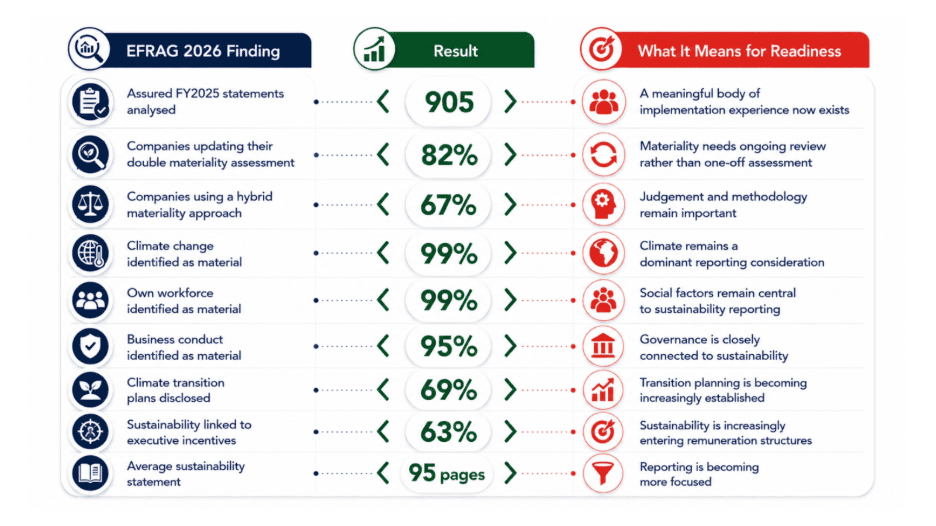
EFRAG’s 2026 State of Play study examined 905 assured FY2025 sustainability statements, creating a substantial evidence base on how companies are implementing ESRS in practice.
The findings are revealing.
Some 82% of companies updated their double materiality assessment, while 67% used a hybrid methodology combining top-down and bottom-up approaches. Climate change and own workforce were each identified as material by 99% of companies. Business conduct was material for 95%.
Reporting is also becoming more focused. The average sustainability statement fell from 115 pages to 95 pages. This suggests that greater familiarity with ESRS may be helping organisations become more selective about what they report.
CSRD Reporting in Numbers
One finding deserves particular attention.
Companies identified an average of 6.4 material ESRS topics but had measurable targets for only 3.3.
That gap points to a deeper issue. Identifying a material sustainability matter does not necessarily mean that an organisation has developed the strategy, governance, targets and management systems required to address it.
This is where CSRD readiness moves beyond reporting.
Read More: ESG Materiality & Risk Assessment
CSRD has been simplified, but readiness has not become simple
The revised ESRS represent an important change in the regulatory environment.
According to the European Commission, the new standards are shorter and clearer. They also introduce greater flexibility and significantly reduce the reporting burden.
Nevertheless, fewer datapoints do not remove the underlying management questions.
Organisations still need to decide what is material. They must determine where reliable information resides, allocate responsibility for collecting and validating it, document important judgements and establish sufficient control over the reporting process.
Simplification puts greater weight on judgement
In practice, simplification may make judgement more important.
A highly prescriptive disclosure framework can encourage organisations to treat reporting as a checklist. By contrast, a more proportionate framework requires management to make stronger decisions about relevance and materiality.
Those decisions must then be capable of explanation and challenge.
Therefore, organisations that began CSRD programmes under the earlier framework should not simply continue with their original implementation plans. Instead, they should reassess scope, reporting requirements, materiality processes and data needs against the revised regulatory position.
A credible adviser should help an organisation remove unnecessary complexity as readily as they help it address genuine reporting gaps.
Double materiality remains one of the most important readiness tests
Double materiality requires organisations to consider sustainability from two connected perspectives.
Impact materiality considers how an organisation affects people and the environment.
Financial materiality considers how sustainability-related risks and opportunities could affect the organisation.
The concept is straightforward. Applying it rigorously is more difficult.
PwC identifies several potential weaknesses in CSRD-aligned double materiality assessments. These include insufficient documentation, limited understanding of value-chain matters and assessments that do not capture enough detail to support later reporting and assurance.
What a credible materiality process needs
A robust process should bring together information from across the organisation and, where relevant, its value chain.
Depending on the business, this may involve:
- Business strategy and financial planning
- Enterprise risk management
- Environmental impacts and dependencies
- Workforce and human rights considerations
- Supply-chain and procurement information
- Stakeholder perspectives
- Regulatory exposure
- Governance and business conduct
- Financial risks and opportunities
- Evidence supporting management judgements
Crucially, the adviser should be able to explain why an issue has been judged material or non-material.
If the conclusion cannot be reconstructed and defended later, the process is weaker than it appears.
Explore More: ESG Materiality & Risk Assessment
What should a leading CSRD readiness adviser actually provide?
The CSRD advisory market includes large professional services networks, specialist sustainability consultancies, technology providers and smaller governance-led firms.
Size alone is therefore a poor basis for comparison.
Instead, organisations should assess whether a provider can address the particular weaknesses in their reporting model.
CSRD Readiness Adviser Scorecard
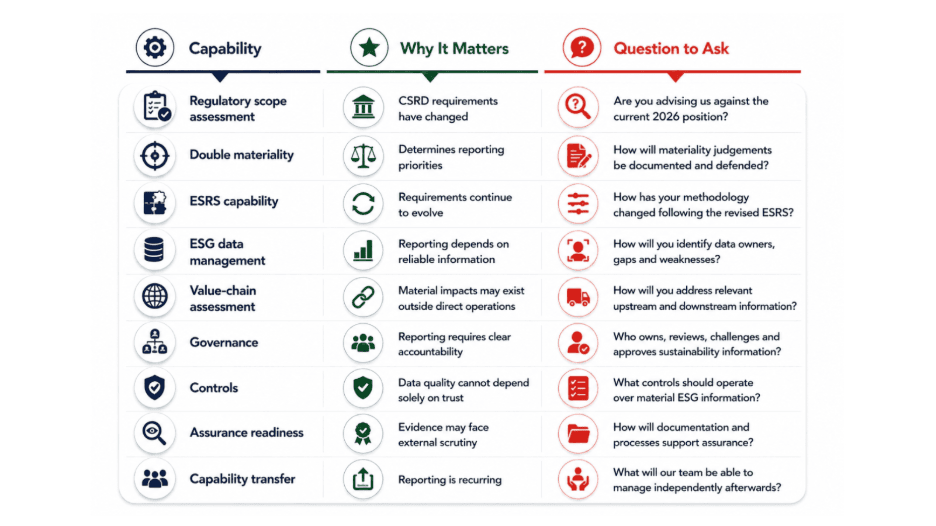
The final question is particularly important.
A successful readiness engagement should strengthen the client’s internal capability rather than create permanent dependence on an external provider.
Leading CSRD readiness advisory providers to consider
There is no defensible universal ranking of CSRD advisers.
Suitability depends on organisational scale, geography, reporting maturity, sector, assurance arrangements and the nature of the problem being addressed.
However, several providers illustrate the different types of capability organisations should consider.
PwC: strong for complex reporting transformation and double materiality
PwC has developed significant capability around CSRD implementation and double materiality.
Its published analysis examines how companies approach materiality under the Directive. Its guidance also identifies practical weaknesses organisations should avoid when designing and documenting their assessments.
PwC’s wider professional services model can be particularly relevant for large organisations that need sustainability reporting to connect with finance, controls, risk and wider corporate reporting.
However, as with any large provider, buyers should assess the proposed delivery team and methodology rather than rely on brand recognition alone.
Best suited to: multinational organisations requiring substantial reporting transformation, double materiality support and integration with wider corporate reporting.
Deloitte: strong for complex regulatory and multi-framework environments
Deloitte offers sustainability reporting capabilities spanning regulatory readiness, materiality and broader corporate reporting.
For organisations operating internationally, this breadth can be valuable because CSRD rarely exists in isolation. Large groups may also be considering ISSB-aligned reporting, jurisdiction-specific climate disclosures and investor information requirements alongside European obligations.
The advantage of this model is its ability to connect regulatory interpretation with wider reporting transformation.
However, organisations should ensure that the proposed engagement remains proportionate to their actual reporting needs, particularly following the simplification of ESRS.
Best suited to: multinational groups managing overlapping sustainability reporting requirements and complex reporting structures.
KPMG: strong where assurance readiness is central
KPMG positions its CSRD support across readiness assessments, double materiality and assurance readiness.
Its published approach includes identifying gaps between existing reporting and ESRS requirements and developing implementation roadmaps.
This model can be particularly relevant where an organisation’s principal weakness lies in controls, evidence and its ability to support external assurance.
Nevertheless, companies should consider auditor independence and applicable regulatory restrictions when purchasing advisory and assurance-related services from the same network.
Best suited to: organisations where reporting controls, evidence and assurance preparation are significant priorities.
Lumorus: governance-led ESG readiness and practical implementation
Lumorus approaches sustainability reporting as part of a broader system of governance, accountability, risk and responsible business.
Through ESG Reporting and Disclosure, Lumorus supports organisations with reporting framework development, ESG data collection and analysis, materiality, stakeholder engagement, regulatory compliance and assurance preparation.
This matters because CSRD readiness cannot sit indefinitely within a sustainability team.
Material information frequently crosses finance, HR, procurement, risk, legal, operations and governance. Organisations therefore need clarity not only about what should be disclosed, but also about who owns the information and how it reaches executive management and the board.
Lumorus’ wider sustainability capabilities include:
Lumorus’ ESG capabilities emphasise materiality, performance measurement, stakeholder engagement, reporting processes and the integration of sustainability into business strategy.
Best suited to: organisations seeking a governance-led approach that connects sustainability reporting with materiality, strategy, accountability and practical implementation.
The hardest CSRD problem may be organisational rather than technical
CSRD is frequently approached as a reporting project. Yet the information required rarely belongs to one department.
Climate and energy data may sit with operations, facilities or sustainability teams. Workforce information sits with HR. Supply-chain information may belong to procurement. Financial effects require finance involvement, while enterprise risk teams may hold information about sustainability-related exposures.
Meanwhile, legal and governance teams may maintain evidence concerning policies, oversight and decision making.
As a result, one of the most important readiness questions is deceptively simple:
Who owns sustainability information?
The answer should not be everyone. When accountability belongs vaguely to everyone, it can belong clearly to no one.
Build clear accountability
A robust reporting operating model should therefore define:
- Board oversight: which board or committee oversees material sustainability matters
- Executive accountability: which executives are responsible for reporting quality and performance
- Data ownership: who owns each material metric and its underlying evidence
- Review and challenge: who tests assumptions, methodologies and reported information
- Escalation: how significant data weaknesses or sustainability risks reach senior leadership
- Controls: which processes protect the integrity of reported information
- Assurance preparation: how evidence is maintained and made available for external scrutiny
- Approval: who signs off the final sustainability disclosures and on what basis
Once those responsibilities are clear, reporting becomes considerably more resilient.
Read More: ESG Strategy Development
Our View
CSRD readiness should not be measured by whether an organisation can produce a compliant report once. It should be measured by whether the organisation has built the governance, data, accountability and evidence required to produce credible sustainability information repeatedly.
A well-produced first report can hide weak infrastructure.
The more revealing test is what happens during the next reporting cycle.
Can management explain where material figures originated? Can the board challenge significant assumptions? Can data owners reproduce their evidence?
Can the organisation explain why particular sustainability matters were judged material? Can an assurance provider follow the information from disclosure back to source?
If those questions cannot be answered confidently, the organisation may be disclosure-ready without being genuinely reporting-ready.
Related Insight: Why ESG Is Shifting from Storytelling to Accountability
Does CSRD simplification mean companies need less advisory support?
There is an important counterargument.
If the EU is reducing reporting requirements and narrowing the burden associated with sustainability reporting, do companies still need extensive CSRD readiness programmes?
For some organisations, the answer may be no.
Businesses should reassess programmes designed under the previous requirements rather than continue with unnecessary work. Indeed, the European Commission’s simplification programme is intended to reduce administrative burdens. Its voluntary reporting standard also provides a more proportionate framework for smaller companies outside CSRD scope.
A good adviser should therefore be prepared to recommend less work when less work is justified.
Proportionate readiness is the real objective
Regulatory simplification does not eliminate the demand for credible sustainability information.
Investors, lenders, major customers and value-chain partners may continue to request ESG information. Organisations themselves also need reliable data to understand sustainability risks and opportunities.
The objective should therefore not be maximum disclosure or maximum advisory spend.
It should be proportionate readiness, based on the organisation’s regulatory exposure, business model, investor expectations, stakeholder demands and strategic needs.
Seven questions to ask before appointing a CSRD adviser
Before selecting a provider, boards and executives should test whether the proposed engagement will solve the underlying reporting problem.
Ask:
- Are you advising us against the current 2026 CSRD and ESRS position, rather than an older implementation model?
- How will you determine which requirements actually apply to our organisation and group structure?
- How will your double materiality methodology reflect our business model, value chain and risk profile rather than a standard template?
- How will you identify ESG data owners, control weaknesses and evidence gaps?
- How will sustainability reporting connect with finance, risk, governance and strategy?
- How will you prepare our processes for assurance while respecting applicable independence requirements?
- What knowledge, systems and capability will remain inside our organisation when the engagement ends?
These questions move the procurement discussion beyond methodology presentations and day rates.
More importantly, they reveal whether the adviser understands CSRD as an organisational capability rather than simply a reporting assignment.
The Bottom Line
The leading CSRD readiness provider in 2026 is not automatically the largest consultancy, the most sophisticated technology provider or the adviser offering the most extensive implementation programme.
The right choice depends on the organisation’s actual reporting problem.
A complex multinational may require global regulatory reach and substantial reporting transformation. Another organisation may need specialist support with double materiality. A third may already understand the standards but lack reliable ESG data, controls and governance.
What should no longer be acceptable is treating CSRD readiness as document production.
The revised European standards may require fewer datapoints, but credible sustainability reporting still depends on evidence, judgement, ownership and accountability.
As the market matures, those capabilities will increasingly separate organisations that merely publish sustainability information from those capable of standing behind it.
CSRD readiness is ultimately not about being ready to publish. It is about being ready to defend what you publish.
How ready is your sustainability reporting infrastructure?
If your organisation is reassessing CSRD readiness following the latest European reforms, the starting point should be an honest assessment of the infrastructure behind the disclosure.
Lumorus works with boards, sustainability teams and leadership to strengthen the materiality, governance, data and accountability systems that support credible ESG reporting.
Depending on where the weakness sits, organisations can explore:
- Materiality and ESG risk: ESG Materiality & Risk Assessment
- Reporting frameworks and disclosure: ESG Reporting and Disclosure
- Connecting sustainability with business strategy: ESG Strategy Development
- Integrating ESG into capital allocation: ESG Integration in Investment Decisions
- Measuring social outcomes and impact: Social Impact Measurement and Management
Lumorus: Better Business, Built on Purpose
Lumorus is a UK-headquartered global governance, ESG, company secretary and advisory firm supporting organisations across Europe, Africa, Asia, the Caribbean, Canada, the Middle East and international markets.
We help boards, investors and leadership teams strengthen governance, sustainability, accountability and organisational resilience.
Our approach to ESG reporting is built around a simple principle: sustainability information should not merely satisfy disclosure requirements. It should help organisations understand material risks, improve decision making and demonstrate credible accountability.
Explore Lumorus Sustainability & Responsibility services
Sources
- European Commission – Revised European Sustainability Reporting Standards, July 2026.
- EFRAG – State of Play 2026: Implementation of the European Sustainability Reporting Standards.
- PwC – Guidance on CSRD-aligned double materiality and common implementation weaknesses.
- KPMG – CSRD readiness, double materiality and assurance readiness guidance.
- Lumorus – Sustainability & Responsibility capabilities.