



Championship winning teams are not built on talent alone. They are built on clarity.
Every four years, the FIFA World Cup reminds us that success is rarely accidental.
The teams that progress furthest are not always those with the most talented players.
They are the teams where everyone understands their role.
The coach sets the strategy.
The captain leads on the pitch.
Players execute the game plan.
Officials enforce the rules.
Analysts provide insight.
Medical teams manage fitness.
Every role is distinct.
Every role contributes to performance.
No one expects the goalkeeper to coach the team or the referee to score goals.
The same principle applies in business.
High performing organisations are rarely defined by brilliant individuals alone.
They are defined by governance operating models that make accountability clear long before pressure arrives.
According to the OECD G20 Principles of Corporate Governance, clearly defined roles, responsibilities and accountability structures are fundamental to effective governance and sustainable organisational performance.
Read More: Governance Failure & Board Accountability
Great teams know who decides, who delivers and who challenges
A World Cup winning team operates through disciplined coordination.
The coach provides direction.
The players execute.
The captain leads on the field.
Match officials provide independent oversight.
No role exists in isolation.
The same discipline should exist inside organisations.
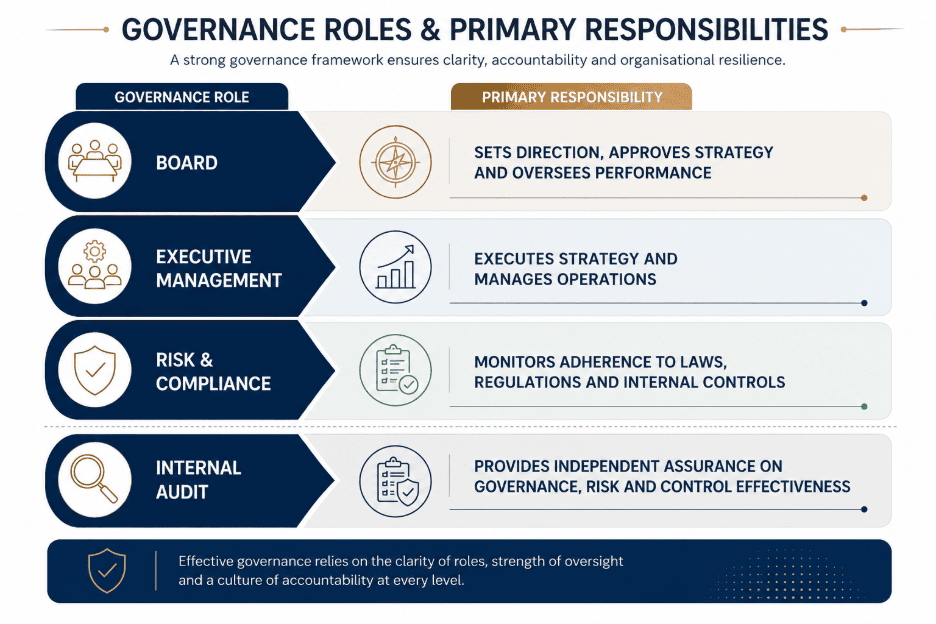
An effective governance operating model defines:
When responsibilities become blurred, organisations lose more than efficiency.
They lose accountability.
Pressure does not create governance. It exposes it.
During a World Cup final, every weakness becomes visible.
Poor communication.
Unclear leadership.
Confused responsibilities.
Lack of preparation.
These issues rarely begin during the match.
They existed beforehand.
Pressure simply exposes them.
Boards experience similar moments.
A regulatory investigation.
A cyber incident.
An acquisition.
An activist shareholder.
A reputational crisis.
These events do not create governance weaknesses.
They reveal them.
According to the Financial Reporting Council’s Guidance on Board Effectiveness, boards perform best when governance arrangements are clearly understood before organisations face periods of heightened uncertainty.
Read More: Board Evaluation
High performing organisations train their governance before they need it
Elite football teams spend years preparing for moments that may last only ninety minutes.
Governance should be approached with the same discipline.
Leading organisations establish clear operating models before complexity increases.
They define:
- Decision rights
- Reporting lines
- Escalation procedures
- Committee responsibilities
- Information flows
- Accountability mechanisms
This creates confidence across the organisation.
Everyone understands not only what they are responsible for, but also where responsibility begins and ends.
Governance operating models eliminate uncertainty
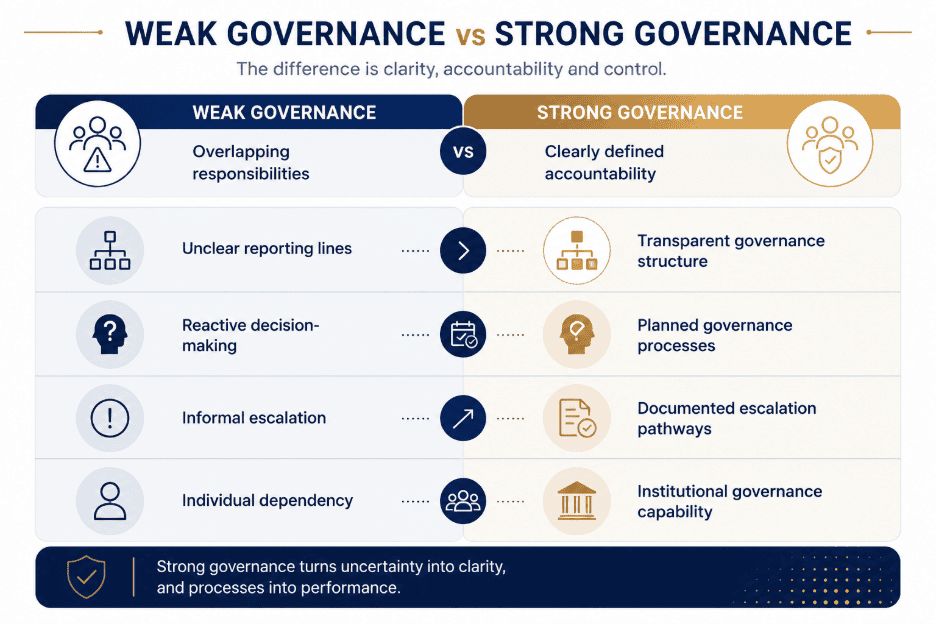
Many governance failures occur because people assume someone else is responsible.
The board assumes management is monitoring the issue.
Management assumes compliance is overseeing it.
Compliance assumes internal audit will identify it.
Internal audit assumes the board understands the risk.
Responsibility becomes diluted.
A strong governance operating model removes ambiguity.
Clarity is not bureaucracy.
It is organisational resilience.
Read More: What to do after a failed Governance Audit?
The best governance operates like the best teams
Football teaches an important lesson.
The greatest teams trust their system.
Every player understands their position.
Every movement supports the wider strategy.
Every decision contributes to a common objective.
Organisations should aspire to the same level of governance discipline.
Governance is not simply about compliance.
It is about creating an operating model that enables good decisions, effective oversight and sustainable performance.
Why governance operating models matter more than ever
Today’s organisations operate in an environment of increasing complexity.
- More regulation.
- More stakeholders.
- More scrutiny.
- More risk.
Under these conditions, governance cannot depend on institutional memory or individual effort.
It requires a governance operating model that clearly defines who sets direction, who executes, who challenges and who provides independent assurance.
The organisations that respond most effectively under pressure are rarely those with the most policies.
They are those with the clearest governance architecture.
How Lumorus helps organisations strengthen governance operating models
At Lumorus, we believe governance is the operating system of every successful organisation.
We work with boards, executives and leadership teams to design governance operating models that improve accountability, clarify decision making and strengthen organisational resilience.
Our governance advisory services help organisations:
- Define board and management responsibilities
- Strengthen governance operating models
- Improve board effectiveness
- Clarify decision rights
- Enhance governance infrastructure
- Strengthen accountability frameworks
- Support governance transformation
Good governance should not be improvised when pressure arrives.
It should already be embedded within the organisation.
Lumorus: Better Business, Built on Purpose
Lumorus is a UK headquartered global governance, company secretary, ESG and advisory firm supporting organisations across Europe, Africa, Asia, the Caribbean, Canada and other international markets.
For more than 10 years, we have helped boards, leadership teams and organisations strengthen governance, accountability and organisational resilience.
Our expertise includes:
Is your governance infrastructure strong enough for the complexity, scrutiny and accountability you now face?
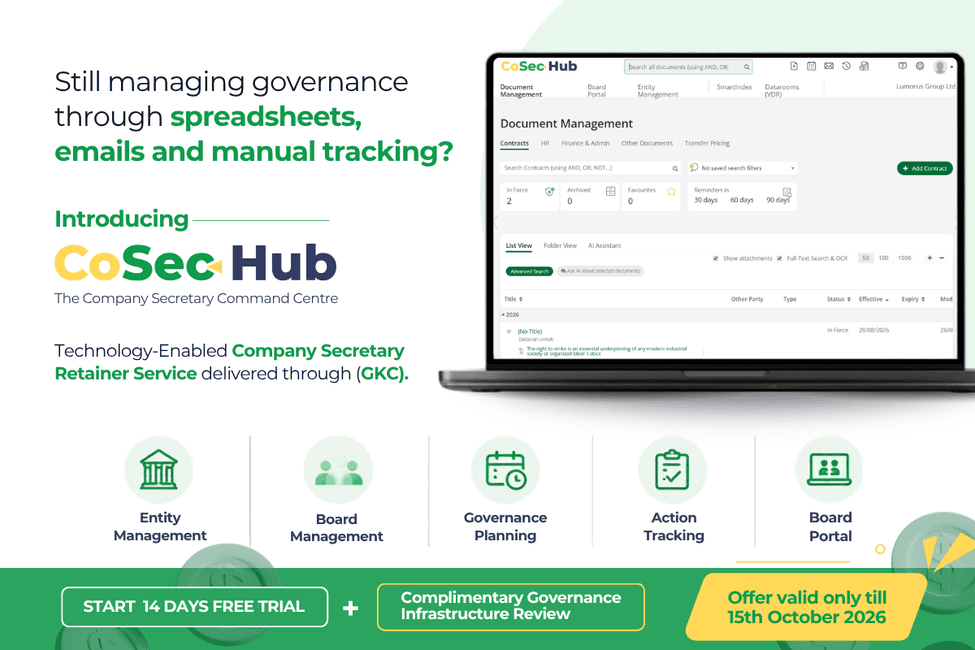
Contact Lumorus to request a Governance Infrastructure Assessment and explore how CoSec Hub can help your organisation move from fragmented administration to connected, compliant and board-ready governance.
Learn more: lumorus.com
Email: [email protected]